Pearson Edexcel · GCSE · Mathematics
Geometry and measures
Geometry and Measures forms the foundation of spatial reasoning in GCSE Mathematics. Mastering angle rules, polygons, and parallel lines guarantees you can secure highly predictable marks in both Foundation and Higher tier papers.
- 4 min read
- 3 worked examples
- 5 practice questions
- 6 key terms
Study Notes

Overview
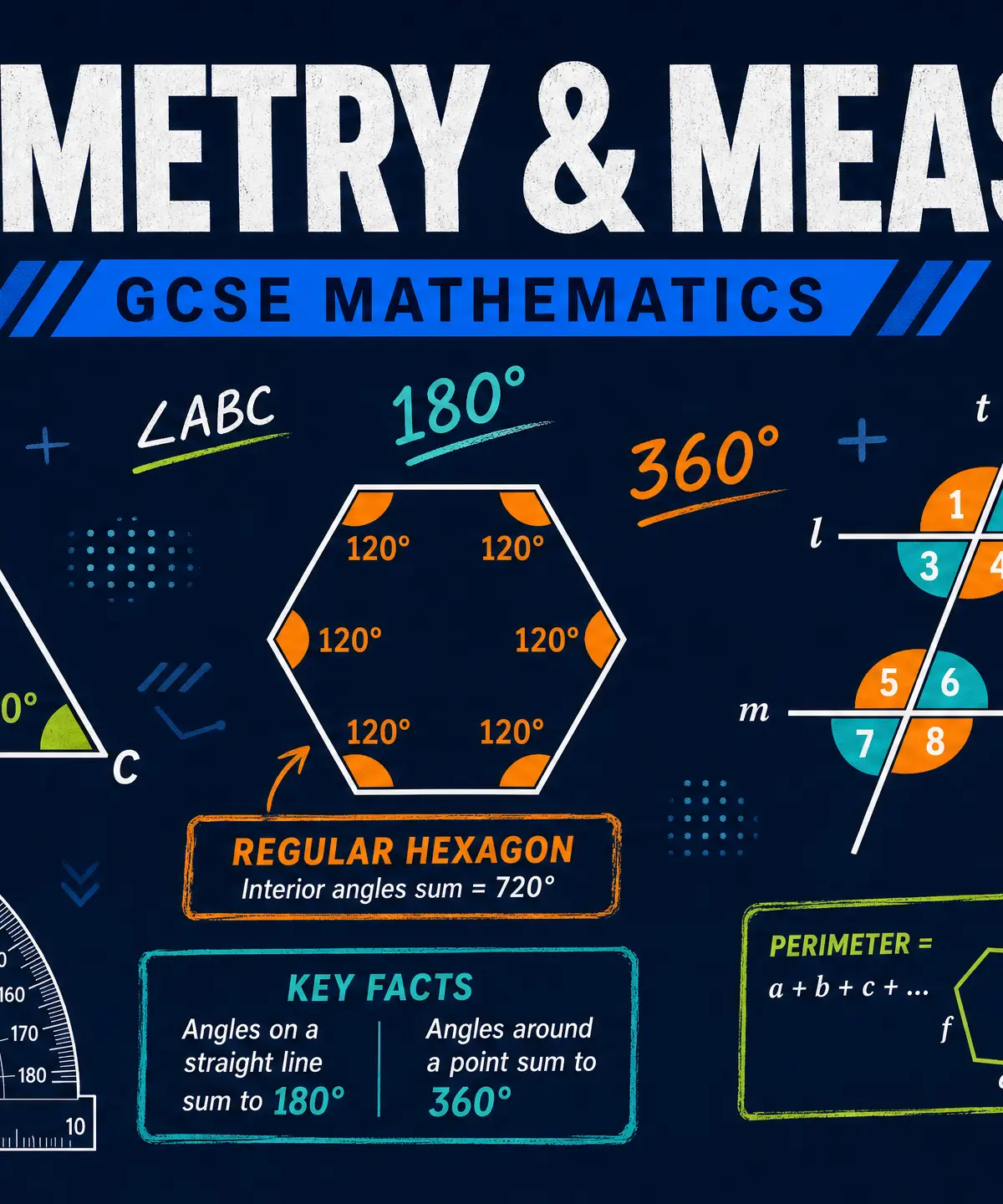
Geometry and Measures is a fundamental pillar of the GCSE Mathematics specification. This topic is about understanding the relationships between points, lines, angles, and shapes. It is incredibly important because it tests your logical reasoning and your ability to construct mathematical proofs. Examiners love this topic because it allows them to award method marks for clear, step-by-step reasoning, even if your final numerical answer is incorrect.
This topic connects heavily to other areas of the specification, such as trigonometry, circle theorems, and coordinate geometry. Typical exam questions will present you with a complex diagram featuring intersecting lines and polygons, asking you to 'Calculate angle x' and, crucially, to 'Give reasons for your answer'.
Key Concepts
Concept 1: Angles at a Point and on a Line
The most basic building blocks of geometry are the rules governing angles around points and straight lines. These rules are absolute and form the basis of more complex proofs.
- Angles on a straight line add up to 180^\circ. This works because a straight line represents half a full turn.
- Angles around a point add up to 360^\circ. This is because a full rotation is 360^\circ.
- Vertically opposite angles are equal. When two straight lines intersect, the angles opposite each other are identical. This is a direct consequence of the straight-line rule applied twice.
Example: If two lines intersect and one angle is 40^\circ, the vertically opposite angle is also 40^\circ. The adjacent angle on the straight line would be 180^\circ - 40^\circ = 140^\circ.
Concept 2: Parallel Lines and Transversals
When a line (called a transversal) crosses two parallel lines, it creates specific angle relationships that examiners test rigorously.
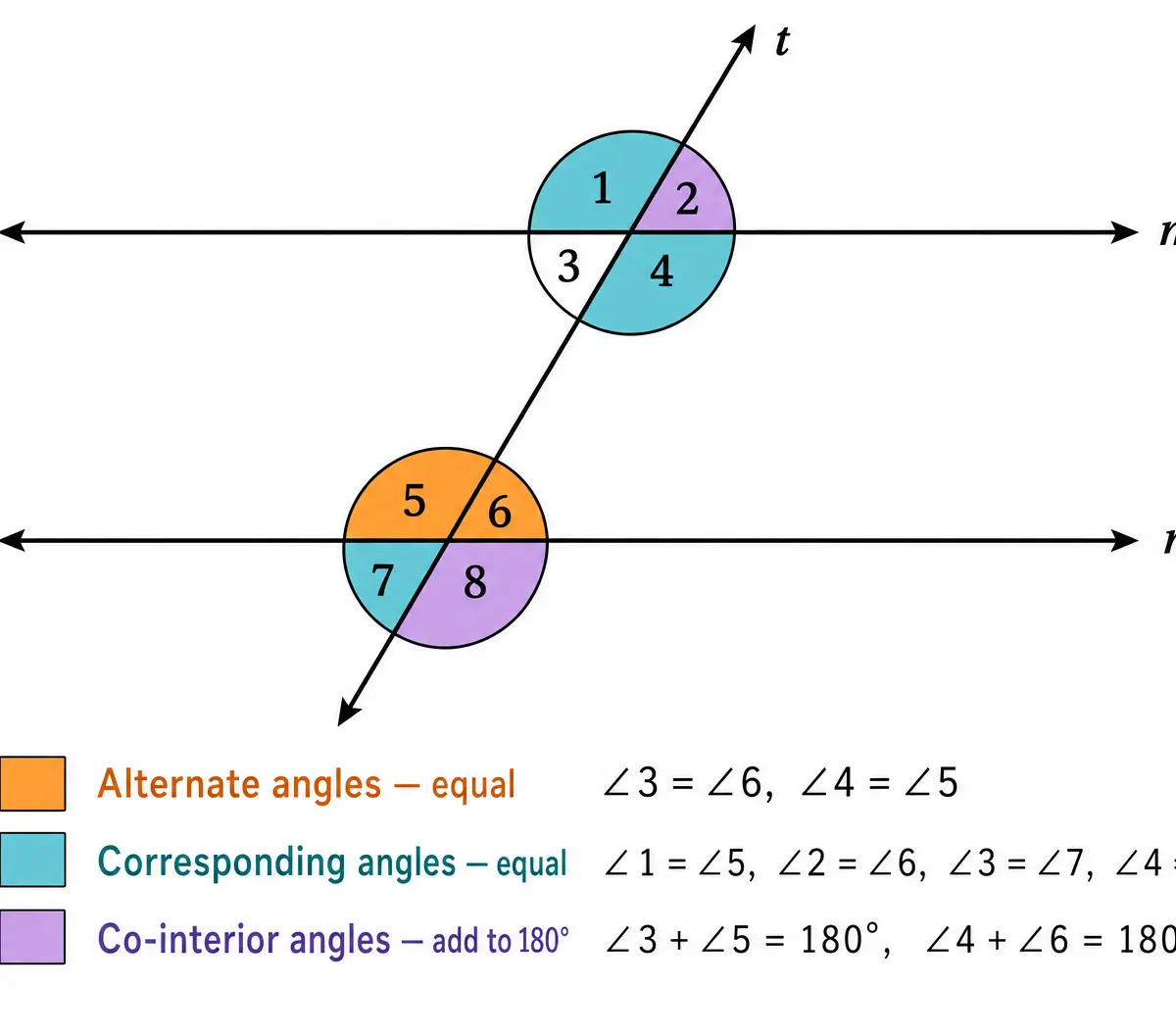
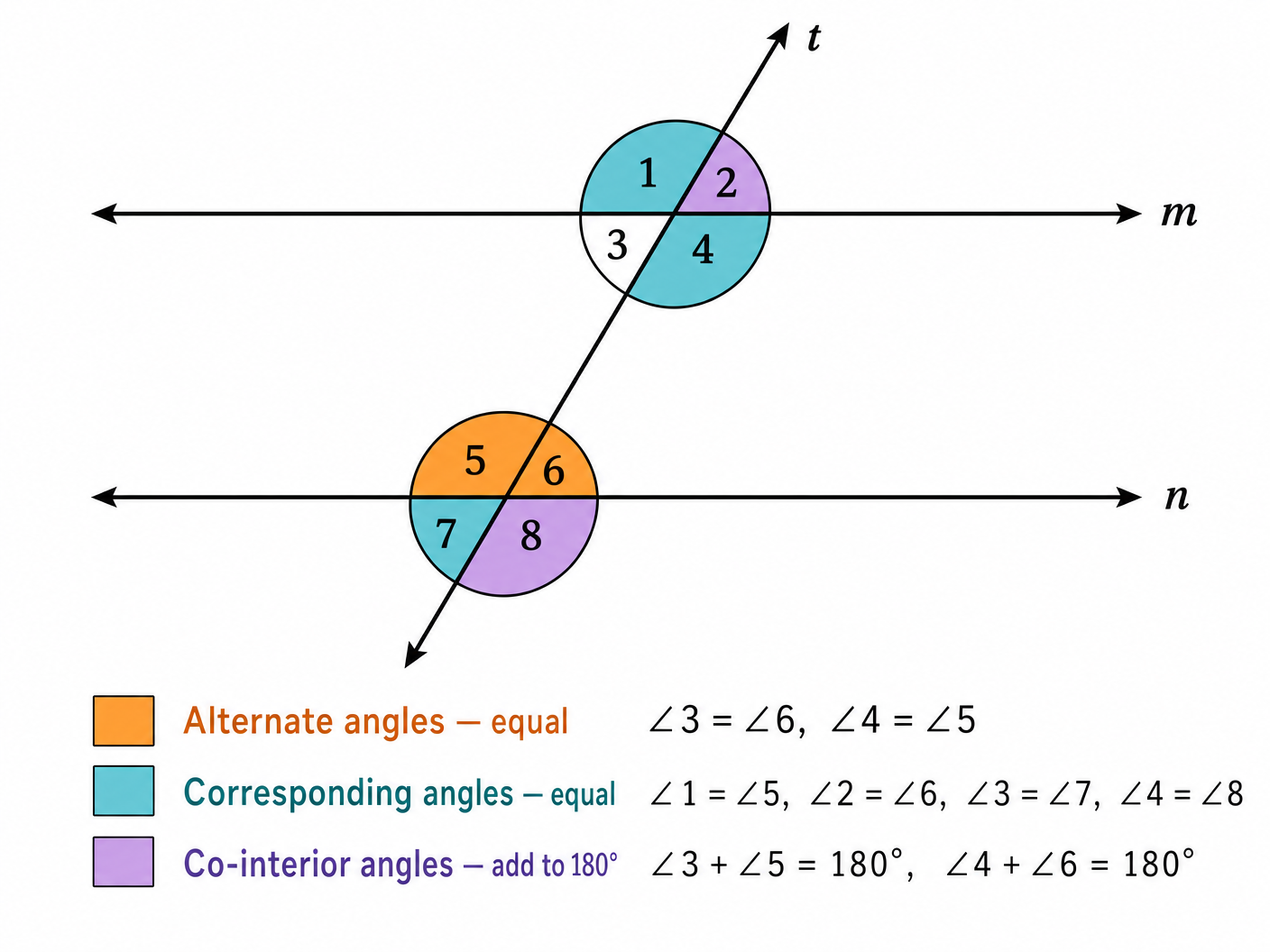
- Alternate angles are equal. These are on opposite sides of the transversal and between the parallel lines (often forming a 'Z' shape).
- Corresponding angles are equal. These are in the same relative position at each intersection (often forming an 'F' shape).
- Co-interior (allied) angles add up to 180^\circ. These are on the same side of the transversal and between the parallel lines (often forming a 'C' shape).
Crucial Examiner Tip: You can only use these rules if the lines are explicitly stated to be parallel (usually indicated by arrows on the lines). Never assume lines are parallel just because they look it.
Concept 3: Polygons and Interior/Exterior Angles
A polygon is any 2D shape with straight sides. The exam board expects you to fluidly move between the number of sides, interior angles, and exterior angles.
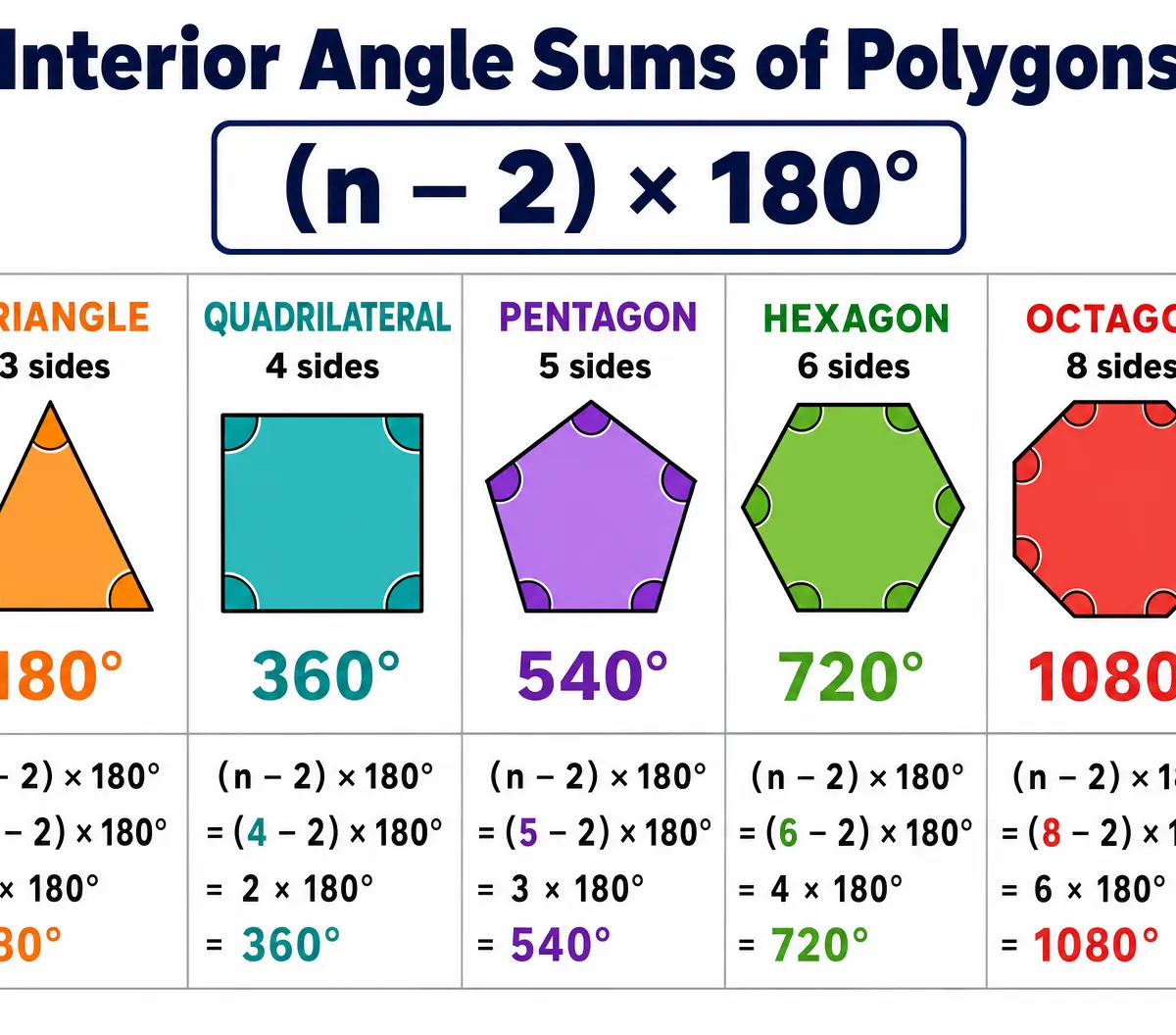
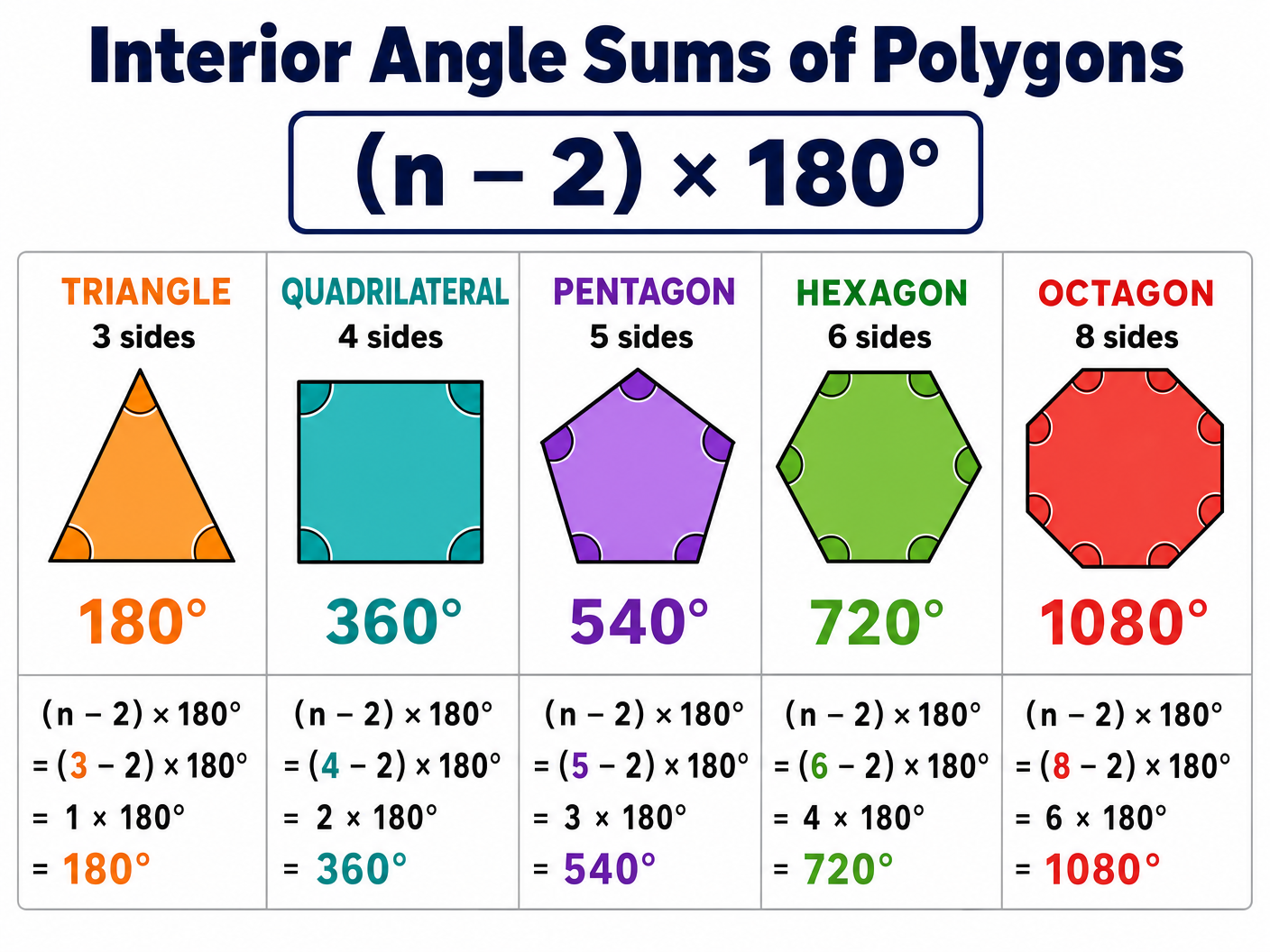
- Interior angles: The sum of interior angles of any polygon is calculated by splitting the shape into triangles from a single vertex. A polygon with n sides can be split into (n-2) triangles.
- Exterior angles: The exterior angle is the angle formed outside the polygon when one side is extended. For any convex polygon, the sum of all exterior angles is always 360^\circ.
- Relationship: For any vertex, the interior angle + exterior angle = 180^\circ (because they lie on a straight line).
Mathematical Relationships
- Sum of interior angles = (n - 2) \times 180^\circ (Must memorise)
- Sum of exterior angles = 360^\circ (Must memorise)
- One exterior angle (Regular Polygon) = 360^\circ \div n (Must memorise)
- One interior angle (Regular Polygon) = 180^\circ - \text{Exterior Angle} (Must memorise)
(Note: n represents the number of sides)
Practical Applications
Geometry is used extensively in architecture, engineering, and computer graphics. For example, rendering a 3D video game environment relies entirely on breaking complex surfaces down into millions of tiny polygons (usually triangles) and calculating the angles between them to determine how light reflects off the surface.
Visual Resources
2 diagrams and illustrations
Interactive Diagrams
2 interactive diagrams to visualise key concepts
Conceptual Flow Outline
Decision tree for solving polygon angle problems.
Conceptual Flow Outline
How to identify which parallel line rule to use.
Worked Examples
3 worked examples — open one to explore the question and available guidance.
Practice Questions
Test your understanding — click to reveal model answers
A regular hexagon and a regular octagon share a common edge. Calculate the size of the angle formed between them at the vertex where they meet. (4 marks)
Hint: Calculate the interior angle of both shapes first, then use angles around a point.
Find the size of an interior angle of a regular 12-sided polygon (dodecagon). (2 marks)
Hint: It's usually faster to find the exterior angle first.
Two parallel lines are cut by a transversal. One of the interior angles is 72^\circ. What is the size of the co-interior angle? Give a reason. (2 marks)
Hint: Do co-interior angles equal each other, or do they add up to something?
In a triangle ABC, angle A is x, angle B is 2x, and angle C is x + 20. Form an equation and solve it to find the value of x. (3 marks)
Hint: What do the angles in a triangle add up to?
Prove that the sum of the interior angles of a pentagon is 540^\circ. (2 marks)
Hint: How many triangles can you split a pentagon into from one corner?