Number Revision Notes

    Subject: Mathematics | Level: GCSE | Exam Board: Pearson

    Mastering fractions, decimals, and percentages is the foundation of GCSE Mathematics. This topic unlocks marks across the entire specification, teaching you how to fluently convert between forms and apply the powerful multiplier method to solve percentage change problems quickly and accurately.

    Revision Notes & Key Concepts

    ![Header image for Fractions, Decimals & Percentages](https://xnnrgnazirrqvdgfhvou.supabase.co/storage/v1/object/public/study-guide-assets/guide_1956de77-c671-4f84-ae56-3cc473458734/header_image.png) ## Overview Fractions, decimals, and percentages are simply three different languages used to describe the exact same thing: a part of a whole. Whether you are dividing a pizza, calculating a discount in a sale, or interpreting probability, you are using these concepts. In GCSE Mathematics, this topic is foundational. Examiners test it directly in dedicated questions, but it also underpins almost every other area of the specification, from geometry and trigonometry to statistics and algebra. Mastering this topic means you can fluently translate between these three forms, allowing you to choose the most efficient method for any given problem. A key focus for examiners, particularly at the Higher tier, is your ability to use **multiplicative reasoning**. Instead of calculating percentages in multiple steps, you will learn to use single multipliers, a skill that reduces errors and saves valuable exam time. ## Key Concepts ### Concept 1: Converting Fractions to Decimals and Percentages To convert a fraction to a decimal, you simply divide the numerator (the top number) by the denominator (the bottom number). For example, $\frac{3}{8}$ means $3 \div 8$, which equals $0.375$. This is a **terminating decimal**. Once you have the decimal, converting to a percentage is as simple as multiplying by 100. So, $0.375 \times 100 = 37.5\%$. **Why it works:** A fraction is a division operation waiting to happen. A percentage literally means "per hundred" (from the Latin *per centum*). By dividing to get a decimal (which is out of 1), and then multiplying by 100, you are scaling the value to be out of 100. **Example:** Convert $\frac{5}{8}$ to a percentage. $5 \div 8 = 0.625$ $0.625 \times 100 = 62.5\%$ ![Fraction-Decimal-Percentage Conversion Triangle](https://xnnrgnazirrqvdgfhvou.supabase.co/storage/v1/object/public/study-guide-assets/guide_1956de77-c671-4f84-ae56-3cc473458734/conversion_triangle.png) ### Concept 2: Converting Decimals and Percentages to Fractions To convert a terminating decimal to a fraction, write the decimal digits over the appropriate power of 10 (10 for one decimal place, 100 for two, 1000 for three), and then **simplify fully**. This simplification step is where many candidates lose marks. To convert a percentage to a fraction, write the percentage value over 100 and simplify. **Example:** Convert $45\%$ to a fraction in its simplest form. $45\% = \frac{45}{100}$ Divide numerator and denominator by their highest common factor (5): $\frac{45 \div 5}{100 \div 5} = \frac{9}{20}$ ### Concept 3: The Multiplier Method for Percentage Change This is the most powerful tool in this topic. Instead of finding a percentage and adding or subtracting it from the original amount, you multiply the original amount by a single scaling factor called a **multiplier**. - **For a percentage increase of $r\%$**: The multiplier is $1 + \frac{r}{100}$. - **For a percentage decrease of $r\%$**: The multiplier is $1 - \frac{r}{100}$. **Why it works:** If you increase a value by $20\%$, you are keeping the original $100\%$ and adding $20\%$, giving you $120\%$ of the original. $120\%$ as a decimal is $1.2$. Therefore, multiplying by $1.2$ achieves the increase in one step. **Example:** A TV costs £450. It is reduced by $15\%$ in a sale. Calculate the sale price. Multiplier = $1 - 0.15 = 0.85$ Sale Price = $£450 \times 0.85 = £382.50$ ![Percentage Change Formulas and Examples](https://xnnrgnazirrqvdgfhvou.supabase.co/storage/v1/object/public/study-guide-assets/guide_1956de77-c671-4f84-ae56-3cc473458734/percentage_change_diagram.png) ### Concept 4: Expressing One Quantity as a Fraction of Another To express quantity A as a fraction of quantity B, write $\frac{A}{B}$. The critical rule here is that **both quantities must be in the exact same units** before you form the fraction. Once formed, the fraction must be simplified. **Example:** Express 45 minutes as a fraction of 2 hours. Convert 2 hours to minutes: $2 \times 60 = 120$ minutes. Form the fraction: $\frac{45}{120}$ Simplify by dividing by the highest common factor (15): $\frac{3}{8}$ ## Mathematical/Scientific Relationships * **Percentage Change Formula:** $\frac{\text{New Value} - \text{Original Value}}{\text{Original Value}} \times 100$ *(Must memorise)* * **Multiplier for Increase:** $1 + \frac{r}{100}$ *(Must memorise)* * **Multiplier for Decrease:** $1 - \frac{r}{100}$ *(Must memorise)* ## Practical Applications These skills are used daily in the real world. Calculating discounts during sales, working out interest rates on savings accounts or loans, determining profit margins in business, and understanding statistics in news reports all rely heavily on fractions, decimals, and percentages. ![Revision Podcast: Fractions, Decimals, and Percentages](https://xnnrgnazirrqvdgfhvou.supabase.co/storage/v1/object/public/study-guide-assets/guide_1956de77-c671-4f84-ae56-3cc473458734/number_1_fractions_decimals_percentages_podcast.mp3) *Listen to the full 17-minute revision podcast covering all core concepts, exam tips, and a quick-fire recall quiz.*

    Key Terms & Definitions

    Numerator
    The top number in a fraction, representing how many parts of the whole are being considered.
    Denominator
    The bottom number in a fraction, representing the total number of equal parts the whole is divided into.
    Terminating Decimal
    A decimal number that has a finite number of digits after the decimal point.
    Percentage
    A number or ratio expressed as a fraction of 100. Literally means 'per hundred'.
    Multiplier
    A single decimal value used to scale a quantity to represent a percentage increase or decrease.
    Reverse Percentage
    The process of finding an original amount before a percentage increase or decrease was applied.

    Worked Examples

    Practice Questions

    Number

    Pearson
    GCSE
    Mathematics

    Mastering fractions, decimals, and percentages is the foundation of GCSE Mathematics. This topic unlocks marks across the entire specification, teaching you how to fluently convert between forms and apply the powerful multiplier method to solve percentage change problems quickly and accurately.

    5
    Min Read
    3
    Examples
    5
    Questions
    6
    Key Terms
    🎙 Podcast Episode
    Number
    0:00-0:00

    Study Notes

    Header image for Fractions, Decimals & Percentages

    Overview

    Fractions, decimals, and percentages are simply three different languages used to describe the exact same thing: a part of a whole. Whether you are dividing a pizza, calculating a discount in a sale, or interpreting probability, you are using these concepts. In GCSE Mathematics, this topic is foundational. Examiners test it directly in dedicated questions, but it also underpins almost every other area of the specification, from geometry and trigonometry to statistics and algebra.

    Mastering this topic means you can fluently translate between these three forms, allowing you to choose the most efficient method for any given problem. A key focus for examiners, particularly at the Higher tier, is your ability to use multiplicative reasoning. Instead of calculating percentages in multiple steps, you will learn to use single multipliers, a skill that reduces errors and saves valuable exam time.

    Key Concepts

    Concept 1: Converting Fractions to Decimals and Percentages

    To convert a fraction to a decimal, you simply divide the numerator (the top number) by the denominator (the bottom number). For example, \frac{3}{8} means 3 \div 8, which equals 0.375. This is a terminating decimal. Once you have the decimal, converting to a percentage is as simple as multiplying by 100. So, 0.375 \times 100 = 37.5%.

    Why it works: A fraction is a division operation waiting to happen. A percentage literally means "per hundred" (from the Latin per centum). By dividing to get a decimal (which is out of 1), and then multiplying by 100, you are scaling the value to be out of 100.

    Example: Convert \frac{5}{8} to a percentage.
    5 \div 8 = 0.625
    0.625 \times 100 = 62.5%
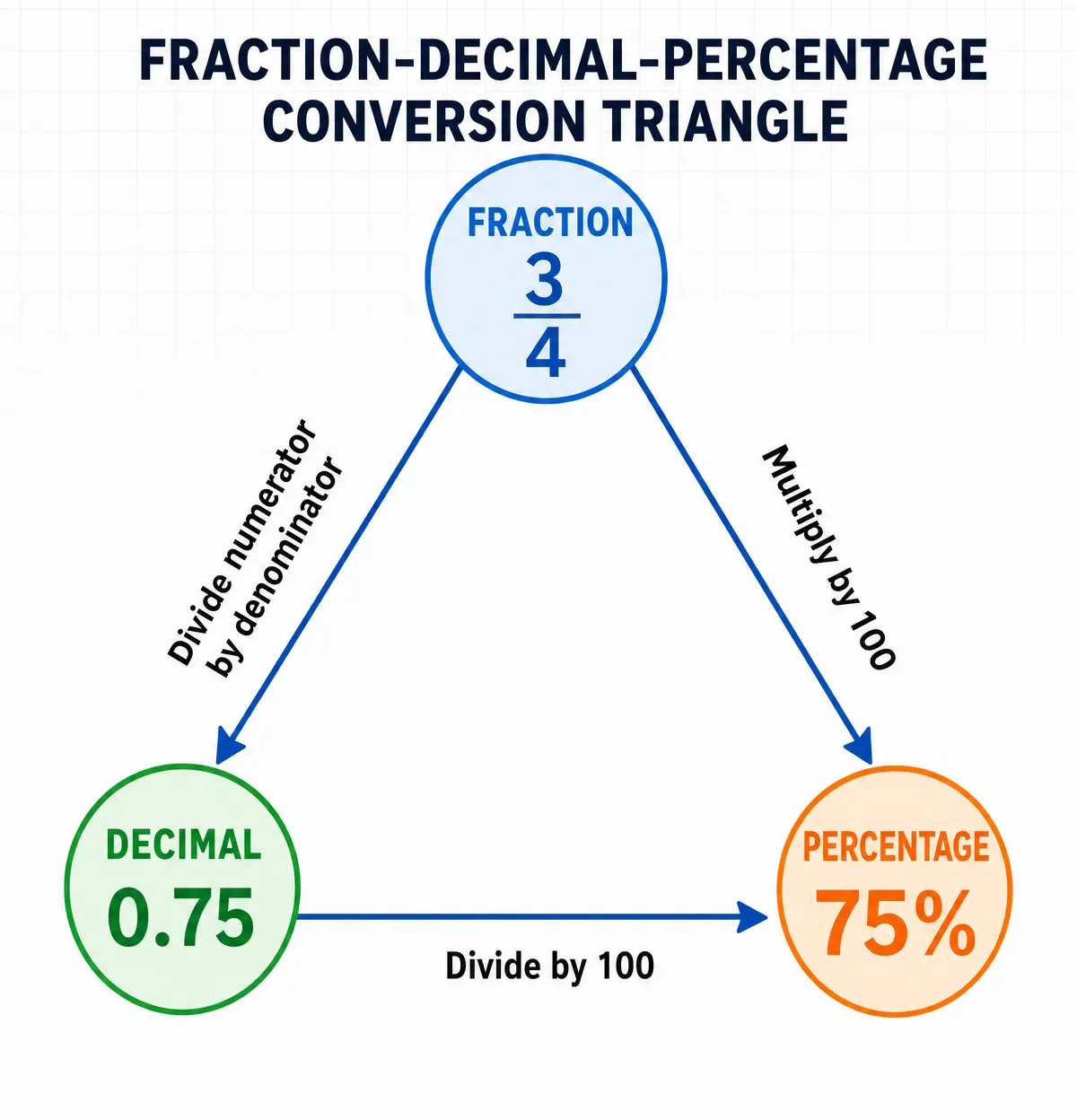
    Fraction-Decimal-Percentage Conversion Triangle

    Concept 2: Converting Decimals and Percentages to Fractions

    To convert a terminating decimal to a fraction, write the decimal digits over the appropriate power of 10 (10 for one decimal place, 100 for two, 1000 for three), and then simplify fully. This simplification step is where many candidates lose marks.

    To convert a percentage to a fraction, write the percentage value over 100 and simplify.

    Example: Convert 45% to a fraction in its simplest form.
    45% = \frac{45}{100}
    Divide numerator and denominator by their highest common factor (5):
    \frac{45 \div 5}{100 \div 5} = \frac{9}{20}

    Concept 3: The Multiplier Method for Percentage Change

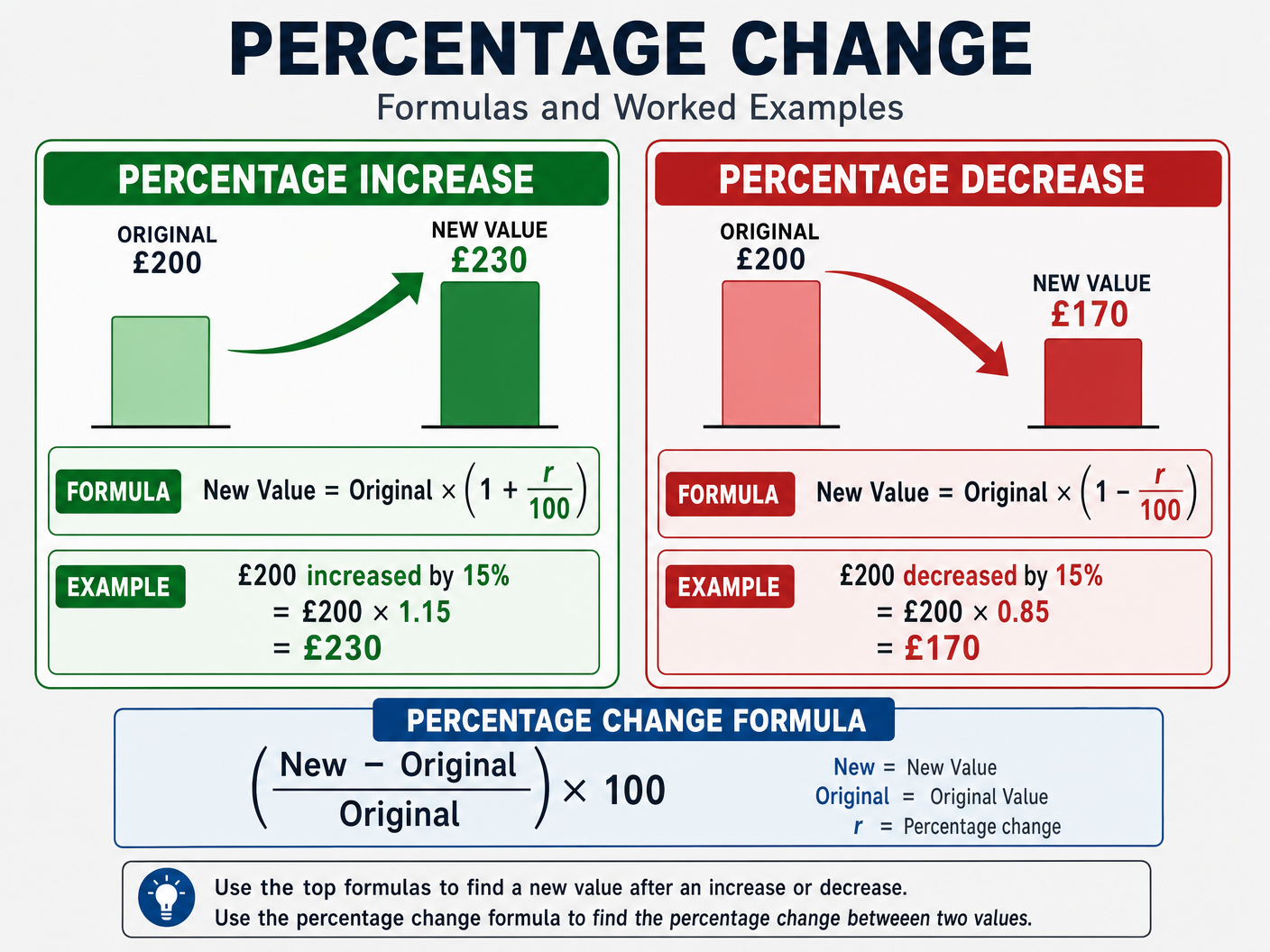
    This is the most powerful tool in this topic. Instead of finding a percentage and adding or subtracting it from the original amount, you multiply the original amount by a single scaling factor called a multiplier.

    • For a percentage increase of r%: The multiplier is 1 + \frac{r}{100}.
    • For a percentage decrease of r%: The multiplier is 1 - \frac{r}{100}.

    Why it works: If you increase a value by 20%, you are keeping the original 100% and adding 20%, giving you 120% of the original. 120% as a decimal is 1.2. Therefore, multiplying by 1.2 achieves the increase in one step.

    Example: A TV costs £450. It is reduced by 15% in a sale. Calculate the sale price.
    Multiplier = 1 - 0.15 = 0.85
    Sale Price = £450 \times 0.85 = £382.50
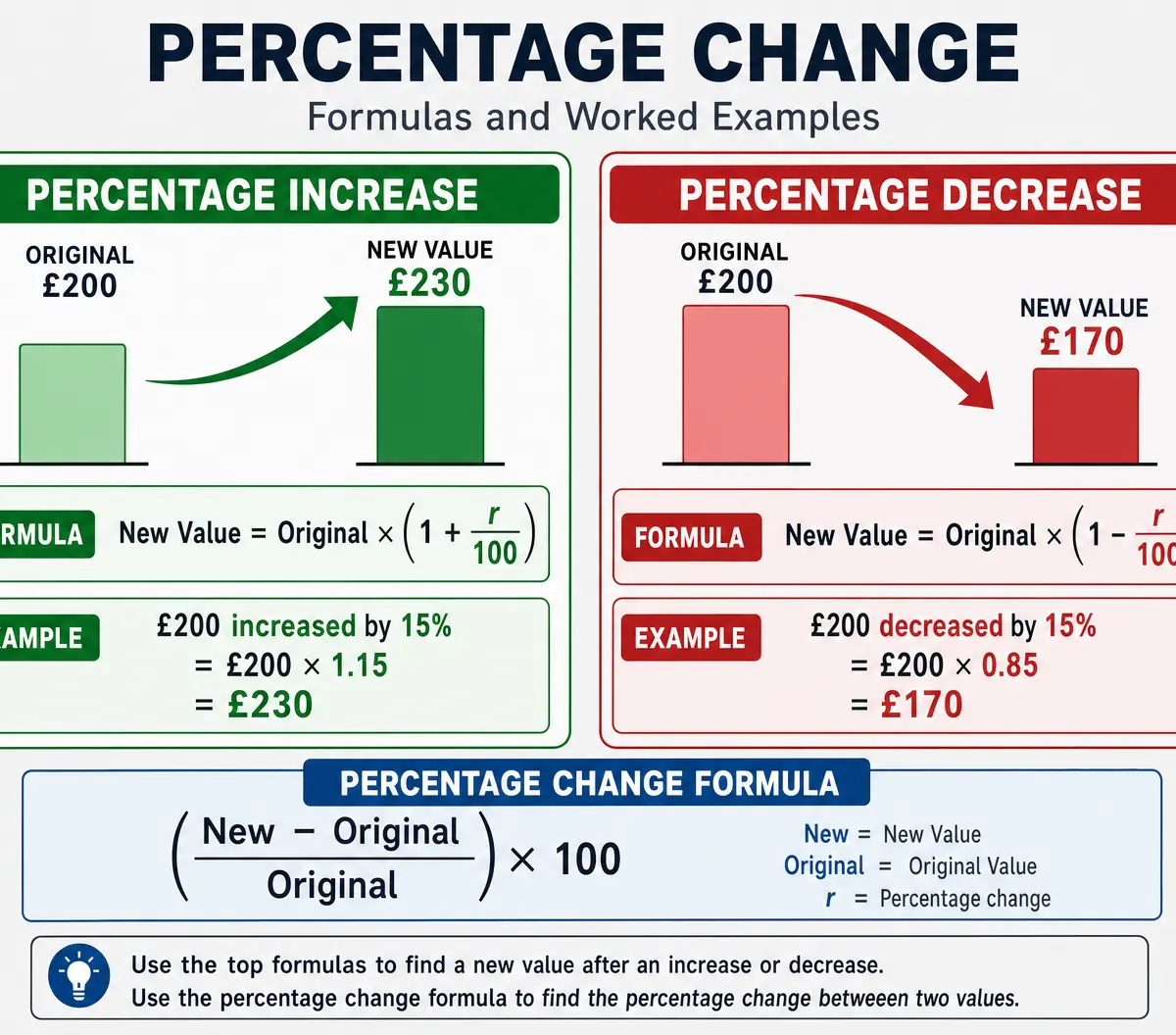
    Percentage Change Formulas and Examples

    Concept 4: Expressing One Quantity as a Fraction of Another

    To express quantity A as a fraction of quantity B, write \frac{A}{B}. The critical rule here is that both quantities must be in the exact same units before you form the fraction. Once formed, the fraction must be simplified.

    Example: Express 45 minutes as a fraction of 2 hours.
    Convert 2 hours to minutes: 2 \times 60 = 120 minutes.
    Form the fraction: \frac{45}{120}
    Simplify by dividing by the highest common factor (15): \frac{3}{8}

    Mathematical/Scientific Relationships

    • Percentage Change Formula: \frac{\text{New Value} - \text{Original Value}}{\text{Original Value}} \times 100 (Must memorise)
    • Multiplier for Increase: 1 + \frac{r}{100} (Must memorise)
    • Multiplier for Decrease: 1 - \frac{r}{100} (Must memorise)

    Practical Applications

    These skills are used daily in the real world. Calculating discounts during sales, working out interest rates on savings accounts or loans, determining profit margins in business, and understanding statistics in news reports all rely heavily on fractions, decimals, and percentages.

    Revision Podcast: Fractions, Decimals, and Percentages
    Listen to the full 17-minute revision podcast covering all core concepts, exam tips, and a quick-fire recall quiz.

    Visual Resources

    2 diagrams and illustrations
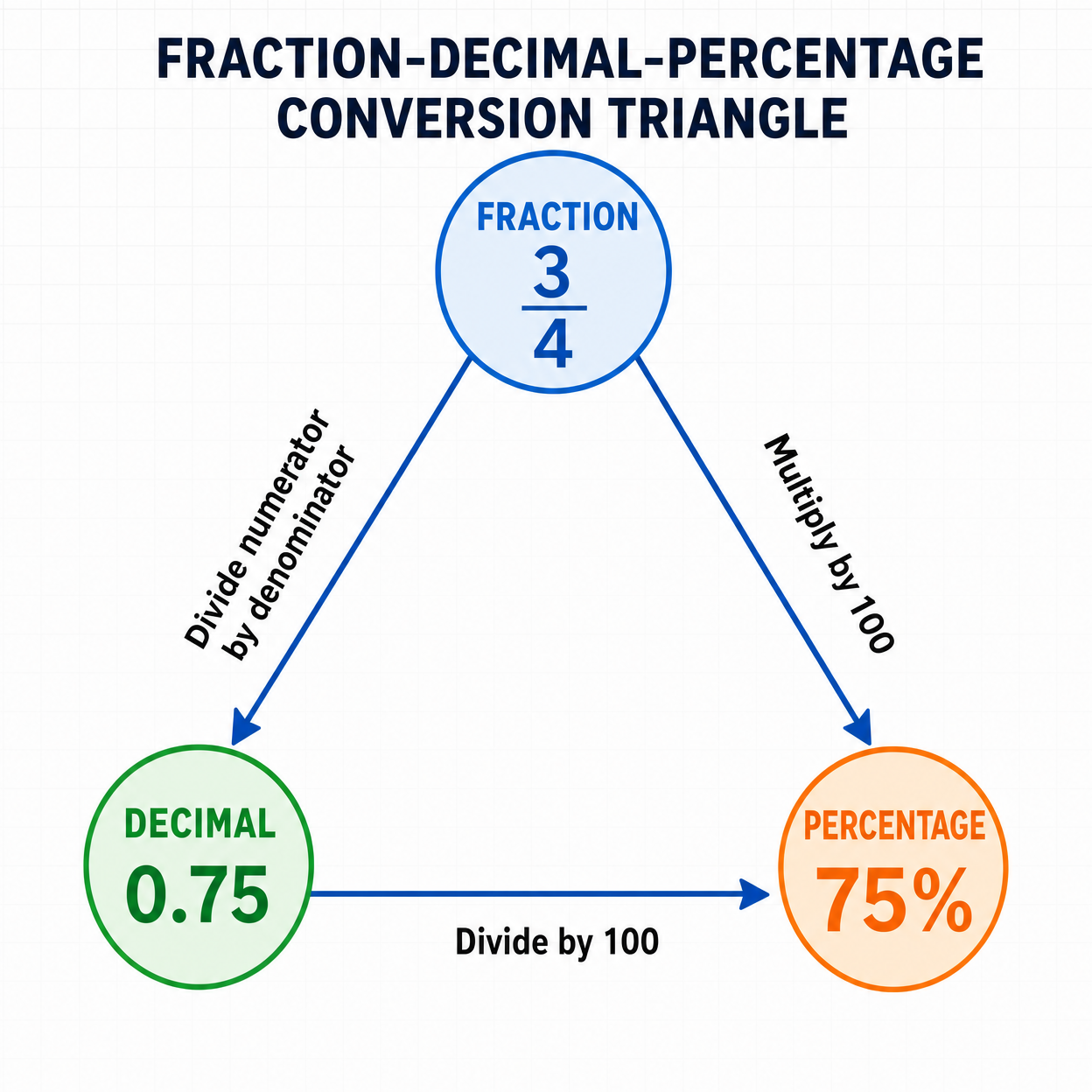
    Fraction-Decimal-Percentage Conversion Triangle
    Fraction-Decimal-Percentage Conversion Triangle
    Percentage Change Formulas and Examples
    Percentage Change Formulas and Examples

    Interactive Diagrams

    2 interactive diagrams to visualise key concepts

    The Multiplier Method for Percentage Change and Reverse Percentages

    Conversion pathways between Fractions, Decimals, and Percentages

    Worked Examples

    3 detailed examples with solutions and examiner commentary

    Practice Questions

    Test your understanding — click to reveal model answers

    Q1

    Convert 0.08 to a fraction in its simplest form.

    2 marks
    foundation

    Hint: Write the decimal over 100 first, then look for common factors to divide by.

    Q2

    A car is travelling at 72 km/h. Express this speed as a fraction of 120 km/h in its simplest form.

    2 marks
    foundation

    Hint: Both values are already in the same units, so you can write the fraction immediately.

    Q3

    A house was bought for £220,000. Five years later, its value had increased by 18%. Calculate the new value of the house.

    2 marks
    standard

    Hint: What single decimal number can you multiply by to increase a value by $18\%$?

    Q4

    The price of a train ticket increases from £45 to £52.20. Calculate the percentage increase in the price of the ticket.

    3 marks
    standard

    Hint: Use the formula: (Change / Original) * 100.

    Q5

    In a sale, normal prices are reduced by 35%. The sale price of a laptop is £552.50. Work out the normal price of the laptop.

    3 marks
    challenging

    Hint: This is a reverse percentage question. Do not find $35\%$ of the sale price. What multiplier was used to get the sale price?

    Explore this topic further

    View Topic PageAll Mathematics Topics

    Key Terms

    Essential vocabulary to know