Pearson Edexcel · GCSE · Mathematics
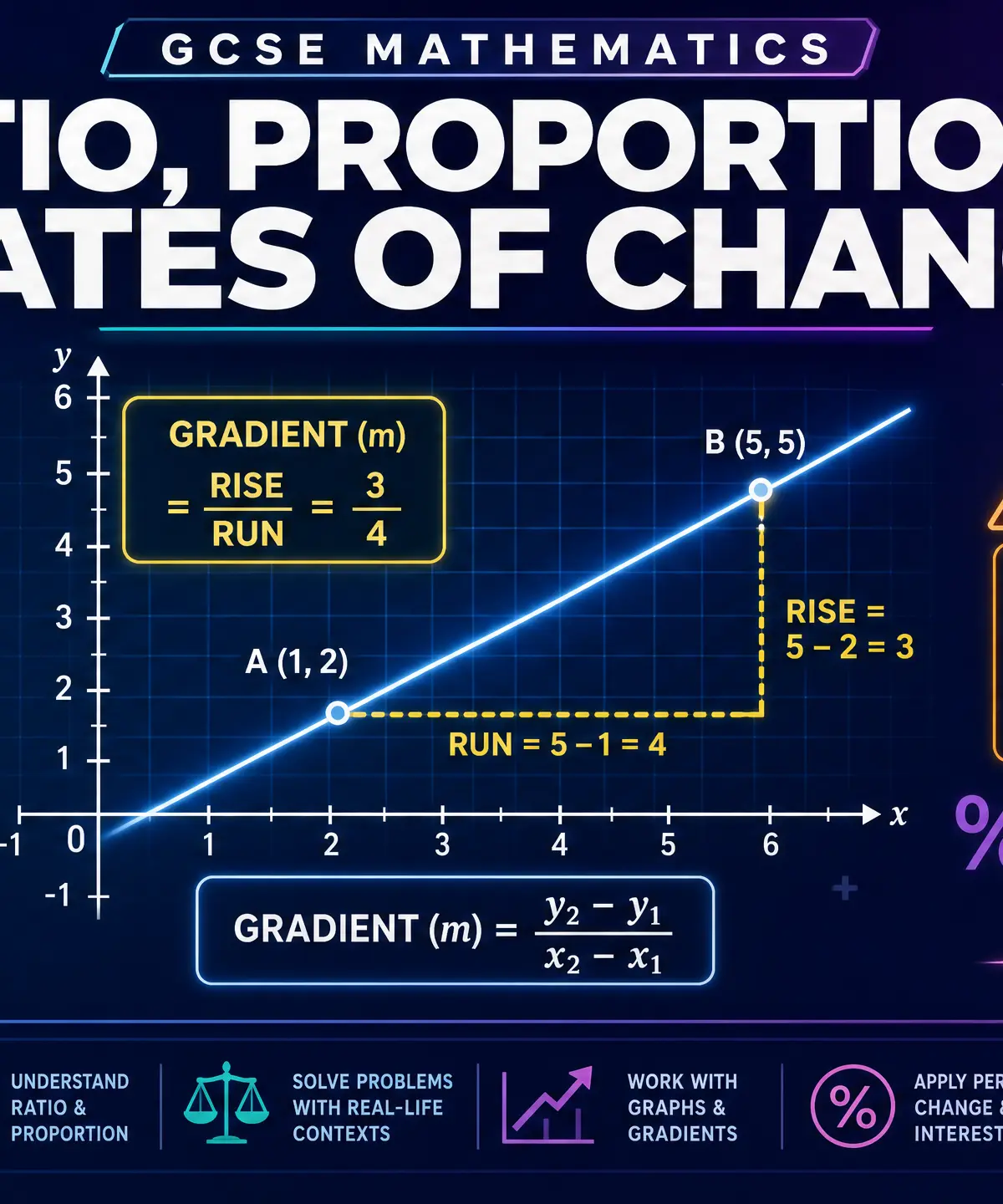
Ratio, proportion and rates of change
Master the mathematics of change! This topic covers calculating gradients from straight lines, applying compound interest to financial problems, and solving compound measure calculations like speed, density, and pressure — all essential skills that carry significant marks across Foundation and Higher tiers.
- 4 min read
- 3 worked examples
- 5 practice questions
- 6 key terms
Study Notes
Overview
Ratio, Proportion and Rates of Change is a fundamental pillar of GCSE Mathematics. This topic bridges the gap between abstract algebra and real-world applications. Whether you're calculating the speed of a moving vehicle, determining the density of a new material, or figuring out how much a bank investment will grow over five years, you are using rates of change.
Examiners love this topic because it tests multiple Assessment Objectives simultaneously: your ability to recall formulas (AO1), apply them to contexts (AO2), and solve complex, multi-step problems (AO3). It connects deeply with graphing skills, percentages, and algebraic rearrangement.
In your exam, expect to see straightforward calculation questions alongside challenging 'show that' proofs and multi-step contextual problems where you must interpret what a calculated value actually means in the real world.
Listen to the companion podcast for an audio walkthrough of these concepts:

Key Concepts
Concept 1: Gradient as a Rate of Change
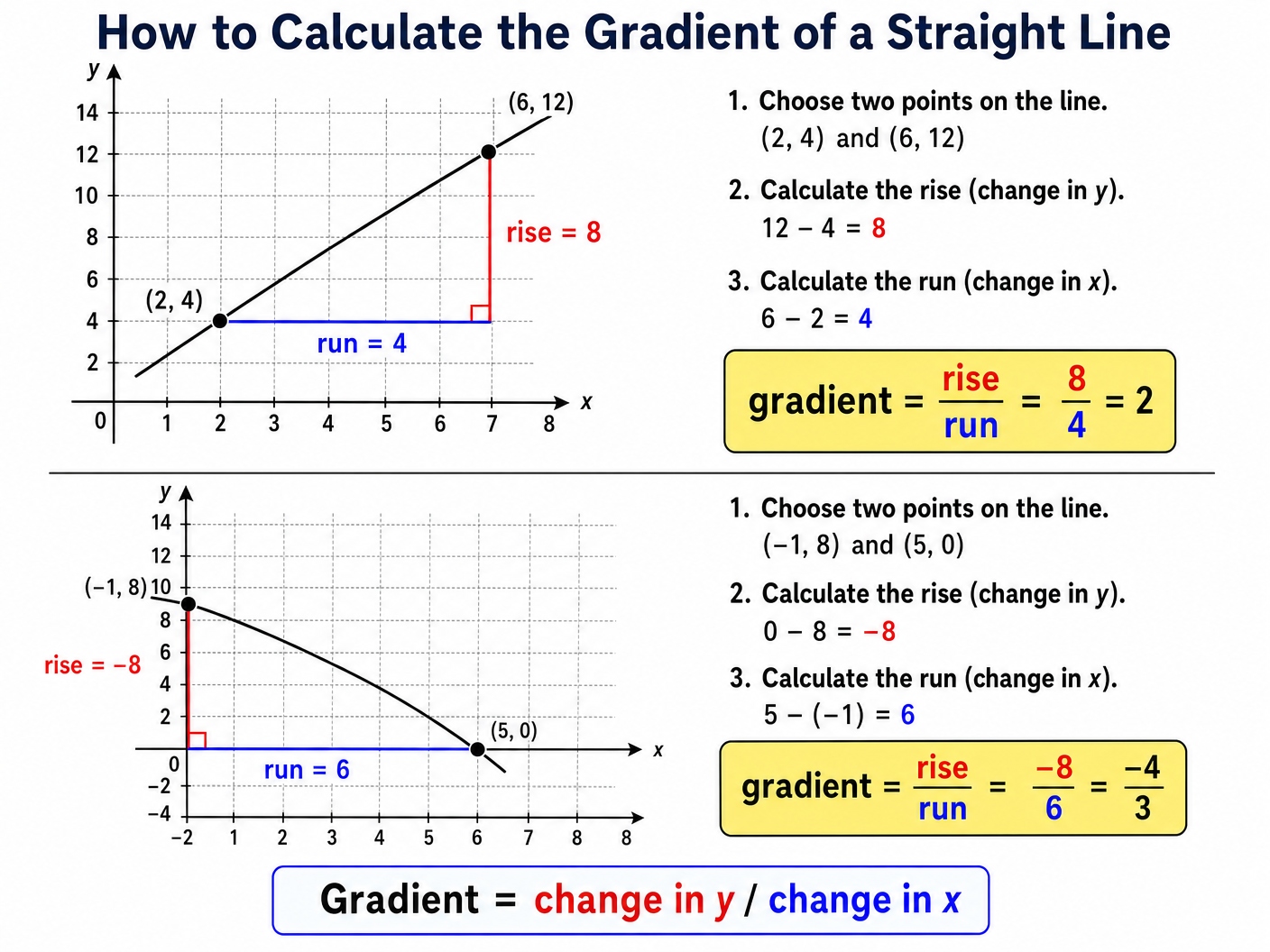
The gradient of a straight line is a measure of its steepness, but more importantly, it represents a rate of change. It tells you how much the y-variable changes for every 1-unit increase in the x-variable.
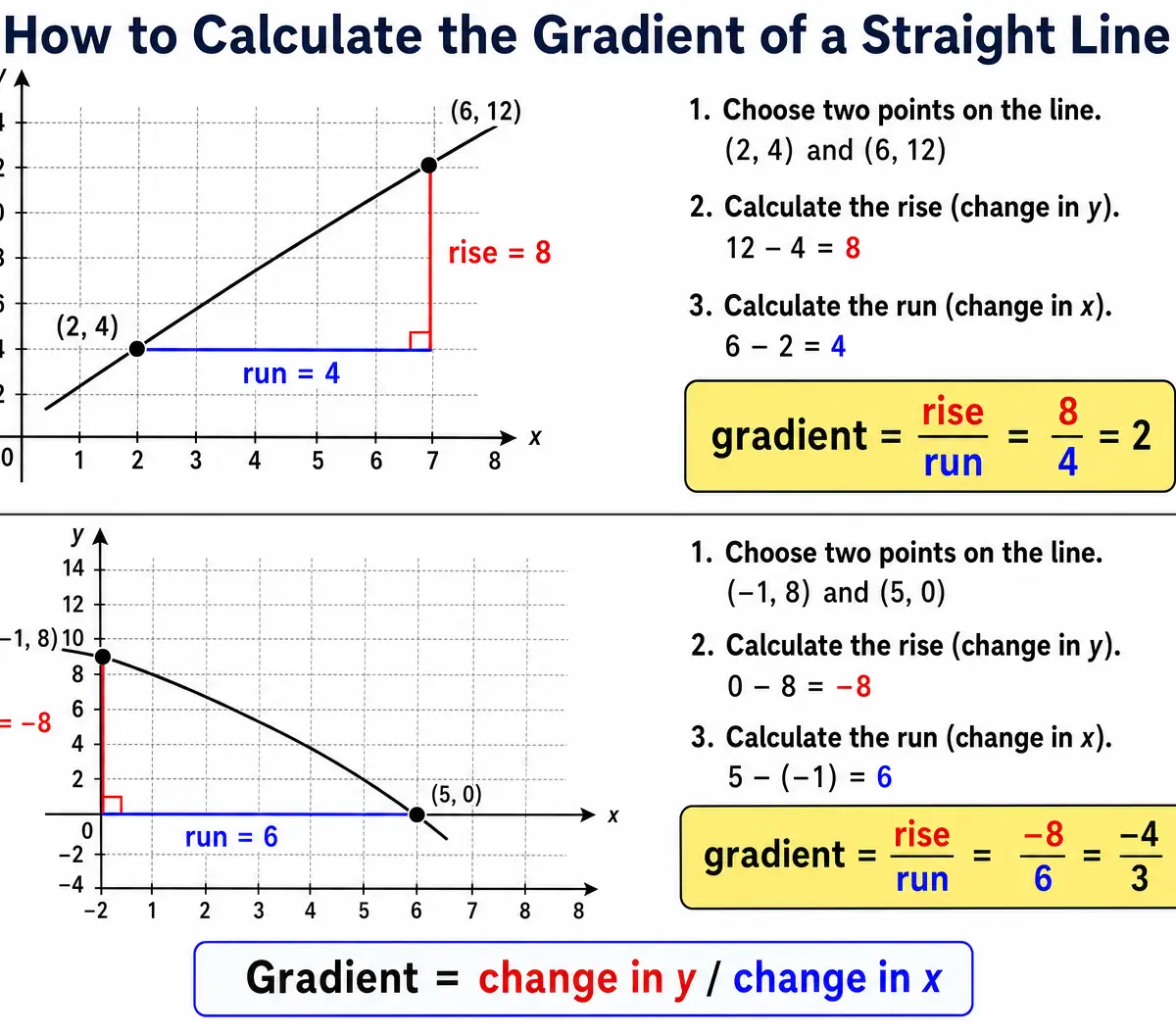
To calculate the gradient (m) from two points (x_1, y_1) and (x_2, y_2), we use the formula:
m = \frac{\text{change in } y}{\text{change in } x} = \frac{y_2 - y_1}{x_2 - x_1}
Why this works: Think of it as finding the 'unit rate'. If you travel 100 miles in 2 hours, dividing 100 by 2 gives you 50 miles per 1 hour. The gradient formula does exactly this graphically.
Example: Find the gradient of the line passing through (2, 5) and (6, 17).
m = \frac{17 - 5}{6 - 2} = \frac{12}{4} = 3
Concept 2: Compound Interest and Repeated Percentage Change
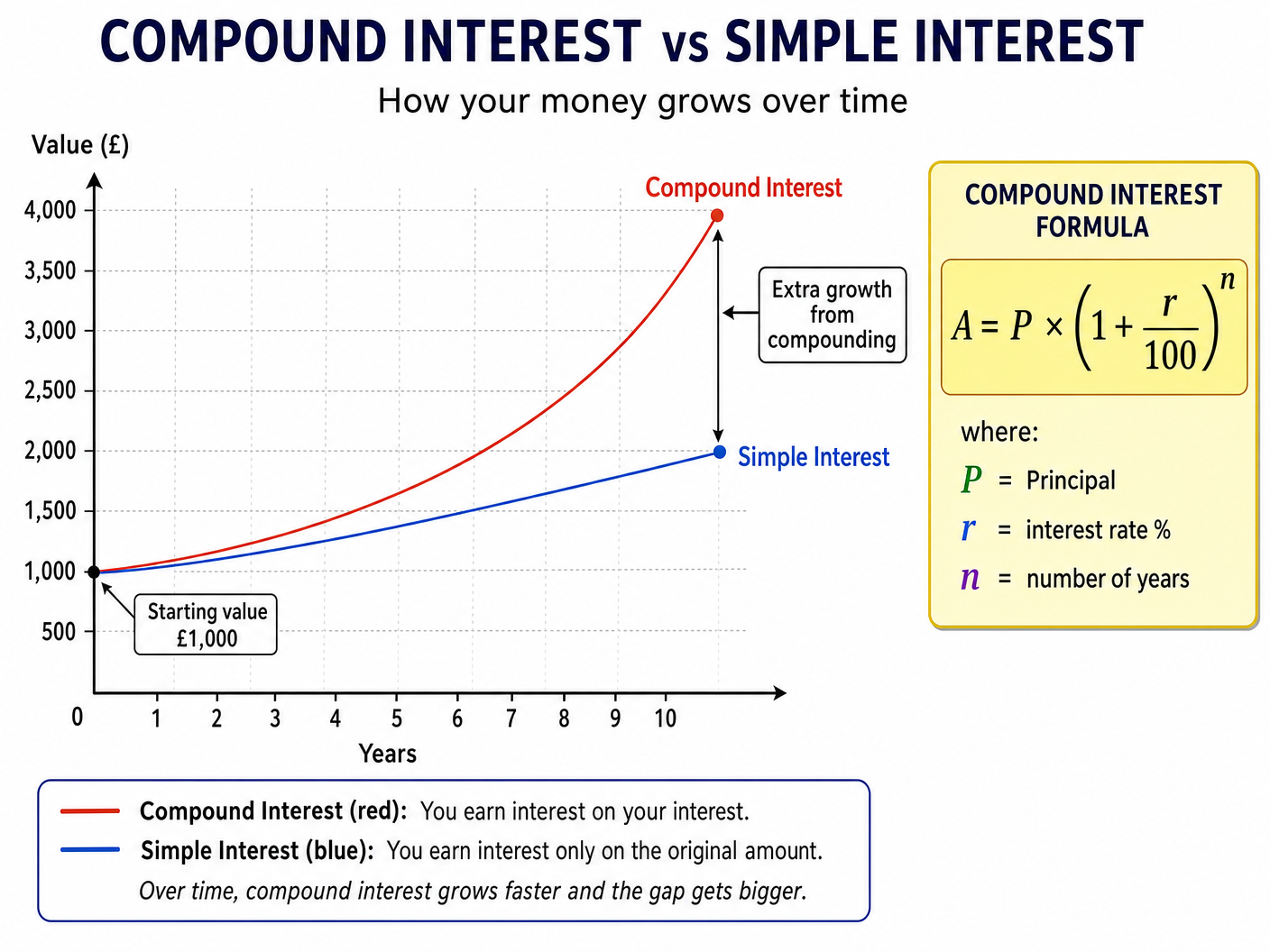
Unlike simple interest, which adds a fixed amount each year, compound interest calculates interest on the new total each year. This leads to exponential growth.
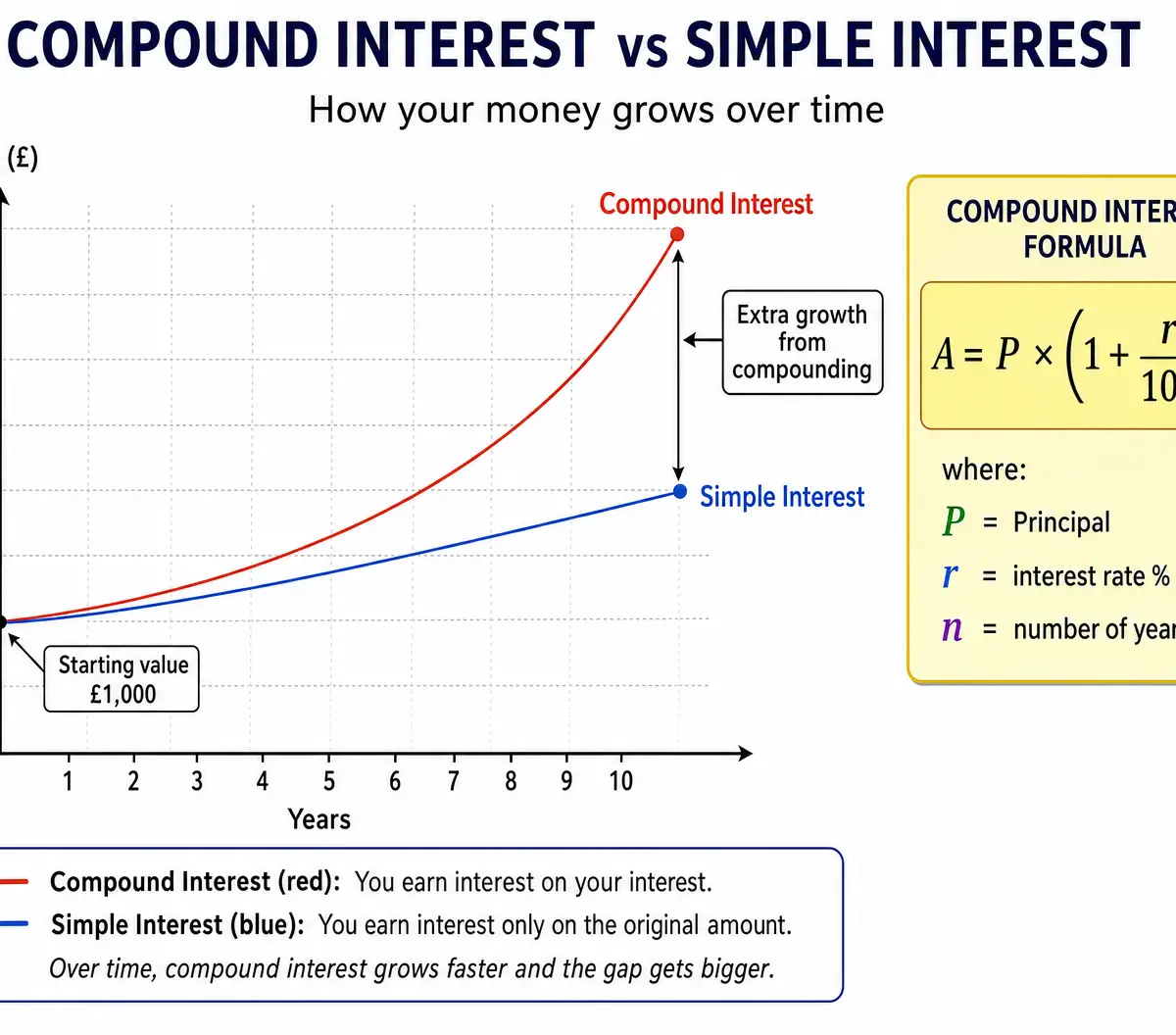
We use a multiplier method. For a 5% increase, the multiplier is 1.05. For a 20% decrease (depreciation), the multiplier is 0.80.
Why this works: Instead of calculating 5% and adding it on (two steps), multiplying by 1.05 calculates 105% of the value directly. Raising it to a power simply repeats this multiplication for the number of years.
Example: £3000 is invested at 4% compound interest for 3 years.
Calculation: 3000 \times 1.04^3 = £3374.59
Concept 3: Compound Measures
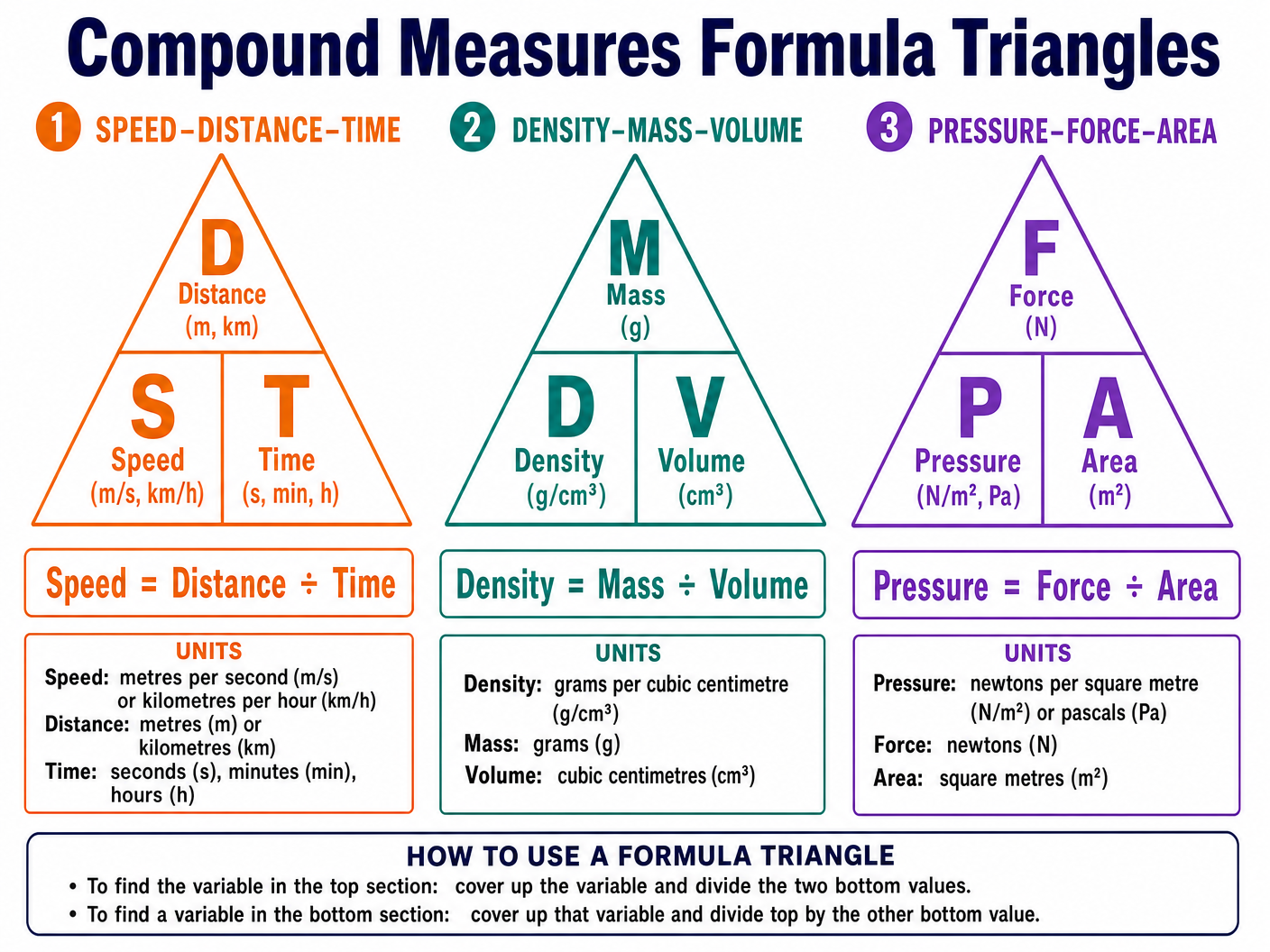
Compound measures are units made by combining two or more other units. The three most common are Speed, Density, and Pressure.
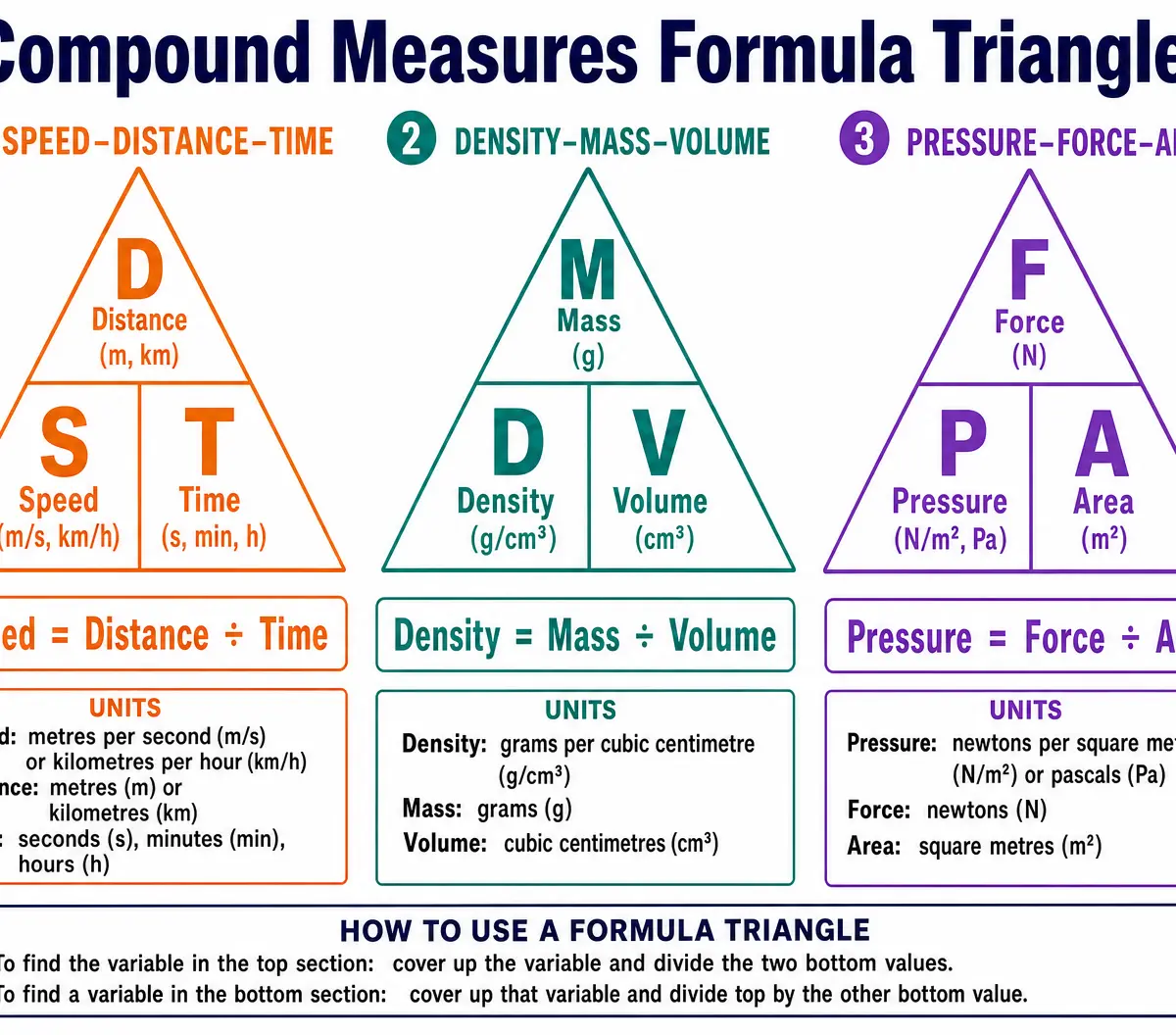
Speed: How fast distance is covered over time.
Density: How much mass is packed into a specific volume.
Pressure: How much force is spread over a specific area.
Why this works: These formulas are all ratios. Density is the ratio of mass to volume. By dividing mass by volume, we find the mass of exactly one unit of volume.
Example: A gold bar has a mass of 386g and a volume of 20cm³. Density = 386 \div 20 = 19.3 g/cm³.
Mathematical Relationships
- Gradient: m = \frac{y_2 - y_1}{x_2 - x_1} (Must memorise)
- Compound Interest: A = P(1 \pm \frac{r}{100})^n (Must memorise)
- Speed: S = \frac{D}{T} (Must memorise)
- Density: D = \frac{M}{V} (Must memorise)
- Pressure: P = \frac{F}{A} (Must memorise)
Practical Applications
- Finance: Mortgages, savings accounts, and car depreciation all rely on compound percentage formulas.
- Engineering: Designing structural supports requires precise pressure calculations (P=F/A).
- Materials Science: Identifying unknown substances by calculating their density and comparing it to known values.
Visual Resources
3 diagrams and illustrations
Interactive Diagrams
2 interactive diagrams to visualise key concepts
Conceptual Flow Outline
Flowchart for solving compound percentage change problems
Conceptual Flow Outline
Process for converting time into decimal hours
Worked Examples
3 worked examples — open one to explore the question and available guidance.
Practice Questions
Test your understanding — click to reveal model answers
A solid metal cylinder has a mass of 8.4kg and a volume of 1200cm³. Calculate the density of the metal in g/cm³. (3 marks)
Hint: Check the units carefully. The mass is in kg but the answer needs to be in g/cm³.
A population of bacteria increases by 12% every hour. The initial population is 5000. Calculate the population after 6 hours. Give your answer to the nearest whole number. (3 marks)
Hint: Use a multiplier and raise it to a power.
A line passes through the points A(3, 8) and B(7, 20). Calculate the gradient of the line AB. (2 marks)
Hint: Use the formula: change in y divided by change in x.
A force of 450N is applied to a circular area with a radius of 0.5m. Calculate the pressure in N/m². Give your answer to 3 significant figures. (4 marks)
Hint: You need to calculate the area of the circle first using $\pi r^2$.
The cost of a taxi journey is given by the graph. The y-axis shows Cost (£) and the x-axis shows Distance (miles). The line passes through (0, 3) and (10, 23). Calculate the gradient of the line and interpret what it means in this context. (3 marks)
Hint: First calculate the number, then write a sentence explaining what that number means about the cost and the distance.