Pearson Edexcel · GCSE · Mathematics
Statistics
Mastering data representation is your key to unlocking major marks in GCSE Mathematics. This guide covers everything from constructing basic charts to interpreting complex histograms and cumulative frequency graphs, ensuring you have the precise techniques examiners demand.
- 4 min read
- 3 worked examples
- 5 practice questions
- 6 key terms
Study Notes
Overview
Data representation and interpretation form the backbone of the GCSE Statistics module. This topic is about much more than just drawing pretty pictures; it is the fundamental mathematical skill of translating raw data into visual formats that reveal patterns, trends, and outliers. Whether you are dealing with categorical data using bar charts or continuous data requiring histograms and cumulative frequency graphs, examiners are testing your precision and analytical thinking.
This topic is heavily assessed across all exam boards and connects strongly to probability and real-world applications in science and geography. Questions often range from simple 2-mark plotting tasks to complex 6-mark comparative analyses where you must construct a graph and interpret its meaning.

Key Concepts
Concept 1: Bar Charts and Pie Charts
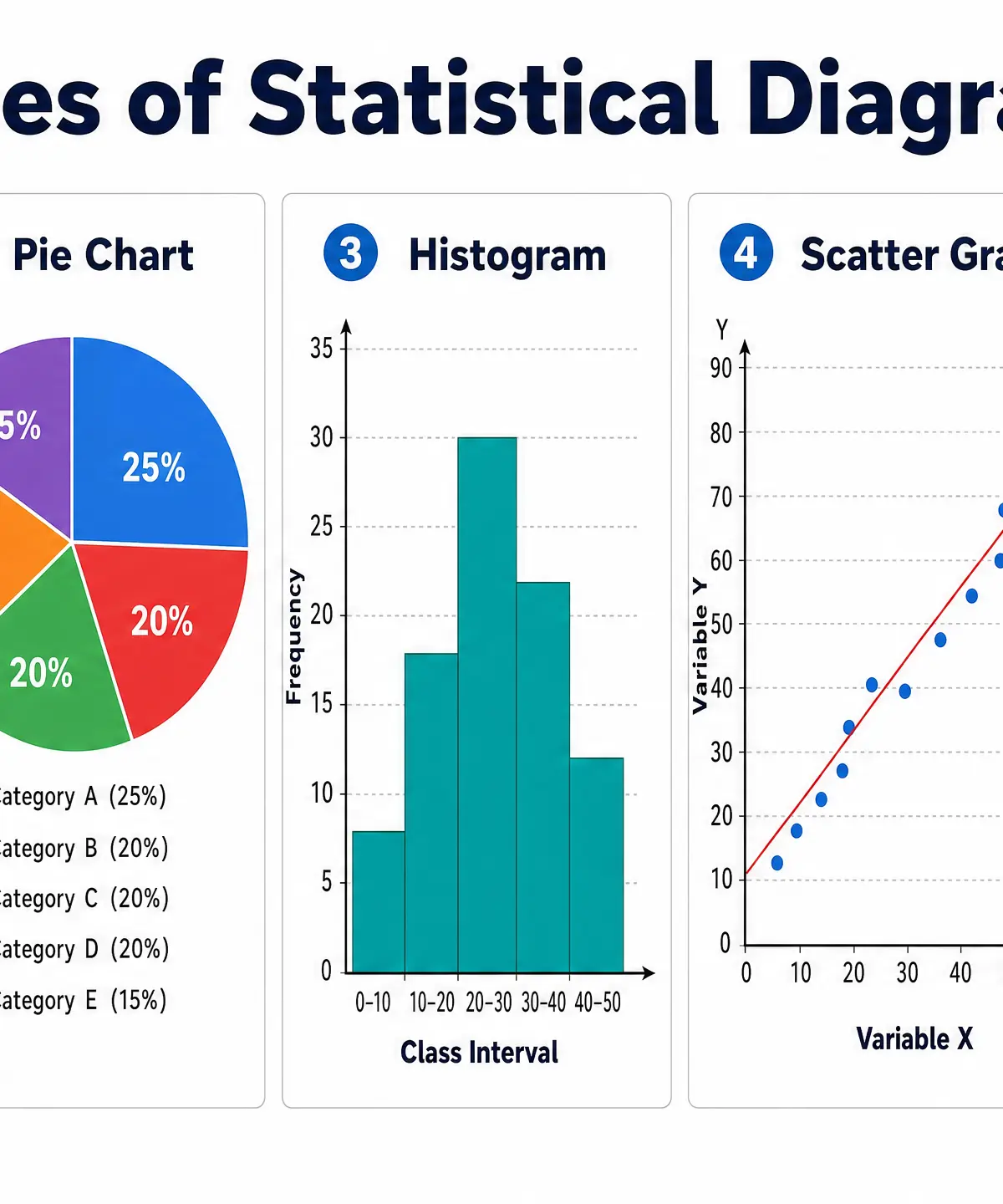
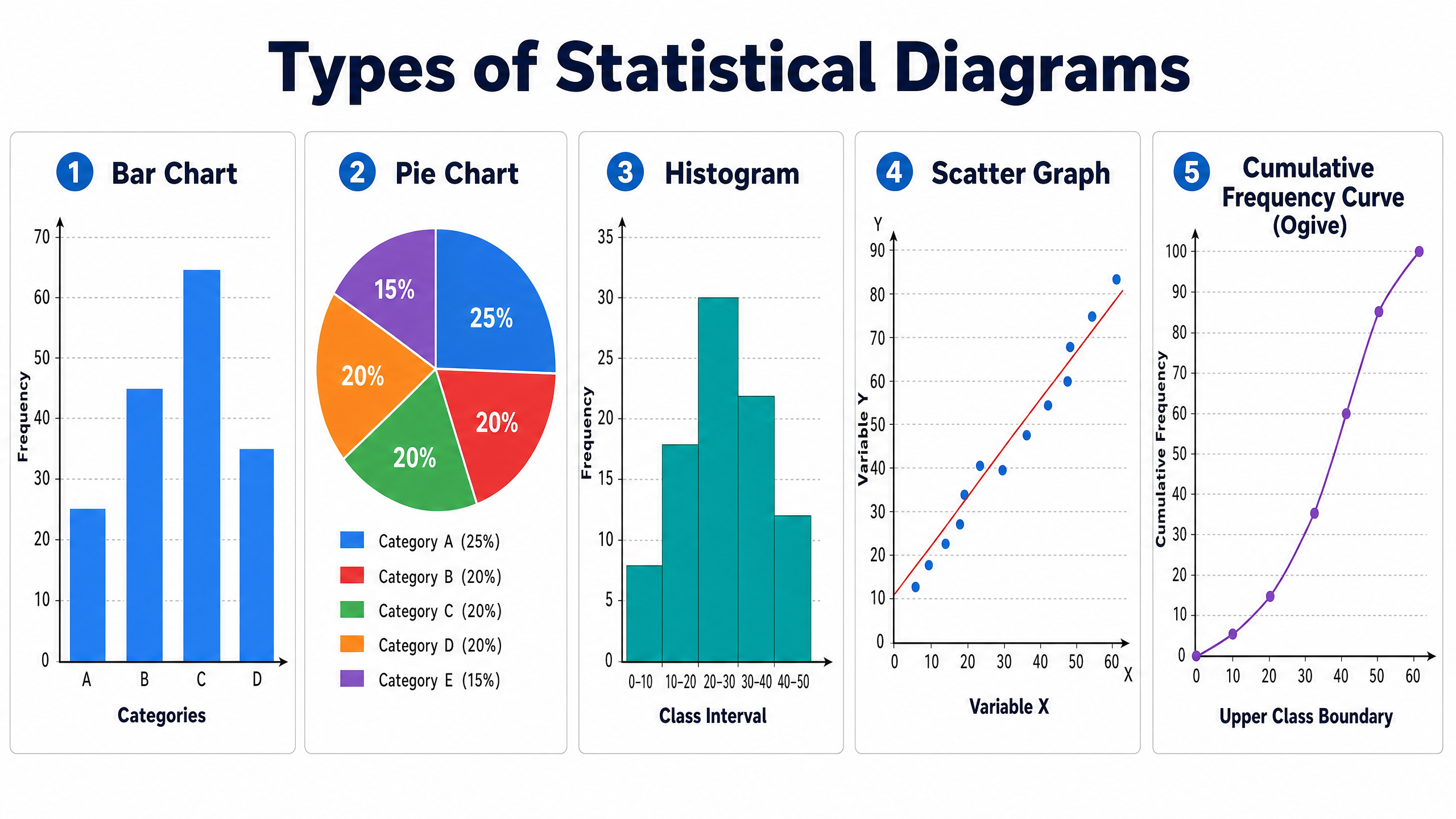
Bar charts are used for discrete or categorical data. The most crucial rule—and the one examiners test relentlessly—is that there must be gaps between the bars. The height of the bar represents the frequency.
Pie charts display data as proportions of a 360° circle. To calculate the angle for a sector, you divide the frequency of that category by the total frequency, and multiply by 360. Examiners expect accuracy to within 2 degrees.
Example: If 30 students are surveyed and 12 chose Blue, the angle is (12 ÷ 30) × 360 = 144°.
Concept 2: Stem-and-Leaf Diagrams
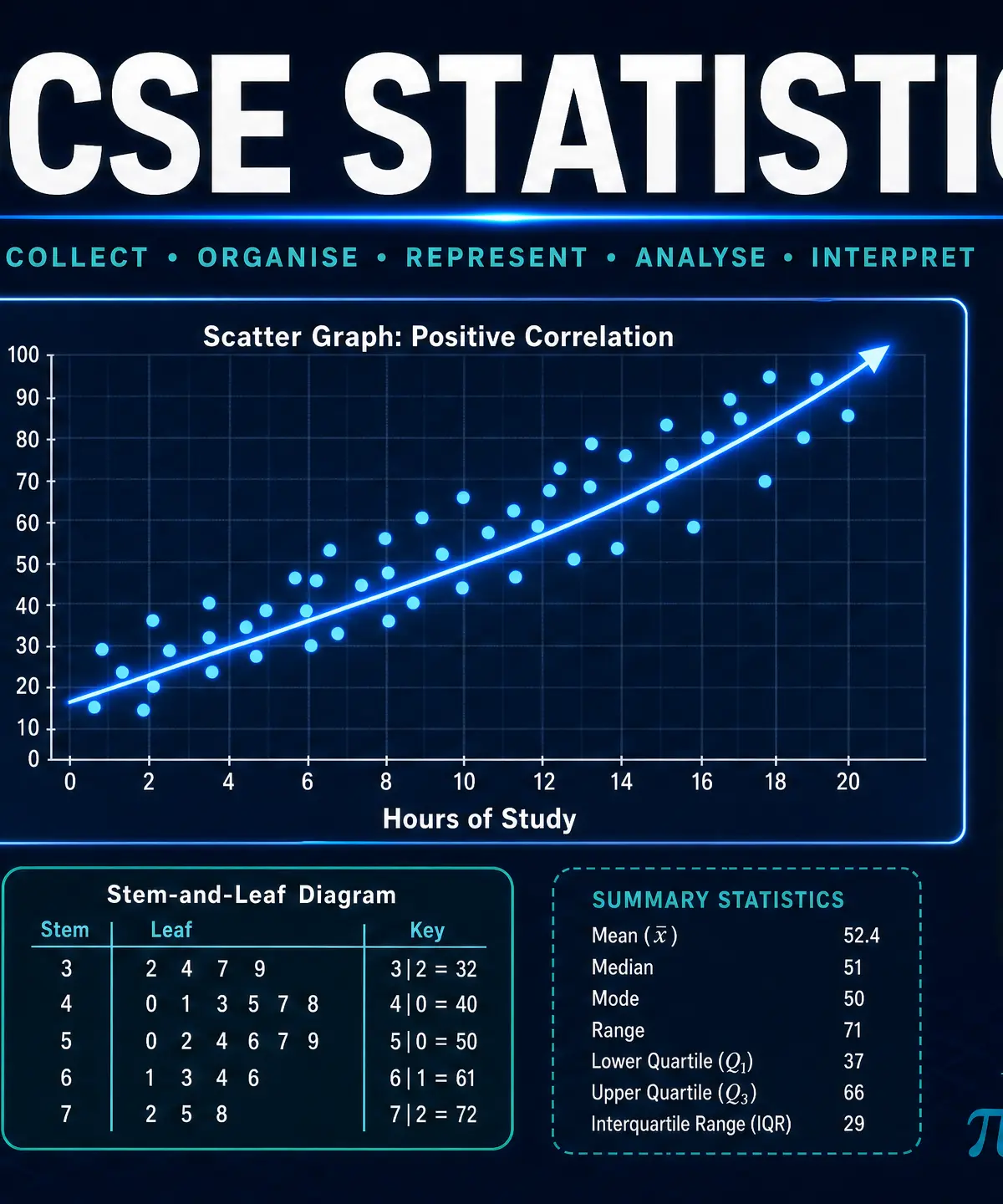
These diagrams are excellent for displaying the shape of a distribution while retaining the original raw data. The 'stem' represents the leading digit(s), and the 'leaf' represents the final digit. A key is absolutely mandatory; without it, the diagram is meaningless and you will lose marks.
Concept 3: Histograms (Higher Tier Focus)
Histograms look like bar charts but are fundamentally different. They are used for continuous data, so there are no gaps between the bars. More importantly, the vertical axis represents frequency density, not frequency. This is because class intervals can be unequal. The area of the bar represents the frequency.
Concept 4: Cumulative Frequency
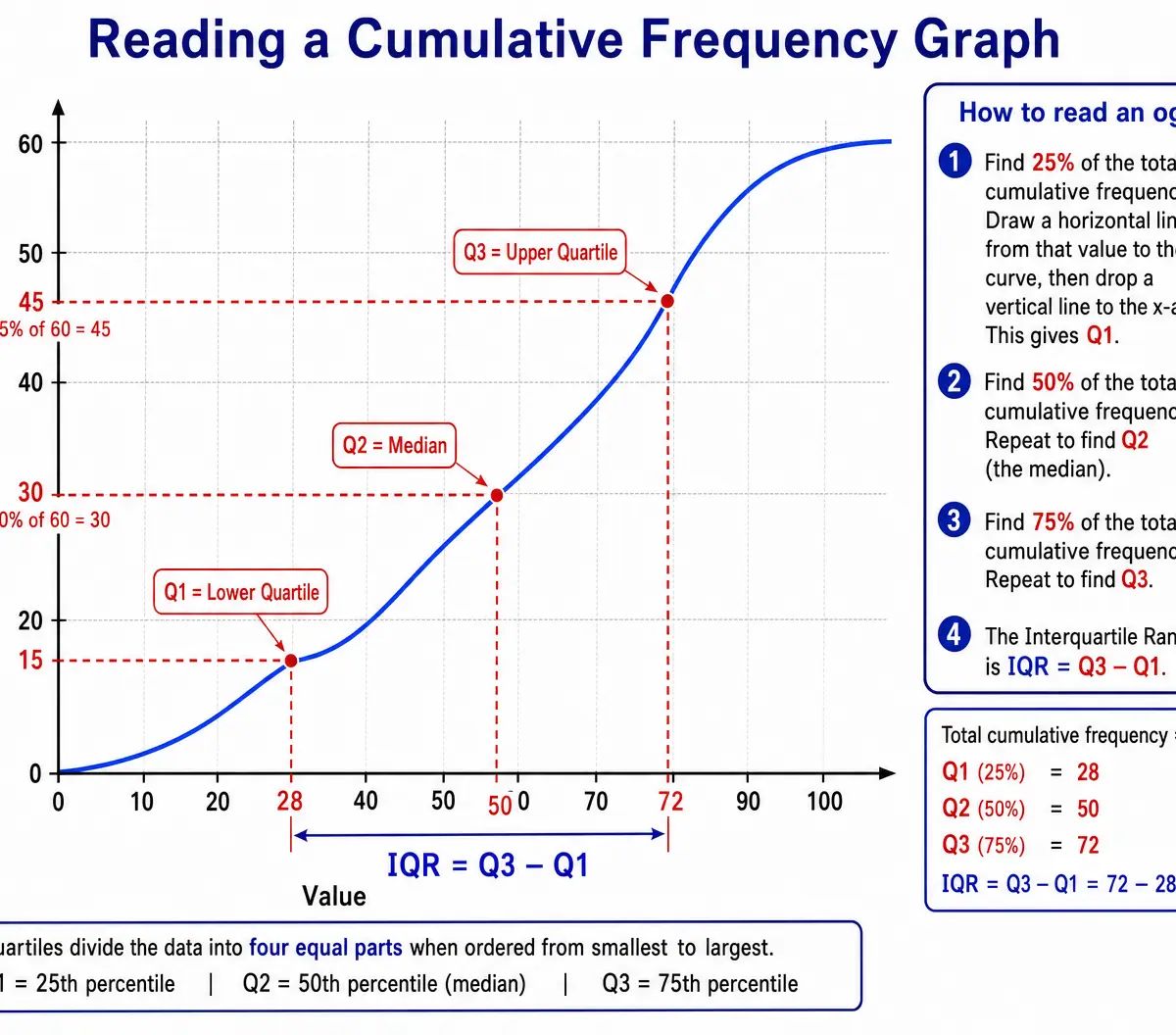
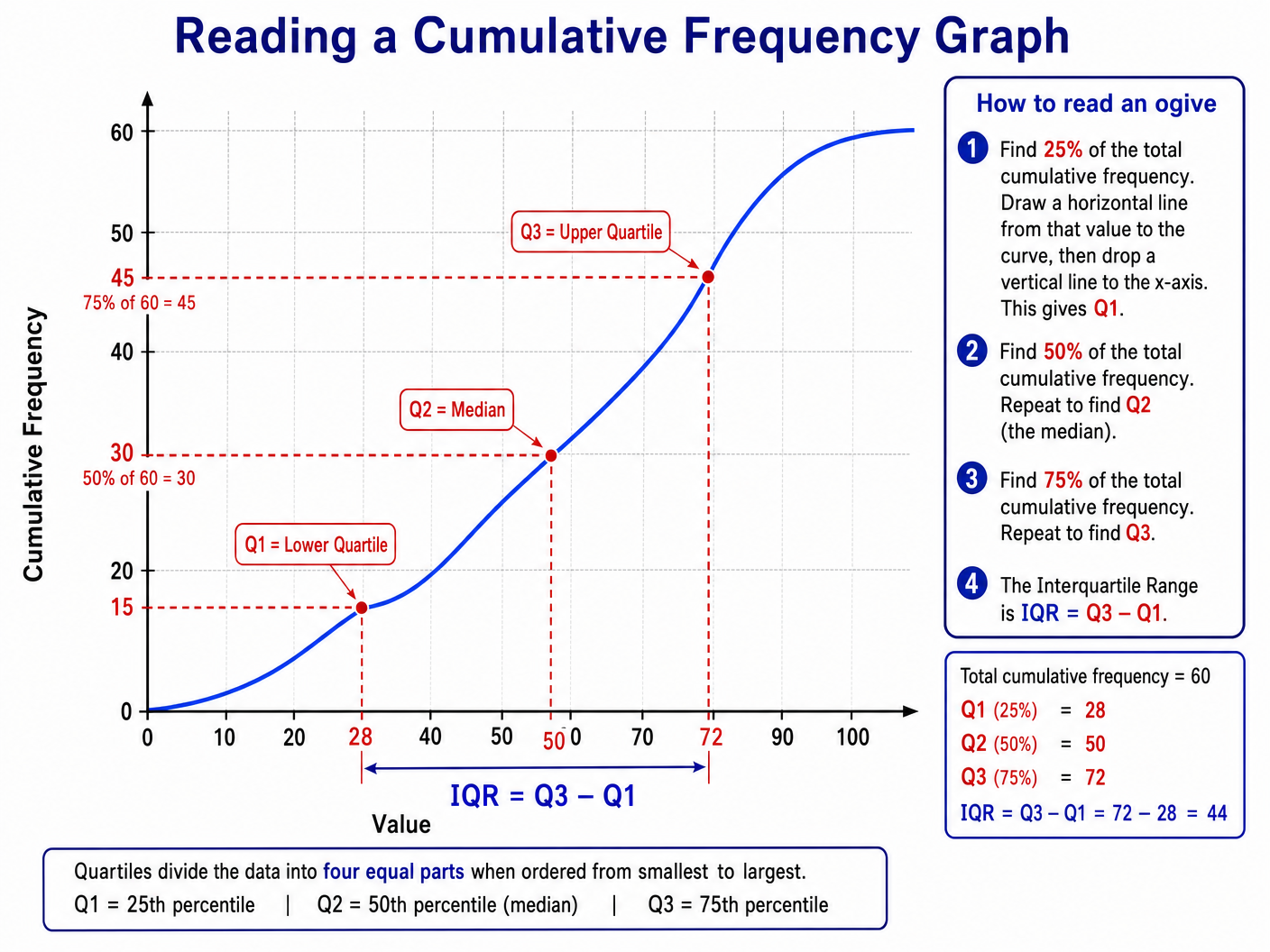
Cumulative frequency is a running total. When plotting a cumulative frequency graph (an ogive), you must plot the cumulative frequency against the upper class boundary of each interval. The resulting S-shaped curve allows you to estimate the median (at 50%), lower quartile (at 25%), and upper quartile (at 75%).
Concept 5: Scatter Graphs and Correlation
Scatter graphs show the relationship between two variables. Correlation can be positive (both increase), negative (one increases as the other decreases), or none. A line of best fit must be drawn with a ruler, pass through the mean point, and have an equal balance of points on either side.
Mathematical/Scientific Relationships
-
Frequency Density Formula:
\text{Frequency Density} = \frac{\text{Frequency}}{\text{Class Width}}
(Must memorise. Used to find the height of histogram bars.) -
Frequency from Histogram:
\text{Frequency} = \text{Frequency Density} \times \text{Class Width}
(Must memorise. Used to find the area of a histogram bar.) -
Pie Chart Angle Formula:
\text{Angle} = \frac{\text{Frequency}}{\text{Total Frequency}} \times 360^{\circ}
(Must memorise.) -
Interquartile Range (IQR):
\text{IQR} = \text{Upper Quartile (Q3)} - \text{Lower Quartile (Q1)}
(Must memorise. Measures the spread of the middle 50% of data.)
Practical Applications
Statistical representation is vital in fields like epidemiology, where histograms show age distributions of diseases, or in finance, where scatter graphs map risk versus return. In geography, cumulative frequency is used to analyse river pebble sizes, proving that maths skills are highly transferable.
Visual Resources
2 diagrams and illustrations
Interactive Diagrams
2 interactive diagrams to visualise key concepts
Conceptual Flow Outline
Decision tree for choosing the correct statistical diagram.
Conceptual Flow Outline
Process for constructing and using a cumulative frequency graph.
Worked Examples
3 worked examples — open one to explore the question and available guidance.
Practice Questions
Test your understanding — click to reveal model answers
A histogram is drawn to represent the weights of 50 apples. The class interval 100 < w \le 120 has a frequency of 15. Calculate the frequency density for this class. (2 marks)
Hint: Remember the formula: Frequency Density = Frequency ÷ Class Width.
A scatter graph shows the relationship between temperature and ice cream sales. The correlation is positive. Describe what this means in context. (2 marks)
Hint: You must mention both variables in your answer.
In a stem-and-leaf diagram, the data values are 12, 15, 15, 21, 24, 30. Write down the median value. (2 marks)
Hint: Find the middle value. If there are two middle values, find halfway between them.
A cumulative frequency graph shows the heights of 80 plants. The median is 45cm and the IQR is 12cm. A second group of 80 plants has a median of 50cm and an IQR of 8cm. Compare the two distributions. (2 marks)
Hint: You need one comment about the average (median) and one comment about the spread (IQR).
The histogram shows information about the time taken by customers to complete a shopping trip. The bar for 10 < t \le 30 has a frequency density of 1.2. Calculate the number of customers in this interval. (2 marks)
Hint: Rearrange the frequency density formula. Area = Frequency.