WJEC · A-Level · Mathematics
Course version: 603/1977/X · Version from Sept 2017
Kinematics
Kinematics turns motion into mathematics: precise definitions become gradients, areas, vectors and calculus. For WJEC A-Level Mathematics 2.2.7, high-scoring candidates choose a direction and a model before choosing an equation, so every line of working earns its marks.
- 10 min read
- 3 worked examples
- 5 practice questions
- 8 key terms
Check what you remember
Read the wording for your board, then hide it and explain Position in your own words. Rough notes are fine. This is a self-check, with no mark or grade.
Reference: WJEC
The location of a particle relative to a chosen origin, normally represented by a signed coordinate or position vector.
Study Notes

WJEC A-Level Mathematics: Kinematics (2.2.7)
Overview
Kinematics is the mathematical language of motion. It answers three linked questions: where is a particle?, how is it moving?, and how is that motion changing? In WJEC questions, candidates are expected to move fluently between precise definitions, graphs, constant-acceleration equations, calculus and vectors. It is not a topic for formula hunting. Marks are awarded for recognising the model first, choosing a direction convention, and then applying the right representation.
This specification point connects strongly to differentiation and integration, vector geometry and trigonometry. Typical questions ask candidates to interpret a graph, calculate displacement or distance, derive velocity from position, integrate acceleration, or model a projectile. A short question may test one definition, while a 5- or 6-mark question often combines component resolution with a clear sequence of equations. Work at roughly one minute per mark, plus a final check of signs, units and direction.
Examiner rule of thumb: a correct numerical answer with an unshown or unjustified method is vulnerable. Show the model, the equation and the substitution so credit can be given for method.
Key Concepts
1. Use the language of kinematics accurately
A position is a signed location relative to an origin. Displacement is the signed change in position, whereas distance travelled is the total length of the route. This distinction is essential when a particle reverses direction. A particle that moves from 0 m to 8 m and then back to 3 m has displacement (+3\text{ m}), but distance travelled (13\text{ m}). The final position controls displacement; the whole journey controls distance.
Velocity is rate of change of displacement, so its sign communicates direction. Speed is the magnitude of velocity and cannot be negative. Acceleration is rate of change of velocity. Therefore, negative acceleration does not automatically mean slowing down. If both velocity and acceleration are negative, the magnitude of the velocity is increasing and the particle is speeding up in the negative direction.
Exam cue: State your positive direction at the start of a vertical or one-dimensional problem. “Take upwards as positive” makes every later sign checkable.
2. Translate graphs into motion
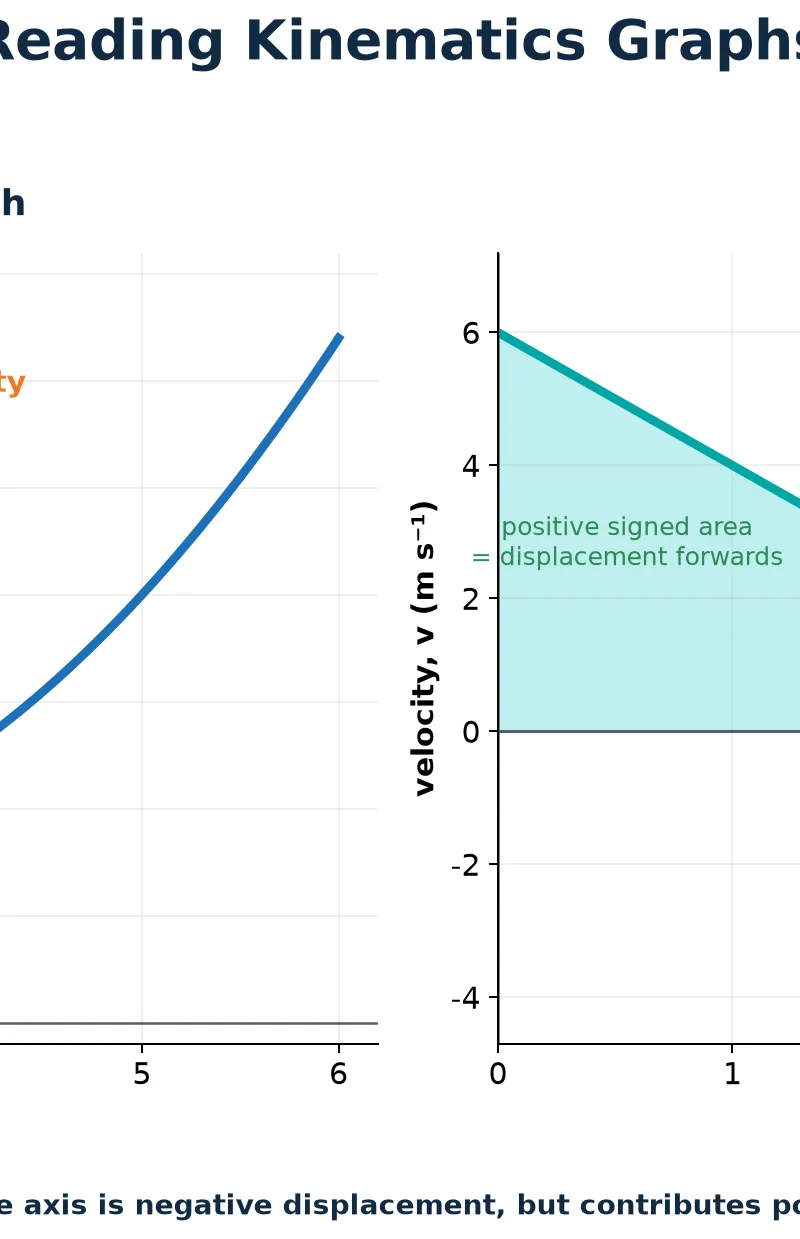
On a displacement–time graph, the gradient is velocity. A horizontal section means the particle is stationary; a straight sloping line means constant velocity; a curve means the velocity is changing. A negative gradient means motion in the negative direction.
On a velocity–time graph, the gradient is acceleration and the signed area between the graph and the time axis is displacement. Area above the axis contributes positive displacement. Area below contributes negative displacement. For distance travelled, add the magnitudes of those areas instead. This is one of the most common 3- or 4-mark traps: candidates lose credit by calling a negative area “negative distance”.
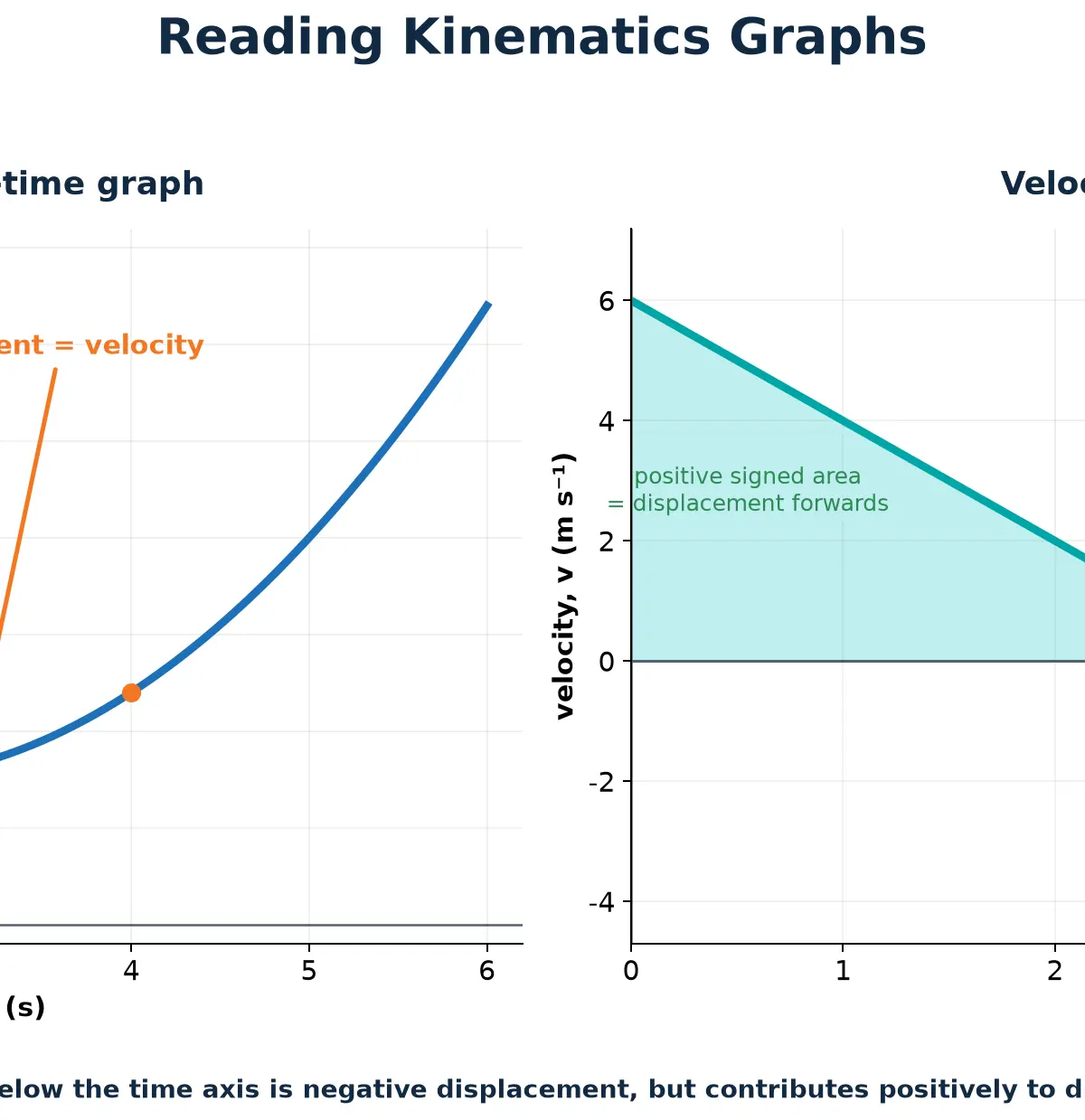
Graph routine for marks:
- Mark where (v=0). A sign change through zero is a change of direction.
- Split areas into labelled triangles, rectangles or trapezia.
- Keep signed areas for displacement; use positive magnitudes for distance.
- State units: gradient of a velocity–time graph is (\text{m s}^{-2}); area is (\text{m}).
3. Use constant-acceleration equations only when the model permits
When acceleration is constant in one dimension, define (s) as displacement, (u) as initial velocity, (v) as final velocity, (a) as acceleration and (t) as time. The equations are not alternatives to thinking. First list the known quantities and the required quantity. Select an equation containing only one unknown after substitution.
For vertical motion near Earth, use (g=9.8\text{ m s}^{-2}). If upwards is positive, (a=-9.8\text{ m s}^{-2}). At the highest point of a vertical projection, vertical velocity is zero, but acceleration remains (-9.8\text{ m s}^{-2}). Candidates often incorrectly set both to zero.
Model check: SUVAT is valid only when acceleration is constant over the interval. A varying acceleration function is a calculus problem, not a SUVAT problem.
4. Let calculus describe variable motion
If position is (r(t)), then (v=\frac{dr}{dt}) and (a=\frac{dv}{dt}=\frac{d$^2r}{dt^2}). Differentiation moves forward through the chain:$
[r \longrightarrow v \longrightarrow a.]
Integration goes backwards. If (a) is given, integrate to obtain (v), include a constant, apply the initial velocity, then integrate again to obtain (r), using the initial position. The constant of integration has physical meaning: it represents missing information about the start of the motion.
Example of the method: if (a=6t-4), then (v=3t^2-4t+C). Given (v=3) at (t=0), (C=3). Do not omit the line that finds (C): it is where method credit is secured.
5. Resolve projectiles before calculating
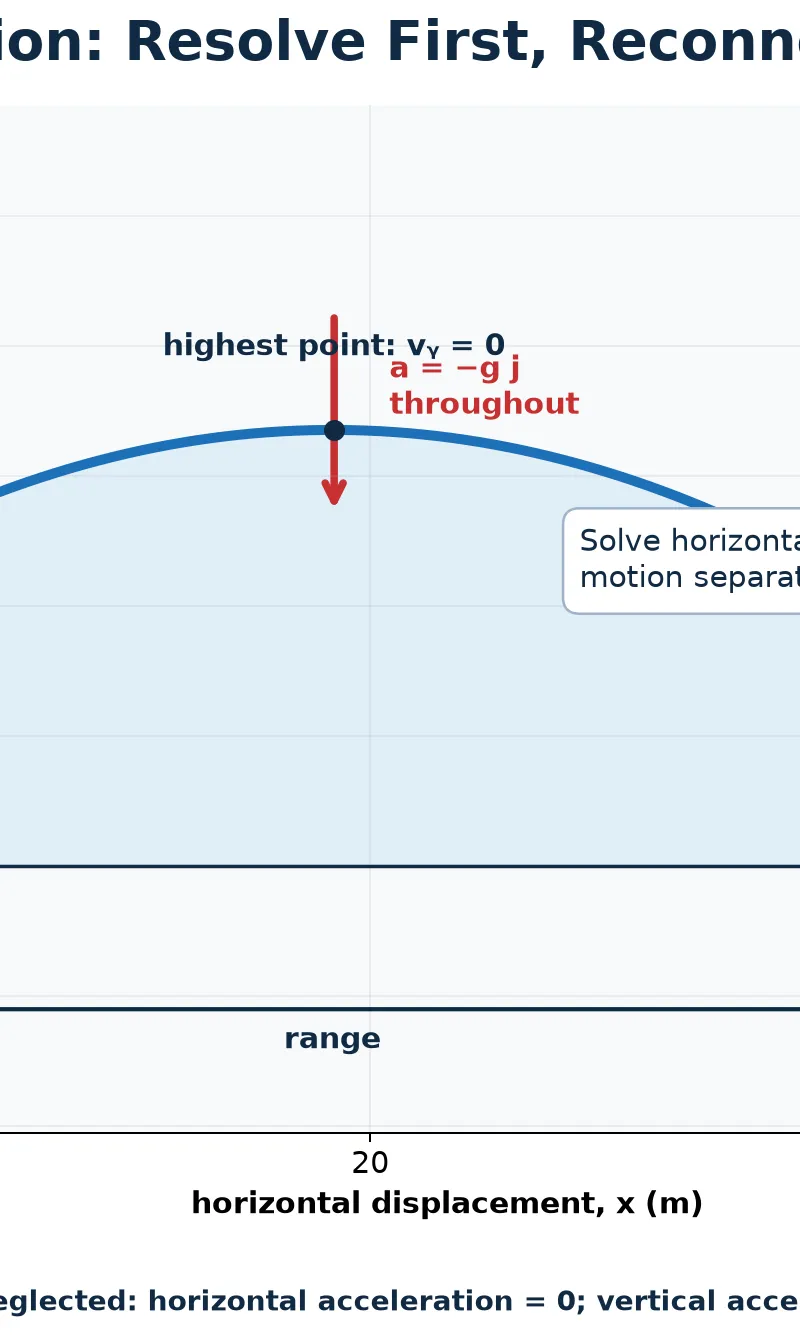
A projectile moving freely under gravity has two simultaneous component motions. They share the same time, but the equations are applied separately.
- Horizontal: (a_x=0), so horizontal velocity is constant.
- Vertical: (a_y=-g) if upwards is positive.
- Initial velocity (u) at angle (\theta) resolves to (u\cos\theta) horizontally and (u\sin\theta) vertically.
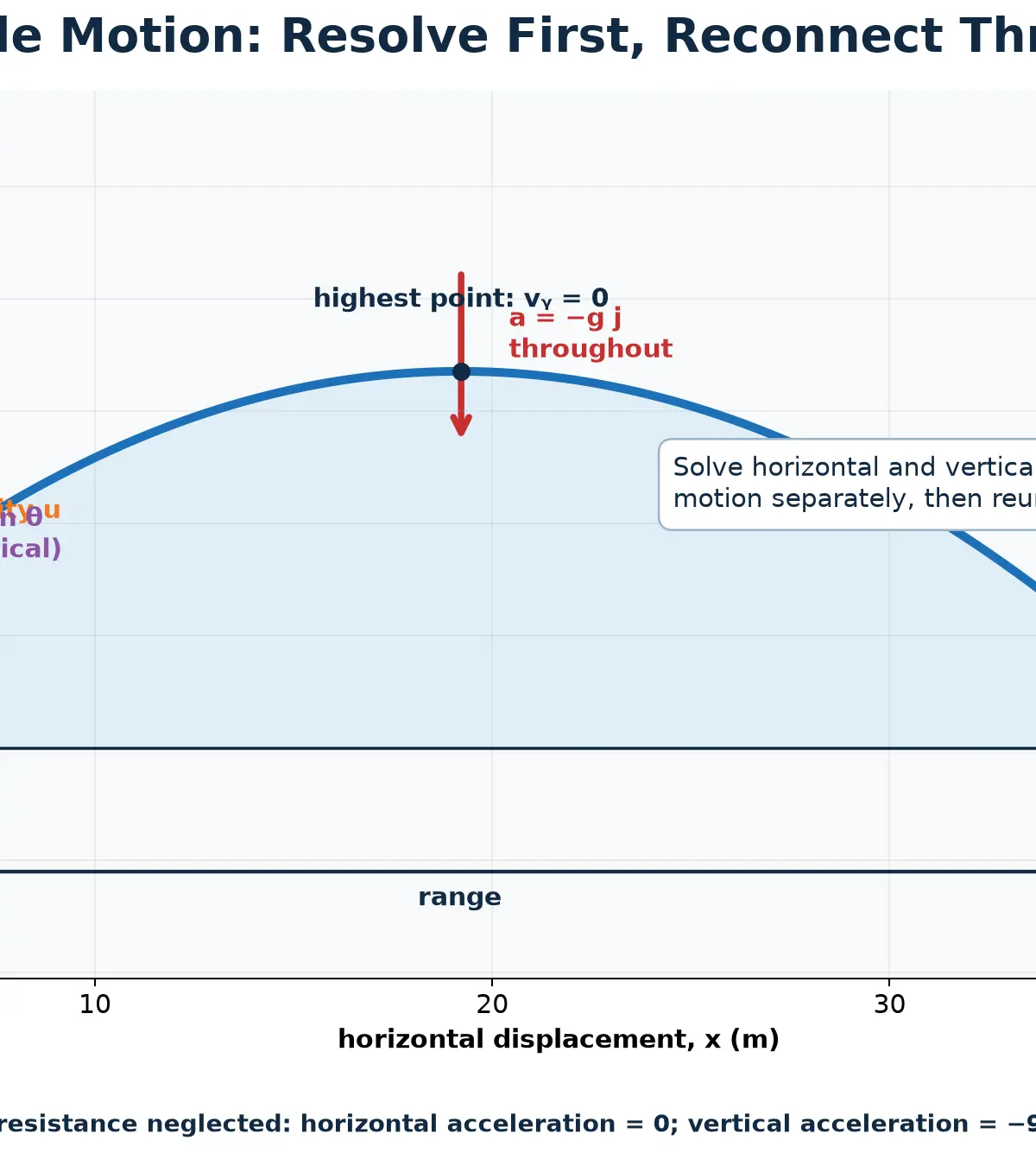
Use a small labelled sketch before writing equations. Find a vertical time, then substitute it into the horizontal equation for range, or obtain two expressions for time and equate them. At the greatest height, (v_y=0), but the horizontal component (v_x) is unchanged. The overall speed is (\sqrt{v_x^2+v_y^2}); its direction follows from (\tan^{-1}(v_y/v_x)), with sensible attention to the quadrant.
Memory phrase: Resolve, run separately, reunite with time. This prevents the error of placing the full launch speed directly into a vertical equation.
6. Turn command words into a mark-winning plan
Before calculating, identify what the command word requires. State normally needs one exact fact, such as “the acceleration is (-9.8\text{ m s}^{-2})”. Calculate requires a visible relationship, substitution, working and units. Show that requires enough unrounded working for the stated answer to emerge; do not begin by writing the printed target. Find the speed asks for a non-negative magnitude, while find the velocity requires direction or a signed component/vector.
For a 3-mark graph question, a reliable plan is: identify the relevant gradient or area, calculate it, then interpret it with units. For a 5- or 6-mark projectile question, a reliable plan is: draw the path, resolve the launch velocity, state the acceleration in each component, solve for a shared time, then report the requested quantity. If a question says “hence”, carry forward the earlier result at full calculator accuracy unless the wording asks for a rounded value.
Use a reasonableness audit before moving on. Time is normally non-negative. A range should be horizontal distance, not a vertical height. A scalar speed should not carry a negative sign, while a signed velocity may. If an answer is physically impossible in the stated model, revisit the positive direction, the component resolution or an algebraic root. This final audit takes seconds and protects the final answer mark.
Keep calculator values in full precision during a multi-stage calculation, then round once at the end to the precision requested in the question.
Mathematical Relationships and Formula-Sheet Status
The WJEC GCE Mathematics formula booklet provides differentiation and integration tables, but it does not supply the kinematics formulae below. Treat the formulae marked “Must memorise” as retrieval-practice material.
| Relationship | Meaning and use | Status |
|---|---|---|
| (v=u+at) | Constant acceleration: final velocity after time (t) | Must memorise |
| (s=ut+\tfrac12at^2) | Constant acceleration: displacement after time (t) | Must memorise |
| (v^2=u^2+2as) | Constant acceleration when time is absent | Must memorise |
| (s=\tfrac12(u+v)t) | Displacement using average velocity | Must memorise |
| (v=\frac{dr}{dt}), (a=\frac{dv}{dt}) | Connect position, velocity and acceleration | Must memorise |
| (r=\int v,dt), (v=\int a,dt) | Recover position or velocity, including constants | Must memorise |
| (\mathbf{u}=u\cos\theta,\mathbf{i}+u\sin\theta,\mathbf{j}) | Resolve a launch velocity in a vertical plane | Must memorise |
| (\mathbf{a}=-g\mathbf{j}) | Projectile model with upwards positive | Must memorise |
| Standard derivative and integral tables | Carry out differentiation/integration once the motion relationship is chosen | Given in the WJEC formula booklet |
Units worth checking: (1\text{ m s}^{-1}) is velocity, (1\text{ m s}^{-2}) is acceleration, (g=9.8\text{ m s}^{-2}), and angles used in vector resolution must be in the mode expected by the question, usually degrees. A displacement is in metres, not (\text{m s}^{-1}).
Practical Applications and Modelling
Kinematics models sporting trajectories, lifts, braking distances, robotics and animated motion. In every context, identify the simplifying assumptions. “Particle” means size and rotation are ignored. “Moves freely under gravity” means air resistance is negligible. “Constant acceleration” is a mathematical assumption that must be justified by the wording, not guessed from the topic title.
There is no required practical within this mathematics specification point. However, graph-reading and modelling skills are examined. A reasonable model has an explicit origin, a stated positive direction, compatible units and a conclusion interpreted in the original context. If the answer would imply a negative time or a launch angle below the horizontal when that does not fit the situation, revisit the algebra and signs.
Audio Revision Companion
Use this approximately ten-minute recap after completing the worked examples. Pause before the quick-fire questions and answer aloud, rather than recognising the answer passively.
Visual Resources
2 diagrams and illustrations
Interactive Diagrams
2 interactive diagrams to visualise key concepts
Conceptual Flow Outline
Choose the mathematical tool from the model, rather than selecting a formula before reading the motion.
Conceptual Flow Outline
Projectile workflow: resolve the initial velocity, model components separately, then reconnect them using time.
Worked Examples
3 worked examples — open one to explore the question and available guidance.
Practice Questions
Try the question, then reveal an answer plan or example response
A particle moves from position −2 m to 7 m, then to 1 m. State its displacement and its distance travelled. [3 marks]
Hint: Displacement compares only start and finish. Distance adds both stages.
For 0 ≤ t ≤ 4, a particle has velocity v = 4 − 2t m s⁻¹. Calculate its displacement and distance travelled over the interval. [3 marks]
Hint: Find when v = 0, then use two triangular signed areas.
A particle has initial velocity 5 m s⁻¹ and constant acceleration 3 m s⁻² for 4 s. Calculate its final velocity and displacement. [3 marks]
Hint: Use v = u + at, then s = ut + ½at².
The position of a particle is r = t³ − 6t² + 9t metres. Find its velocity and acceleration at t = 1 s, and state whether it changes direction at that instant. [4 marks]
Hint: Differentiate position once, then again. Use the sign of velocity either side of t = 1.
A ball is projected at 18 m s⁻¹ at 40° above the horizontal. Neglect air resistance. Calculate the initial horizontal and vertical components of velocity, then find the maximum height above the launch point. Take g = 9.8 m s⁻². [5 marks]
Hint: Resolve first. At maximum height, vertical velocity is zero, but horizontal velocity is unchanged.
Exam technique
How to turn what you know into marks
How to approach the question
Read for the model before writing equations. State a positive direction, identify whether acceleration is constant, sketch graphs or projectile components where useful, list known variables, then select one justified relationship. Keep more figures until the final answer.
How to structure your answer
For 1–2 marks, state the definition or relationship precisely with units. For 3–4 marks, show the model, formula, substitution and conclusion. For 5–6 marks, add a labelled sketch or component resolution, declare assumptions/sign convention, and make each transition visible so method credit can be awarded.
Timing
Aim for approximately 1 minute per mark. Allow a final 20–30 seconds to check signs, units and whether the answer is displacement, distance, speed or velocity.
Common pitfalls
- Treating area below a velocity–time axis as negative distance. Avoid it by calculating signed displacement first, then adding absolute areas for distance.
- Applying SUVAT to variable acceleration. Avoid it by checking whether a is a constant or a function of time/position before choosing a method.
- Forgetting the constant of integration. Avoid it by writing + C immediately on every indefinite integral and applying the stated initial condition on the next line.
- Using the full launch speed in a vertical projectile equation. Avoid it by resolving into u cos θ and u sin θ before any SUVAT calculation.
What the command words want
- Compare
- Identify a similarity and a difference, for example displacement is signed whereas distance is a non-negative total.
- Explain
- Link a mathematical fact to a conclusion using ‘because’, for example ‘the particle changes direction because velocity changes sign’.
- Describe
- Report what the graph or motion does, using direction, gradient, curvature and turning points where relevant.
- Evaluate
- State model assumptions, test whether they are reasonable for the context, and give a justified judgement.
- Calculate
- Show a relationship, substitute values, preserve accuracy, state a final answer and include units.
- State/Give
- Give a brief, exact definition or value. Do not add an ambiguous explanation that changes the meaning.
Watch or listen (optional)
Test your understanding of Kinematics
Active recall beats re-reading. Take an instant quiz now to test what you’ve learned and lock it into long-term memory.
7 days Premium · Then the free plan continues · No card, no charge