Study Notes
Overview
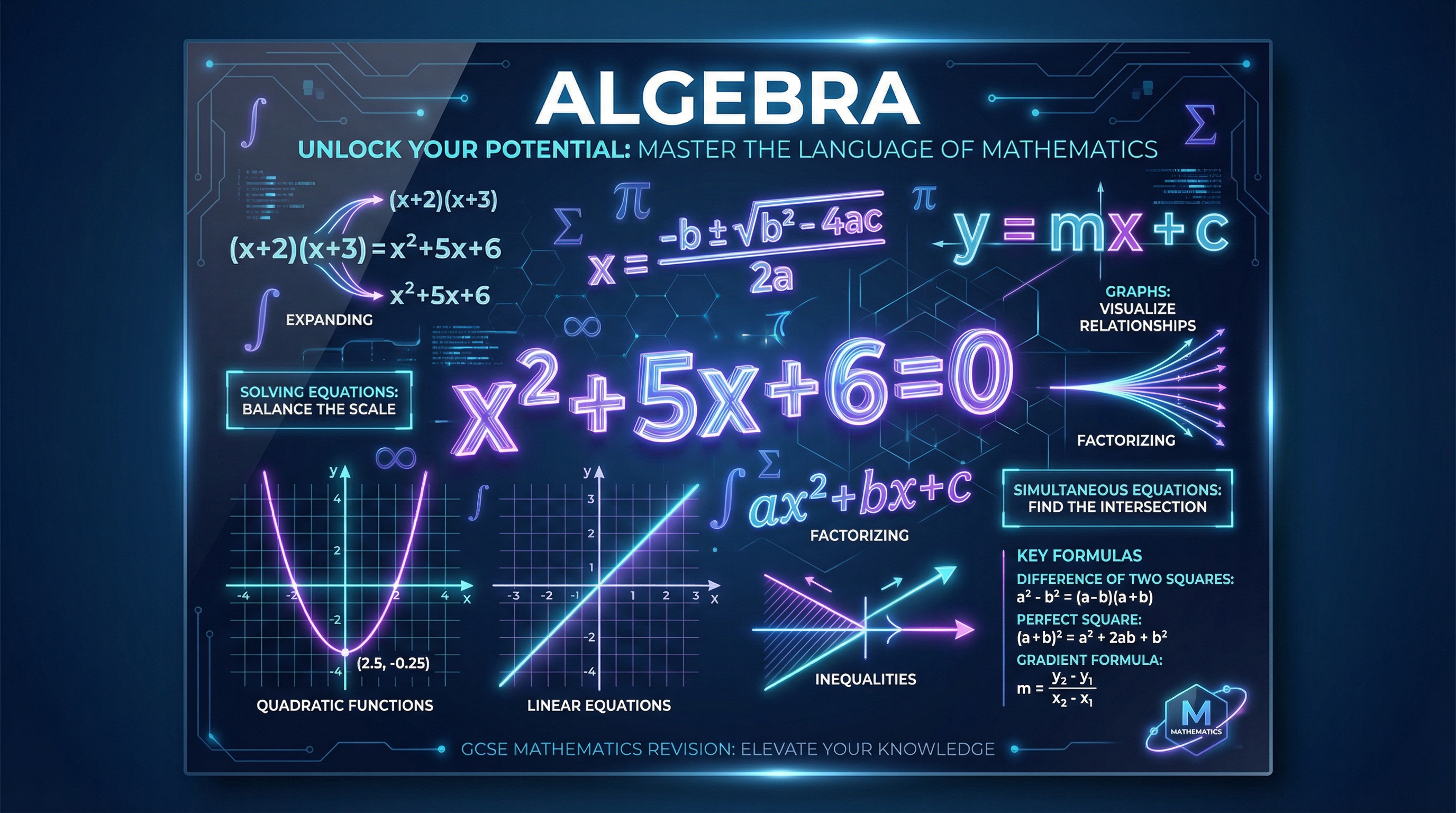
Algebra forms the structural backbone of the GCSE Mathematics specification. Rather than calculating with specific numbers, algebra allows candidates to work with general rules, patterns, and unknown values using letters. This topic is heavily weighted in both Foundation and Higher tiers, typically accounting for 20-30% of the total marks available across the papers.
Mastering algebra is not just about memorising rules; it is about developing logical, step-by-step problem-solving skills. The examiner will look for clear, methodical working out, and method marks are frequently awarded even when the final answer is incorrect. Algebra connects deeply with other topics, particularly Geometry (e.g., finding the equation of a line or calculating missing angles) and Probability (e.g., setting up equations to find unknown probabilities).
Typical exam questions range from straightforward skills tests like expanding brackets and factorising, to complex, multi-step problem-solving questions where candidates must form their own equations from a given context before solving them.
Key Concepts
Concept 1: Simplifying and Manipulating Expressions
Before you can solve equations, you must be fluent in manipulating expressions. An expression is a collection of terms without an equals sign (e.g., 3x + 4y - 2). The fundamental rule here is collecting like terms. "Like terms" must have the exact same letter(s) raised to the exact same power.
Why it works: Think of variables as objects. If you have 3 apples (3a) and someone gives you 2 more apples (2a), you have 5 apples (5a). However, you cannot combine apples (a) and bananas (b). Similarly, x and x^2 represent different dimensions (a line vs. an area) and cannot be added together.
Example: Simplify 4x + 3y - x + 5y
Step 1: Group the x terms: 4x - x = 3x
Step 2: Group the y terms: 3y + 5y = 8y
Final Answer: 3x + 8y
Concept 2: Expanding Brackets
Expanding brackets involves multiplying the term on the outside by every term on the inside. For double brackets, every term in the first bracket must be multiplied by every term in the second bracket. This is crucial for quadratic expressions.
Why it works: Expanding brackets is an application of the distributive property of multiplication. Geometrically, expanding (x+2)(x+3) is equivalent to finding the total area of a rectangle with sides (x+2) and (x+3) by calculating the areas of its four smaller rectangular sections.
Example: Expand and simplify (x + 4)(x - 2)
First: x \times x = x^2
Outer: x \times -2 = -2x
Inner: 4 \times x = 4x
Last: 4 \times -2 = -8
Simplify: x^2 - 2x + 4x - 8 = x^2 + 2x - 8
Concept 3: Factorising
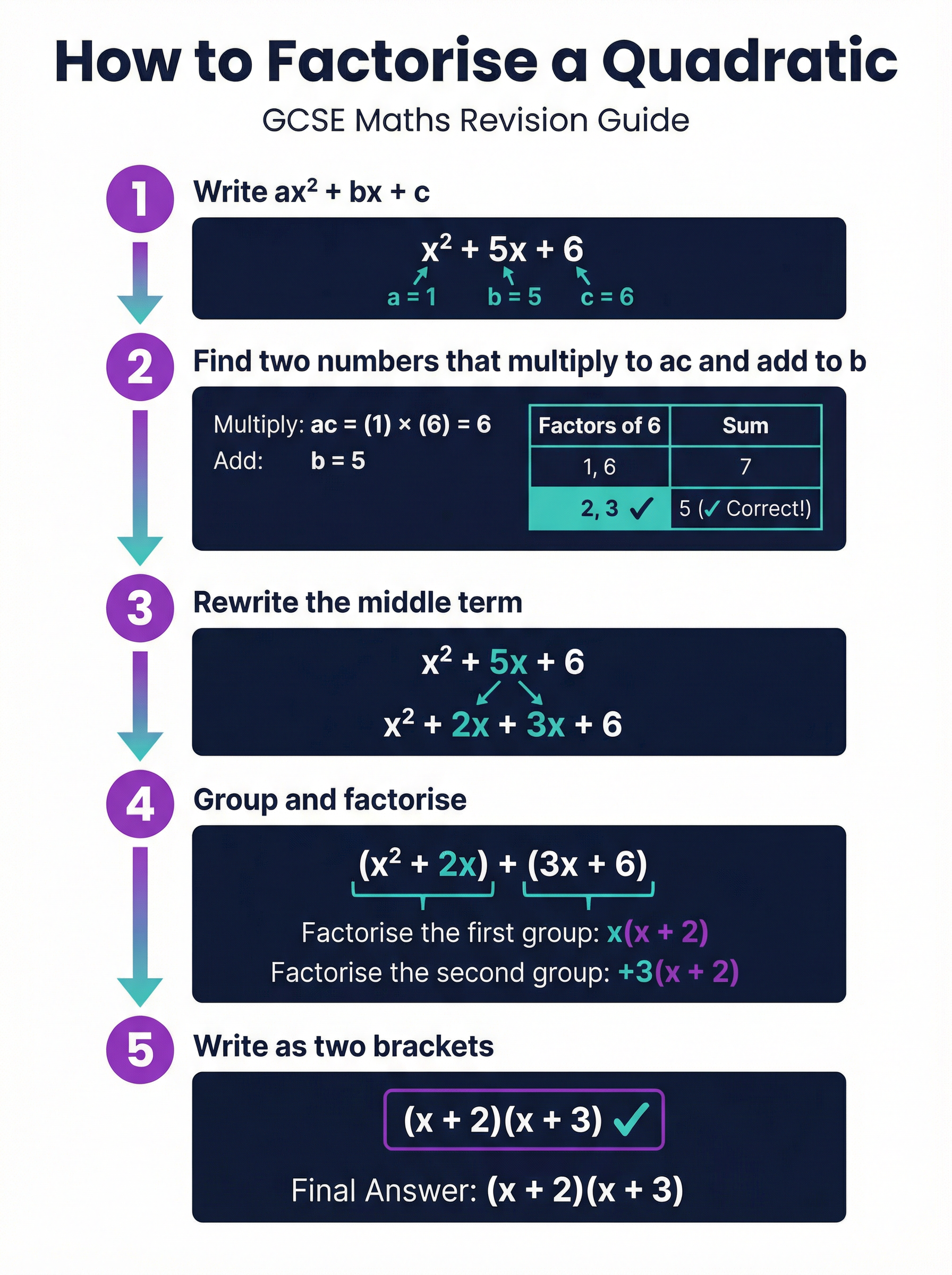
Factorising is the exact reverse of expanding. It means taking an expression and writing it as a product of its factors, introducing brackets. For quadratics (ax^2 + bx + c), you are typically looking for two numbers that multiply to give c and add to give b.
Why it works: Factorising breaks down a complex expression into simpler building blocks (factors). This is essential for solving quadratic equations, because if two brackets multiply to equal zero, one of those brackets MUST equal zero (the zero product property).
Concept 4: Solving Equations
An equation states that two expressions are equal. To "solve" an equation means to find the specific value(s) of the unknown variable that makes the statement true. The golden rule is balance: whatever operation you perform on one side of the equals sign, you must perform on the other.
Why it works: An equation is like a balanced set of scales. If you remove a weight from the left side, the scales tip. To restore balance, you must remove the exact same weight from the right side.
Example: Solve 3(2x - 1) = 21
Step 1: Expand the bracket: 6x - 3 = 21
Step 2: Add 3 to both sides: 6x = 24
Step 3: Divide by 6: x = 4
Concept 5: Simultaneous Equations
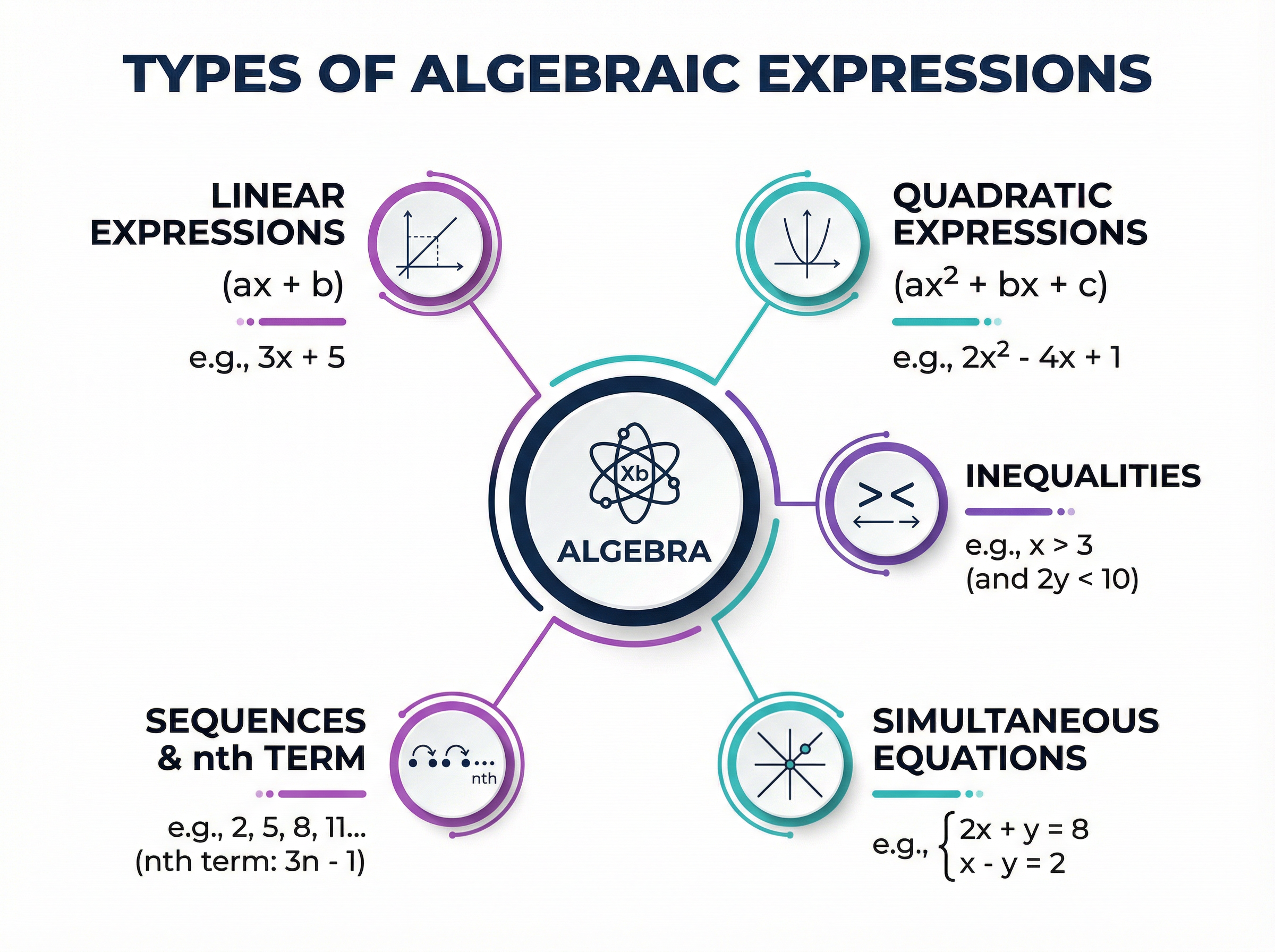
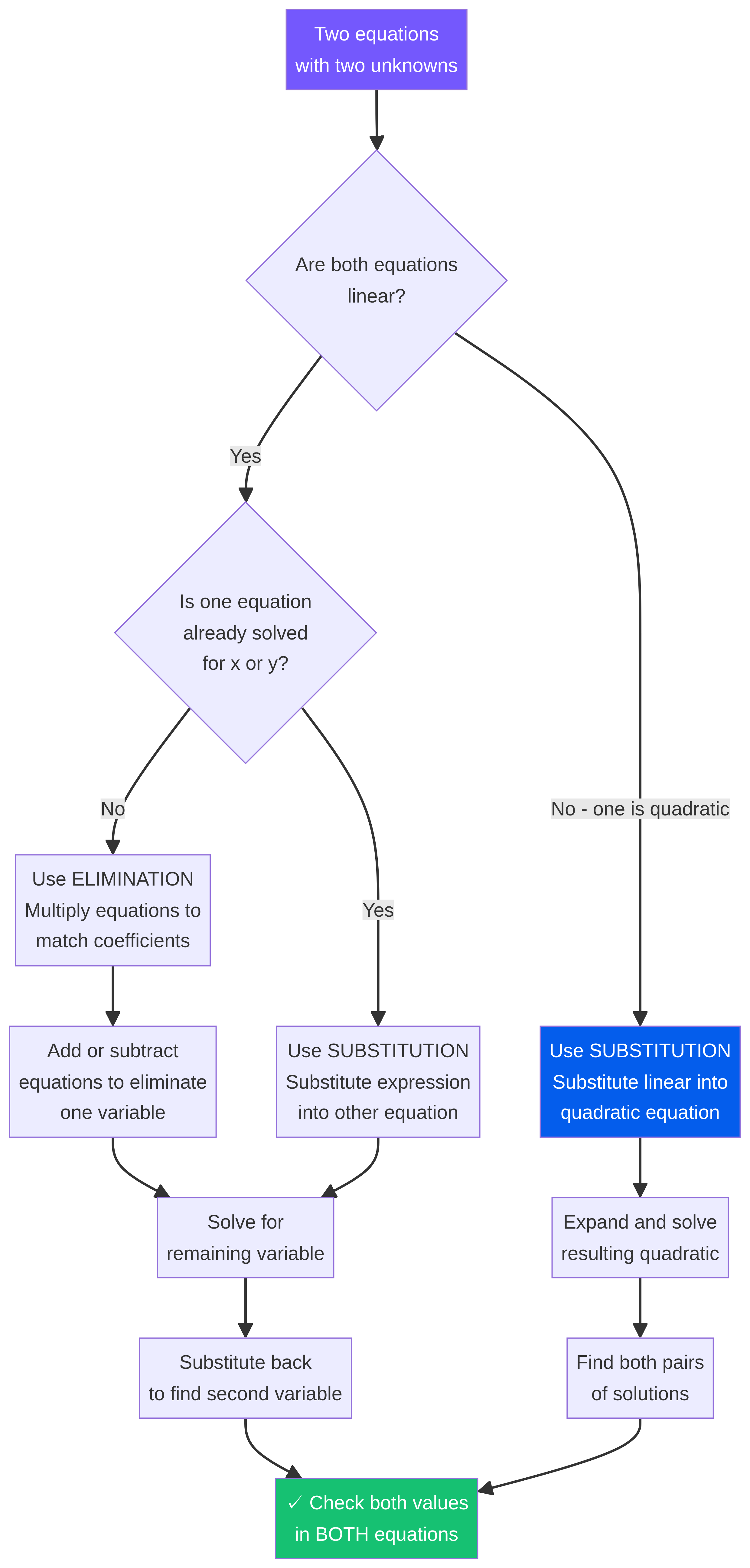
Sometimes you have two unknowns (e.g., x and y) and two different equations linking them. You must find the pair of values that satisfies both equations at the same time. The most common method is elimination, where you manipulate the equations so that adding or subtracting them eliminates one of the variables.
Why it works: Graphically, each linear equation represents a straight line. The solution to a pair of simultaneous equations is the exact (x, y) coordinate where the two lines intersect.
Concept 6: Sequences
A sequence is an ordered list of numbers following a specific rule. The most common type at GCSE is an arithmetic (or linear) sequence, which increases or decreases by a constant amount each time. Candidates must be able to find the n^{th} term formula, which allows you to calculate any term in the sequence without writing out the whole list.
Why it works: The n^{th} term relates the position of the number in the sequence (n) to its value. The common difference becomes the multiplier for n, and you adjust by finding what the "zero term" would be.
Concept 7: Inequalities
Inequalities are similar to equations but represent a range of values rather than a single specific value. They use symbols like < (less than) and \ge (greater than or equal to).
Why it works: Inequalities follow the same balancing rules as equations, with one critical exception: multiplying or dividing by a negative number reverses the direction of the inequality sign. This is because multiplying by a negative reflects values across zero on the number line (e.g., 3 < 5, but -3 > -5).
Mathematical/Scientific Relationships
The following formulas and relationships are critical for this topic:
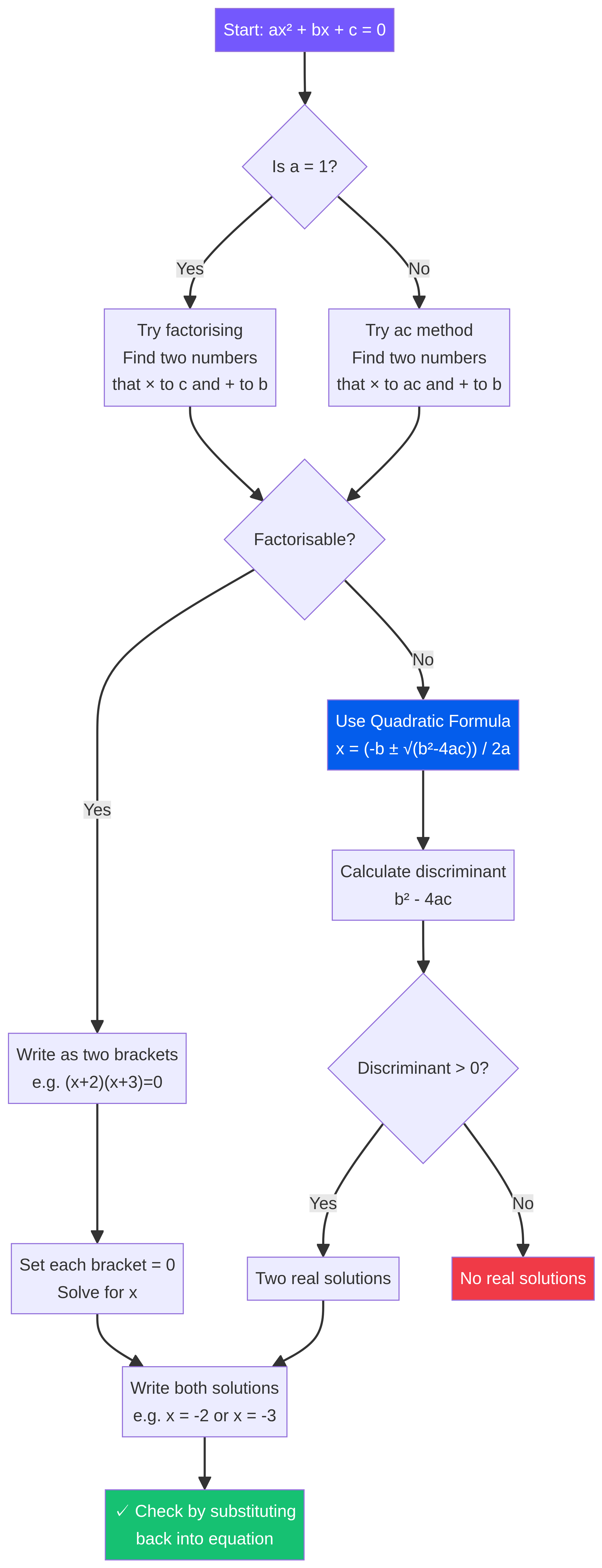
- Quadratic Formula: x = \frac{-b \pm \sqrt{b^2 - 4ac}}{2a}
- What it means: Solves any quadratic equation ax^2 + bx + c = 0.
- When to use: Use when a quadratic equation cannot be easily factorised. (Given on the formula sheet for most boards, but candidates must know how to substitute values correctly).
- Difference of Two Squares: a^2 - b^2 = (a - b)(a + b)
- What it means: A specific pattern for factorising quadratics where there is no middle 'x' term and both terms are perfect squares separated by a minus sign.
- When to use: Quickly factorising expressions like x^2 - 25 into (x-5)(x+5). (Must memorise).
- n^{th} Term of an Arithmetic Sequence: n^{th} \text{ term} = dn + (a - d)
- What it means: d is the common difference, a is the first term.
- When to use: To find the general rule for a sequence that goes up or down by the same amount each time. (Must memorise).
- Equation of a Straight Line: y = mx + c
- What it means: m is the gradient (steepness), c is the y-intercept (where the line crosses the y-axis).
- When to use: When plotting linear graphs or finding the equation from a drawn line. (Must memorise).
Practical Applications
While algebra often feels abstract, it is the underlying language for modeling the real world:
- Finance and Business: Calculating break-even points, profit margins, and compound interest rates relies heavily on algebraic formulas and exponential growth models.
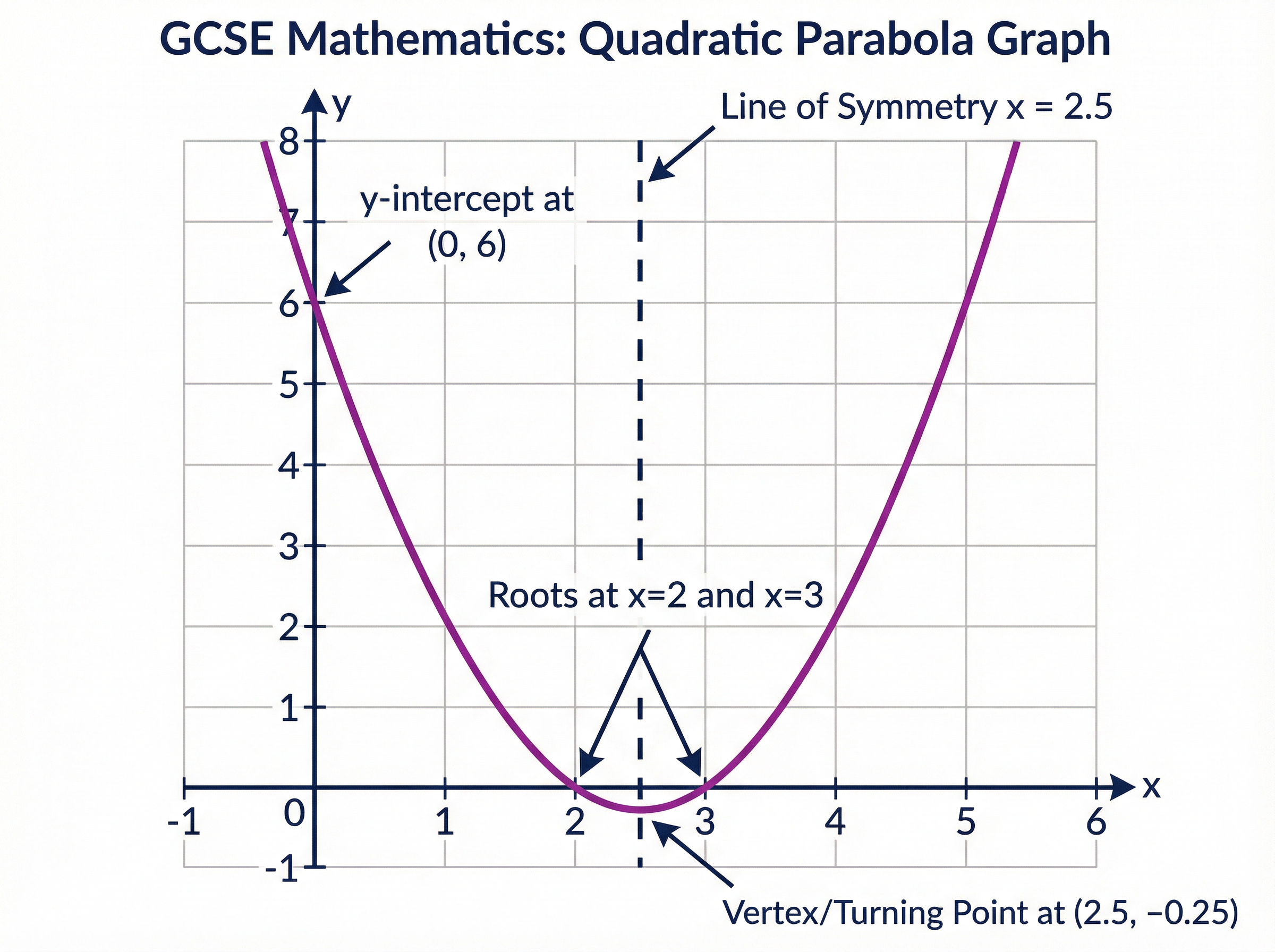
- Engineering and Physics: Designing structures requires solving complex simultaneous equations to balance forces. The trajectory of a thrown object (like a football or a missile) is modeled perfectly by a quadratic parabola.
- Computer Science: Algorithms and programming logic are fundamentally built on algebraic variables, boolean logic (inequalities), and iterative sequences.
Listen to our podcast episode to reinforce these concepts:
Visual Resources
5 diagrams and illustrations
Interactive Diagrams
2 interactive diagrams to visualise key concepts
Conceptual Flow Outline
Decision flowchart for solving quadratic equations.
Conceptual Flow Outline
Method selection for simultaneous equations.
Worked Examples
3 detailed examples with solutions and examiner commentary
Practice Questions
Test your understanding — click to reveal model answers
Simplify fully: 3a + 4b - a + 2b
Hint: Group the 'a' terms together and the 'b' terms together. Remember the sign belongs to the term immediately after it.
Expand and simplify: 3(x - 2) + 2(4x + 1)
Hint: Expand each bracket separately first, then collect the like terms.
Solve the inequality: 5 - 2x > 13
Hint: Treat it like an equation, but remember the special rule if you divide by a negative number.
The n^{th} term of a sequence is 3n - 2. Find the first three terms of the sequence.
Hint: Substitute $n=1$, then $n=2$, then $n=3$ into the formula.
Solve algebraically the simultaneous equations:
y = x^2 + 3x - 5
y = 2x + 1
Hint: Since both equations are equal to 'y', you can set them equal to each other to form a single quadratic equation.