AQA · A-Level · Music
20th and 21st Century Music (Key Composers, Characteristics, Styles)
Appraising Music is the core analytical skill underpinning GCSE and A-Level Music. It requires candidates to listen critically, identify musical elements, and evaluate how composers use them to create effect and meaning within historical contexts.
- 7 min read
- 3 worked examples
- 3 practice questions
- 6 key terms
Check what you remember
Read the wording for your board, then hide it and explain Diatonic in your own words. Rough notes are fine. This is a self-check, with no mark or grade.
Reference: AQA
Notes that belong to the current key of the music, without any chromatic alterations.
Study Notes

Overview
Appraising music is the cornerstone of your musical education. It is not merely about deciding whether you 'like' a piece of music; rather, it is the rigorous process of dismantling a composition to understand its inner workings. As a candidate, you are expected to act as a musical detective, listening actively to identify specific features, describing them with precise terminology, and analysing how they contribute to the overall effect. This skill is assessed directly in the listening examination, but it also fundamentally informs your own performing and composing coursework. By understanding how masterful composers manipulate musical elements, you can apply these techniques to your own creative work.
Key Knowledge & Theory
Core Concepts: The Musical Elements
The foundation of appraising music is a comprehensive understanding of the musical elements. These are the building blocks of all compositions. Examiners will award marks to candidates who can accurately identify these elements and explain their function.
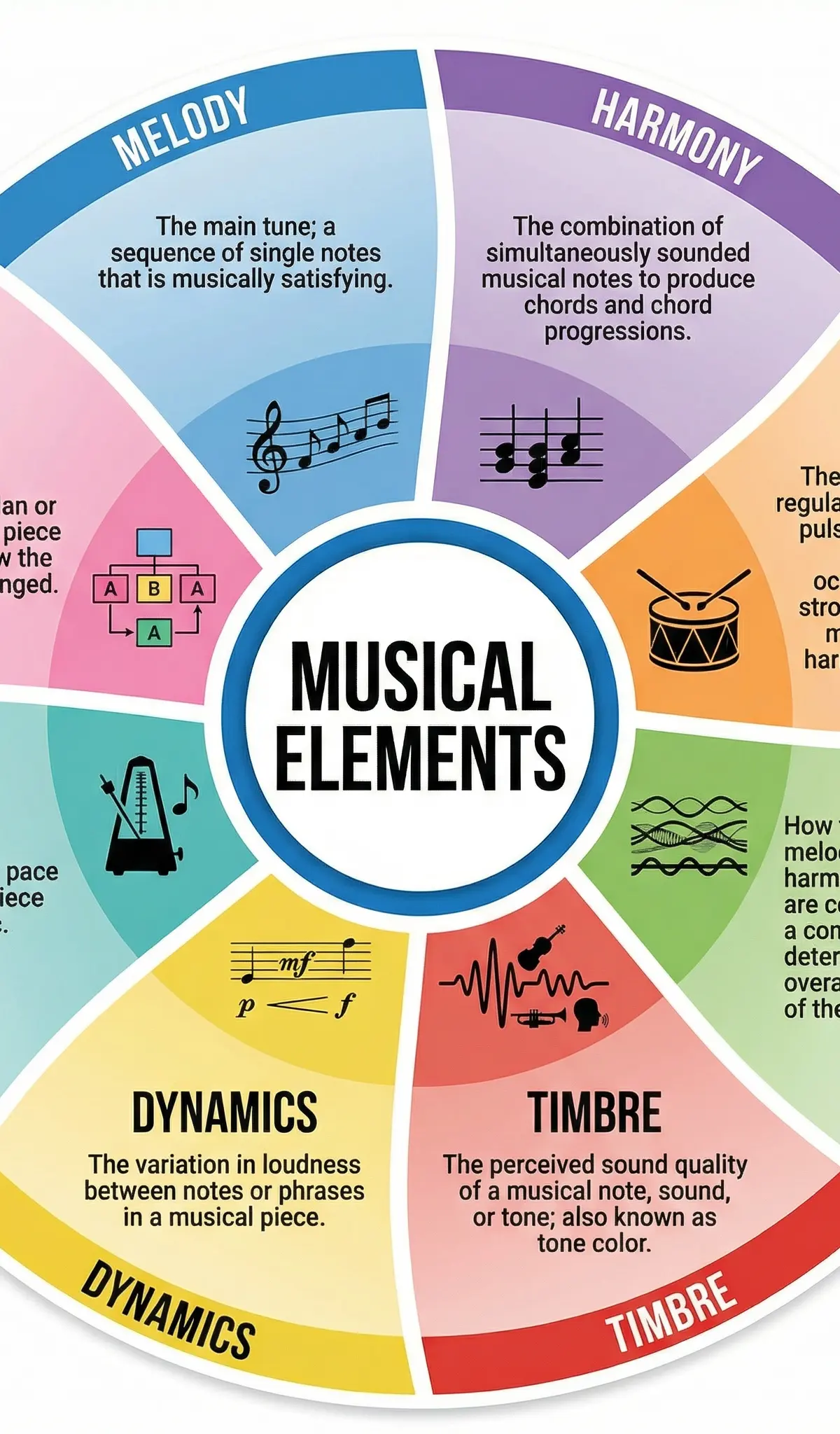
Melody: The primary tune or sequence of single notes. You must consider its contour (conjunct/stepwise or disjunct/leaping), range (narrow or wide), and the use of motifs and sequences.
Harmony and Tonality: The chordal structure and key. Is the tonality major, minor, modal, or atonal? Look for modulations (key changes), cadences (perfect, imperfect, plagal, interrupted), and the use of dissonance or chromaticism to create tension.
Rhythm, Metre, and Tempo: The organisation of time. Rhythm refers to note lengths, metre to the time signature (e.g., simple, compound, irregular), and tempo to the speed. Consider how syncopation, cross-rhythms, or changes in tempo affect the music's momentum.
Texture: How the musical layers interact. Key terms include monophonic (single line), homophonic (melody and accompaniment), polyphonic/contrapuntal (multiple independent lines), and heterophonic.
Timbre and Sonority: The unique tone colour of instruments or voices. This includes playing techniques (e.g., pizzicato, arco, con sordino) and the overall sound quality produced by specific combinations of instruments.
Dynamics and Articulation: The volume and how notes are played. Use terms like pianissimo, fortissimo, crescendo, and diminuendo for dynamics, and staccato, legato, or marcato for articulation.
Structure and Form: The overall architecture of the piece. Common forms include binary (AB), ternary (ABA), rondo (ABACA), strophic, and sonata form. Understanding structure helps you navigate the piece and identify how themes are developed.
Instrumentation: The specific forces used. Is it a string quartet, a full symphony orchestra, or a jazz combo? How does the composer exploit the different sections to create contrast?
Key Practitioners/Artists/Composers
| Name | Period/Style | Key Works | Relevance |
|---|---|---|---|
| J.S. Bach | Baroque | Brandenburg Concertos | Master of polyphonic texture, complex counterpoint, and functional harmony. Essential for understanding early Western classical traditions. |
| L.v. Beethoven | Classical/Romantic | Symphony No. 5 | Pivotal figure bridging two eras. Demonstrates thematic development, structural expansion, and the expressive use of dynamics and instrumentation. |
| Claude Debussy | Impressionism | Prélude à l'après-midi d'un faune | Broke traditional harmonic rules. Use of whole-tone scales, parallel chords, and focus on timbre/sonority over functional harmony. |
| John Williams | Film Music | Star Wars, Jurassic Park | Exemplifies the use of leitmotifs, full orchestral forces, and late-Romantic harmonic language to create specific emotional and narrative effects. |
Technical Vocabulary
To access the higher mark bands, candidates MUST use precise, subject-specific terminology. Avoid vague descriptions.
- Instead of "it gets louder," use crescendo.
- Instead of "the tune goes up and down," describe the melodic contour as having ascending leaps or descending conjunct movement.
- Instead of "different tunes playing at once," use polyphonic texture.
- Instead of "it sounds sad," state that it is in a minor tonality with dissonant harmony.
Practical Skills
Techniques & Processes: The Appraising Framework
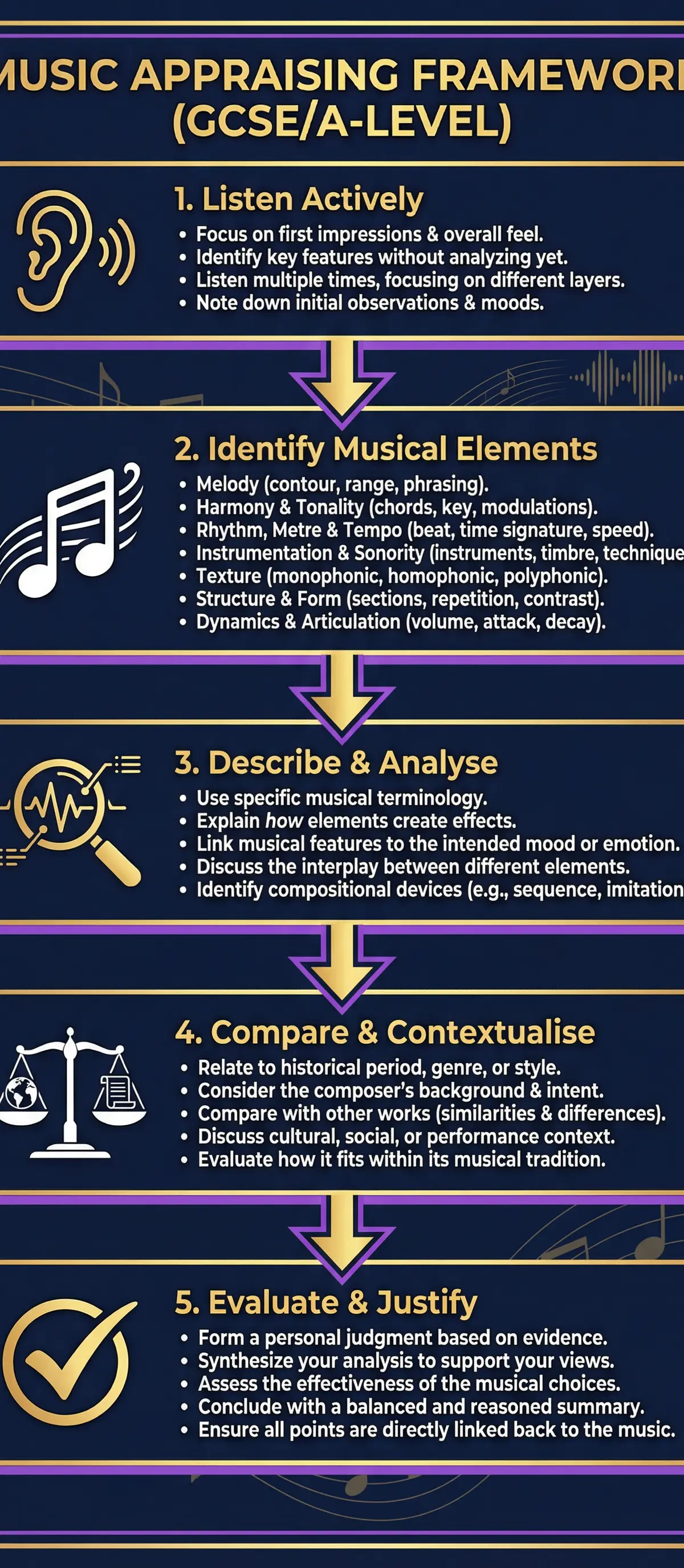
When faced with an unfamiliar listening extract or a set work essay, employ a systematic approach:
- Listen Actively: Do not merely hear the music; listen with intent. On the first hearing, identify the broad strokes: tempo, mood, performing forces, and overall texture.
- Identify Musical Elements: On subsequent hearings, focus on specific elements. Listen for the bassline to determine harmony, track the main melody, and note the rhythmic patterns.
- Describe & Analyse: Use your technical vocabulary to describe what is happening. More importantly, analyse how these elements interact. For example, how does a sudden forte dynamic combined with a dissonant chord create a specific dramatic effect?
- Compare & Contextualise: Relate the music to its historical period, genre, or the composer's other works. How does it conform to or break the conventions of its time?
- Evaluate & Justify: Form a reasoned judgement about the effectiveness of the music, supported entirely by the musical evidence you have identified.
Materials & Equipment
Your primary equipment is your ear, supported by a thorough knowledge of the score (if applicable) and your glossary of terms. For written exams, practice reading full orchestral scores, identifying transposing instruments, and following complex textures visually as well as aurally.
Portfolio/Coursework Guidance
Assessment Criteria
While appraising is primarily assessed in the written/listening exam, it directly impacts your coursework. Examiners look for:
- Analytical Depth: In composition logs or performance evaluations, can you accurately describe your own work using the same rigorous terminology applied to set works?
- Application of Knowledge: Have you successfully applied techniques learned through appraising (e.g., a specific harmonic progression or textural device) to your own compositions?
Building a Strong Portfolio
When writing program notes or composition logs, explicitly link your creative decisions to your appraising studies. For example: "I utilised a polyphonic texture in the B section, inspired by Bach's fugal writing, to create a sense of intellectual complexity before returning to the homophonic A section."
Exam Component
Written Exam Knowledge
The listening and appraising paper tests your ability to identify features aurally and apply theoretical knowledge under timed conditions. Questions range from short-answer identification (e.g., "Name the cadence at bar 12") to extended essay responses requiring comparison and contextual analysis.
Practical Exam Preparation
To prepare, you must practice active listening daily. Use past papers to familiarise yourself with the speed at which extracts are played and the specific phrasing of questions. Create summary sheets for each set work, categorised by the musical elements (MHRTTDSI), ensuring you have at least three specific musical examples for each element.
Interactive Diagrams
1 interactive diagram to visualise key concepts
Conceptual Flow Outline
The Active Listening Process
Worked Examples
3 worked examples — open one to explore the question and available guidance.
Practice Questions
Try the question, then reveal an answer plan or example response
Listen to the extract. Identify the time signature and describe the rhythmic character of the melody. (4 marks)
This prompt needs an extract from your set text. Use the extract provided by your teacher or exam paper; this question card does not include one.
Hint: Count the beats in a bar. Is it grouped in 2s, 3s, or 4s? Listen to where the accents fall in the melody.
Explain how the composer uses instrumentation and texture to build to the climax at the end of this section. (6 marks)
Hint: Track what happens from the start of the section to the end. Which instruments are added? How does the texture change from thin to thick?
Evaluate the success of the composer's use of harmony to reflect the sombre mood of the text in this vocal piece. (8 marks)
Hint: Identify the specific chords and harmonic devices used. How do they sound? Connect those sounds directly to the meaning of the words being sung.
Exam technique
How to turn what you know into marks
How to approach the question
Always read the question BEFORE the extract is played. Annotate the question to highlight exactly what elements you need to listen for. Use the first listen for an overview, and subsequent listens to pinpoint specific details and evidence.
How to structure your answer
For extended answers, use the I-D-A-E framework. Dedicate a paragraph to each major musical element relevant to the question. Always provide a specific musical example (e.g., an instrument, a bar number, a specific chord) for every point you make.
Timing
Aim for approximately 1-1.5 minutes per mark in written/listening papers. Use the playing time of the extracts efficiently.
Common pitfalls
- Describing the music without analysing its effect (e.g., 'it gets louder' instead of 'the crescendo builds tension').
- Using non-musical, vague language ('it sounds spooky' or 'it has a nice beat').
- Failing to address all parts of a comparison question.
- Listing features randomly without structuring the answer logically.
What the command words want
- Analyse
- Break the music down into its constituent elements and discuss how they interact to create the overall sound.
- Compare
- Explicitly state similarities AND differences between two or more pieces, focusing on specific musical elements.
- Explain
- Say HOW or WHY the composer used a feature, linking the musical fact to its effect.
- Describe
- Give a detailed account of what the music sounds like using subject vocabulary.
- Evaluate
- Make a reasoned judgement about the success or effect of the music, supported by specific evidence.
- Identify
- State the correct musical term briefly. No explanation needed.
Watch or listen (optional)
Test your understanding of 20th and 21st Century Music (Key Composers, Characteristics, Styles)
Active recall beats re-reading. Take an instant quiz now to test what you’ve learned and lock it into long-term memory.
7 days Premium · Then the free plan continues · No card, no charge