Pearson Edexcel · GCSE · Music
Course version: Pearson-GCSE-Music · Version from Mar 2026
Appraising
This study guide covers everything you need to know for Component 3: Appraising in your GCSE Music exam. It breaks down the core musical elements, structural concepts, and essential vocabulary required to analyse both set works and unfamiliar pieces, helping you secure top marks in your listening paper.
- 6 min read
- 3 worked examples
- 4 practice questions
- 6 key terms
Check what you remember
Read the wording for your board, then hide it and explain Syncopation in your own words. Rough notes are fine. This is a self-check, with no mark or grade.
Reference: Pearson Edexcel
Placing the rhythmic accent or emphasis on a weak beat or off-beat.
Study Notes
Overview
Component 3: Appraising is the listening and appraising paper of your GCSE Music qualification. This component assesses your ability to listen to music, describe what you hear using precise technical vocabulary, and understand the historical and cultural contexts of various musical styles. The exam requires you to apply your knowledge of musical elements to both familiar set works and completely unfamiliar pieces of music.
Key Knowledge & Theory
The Eight Musical Elements
To succeed in this component, you must master the eight core musical elements. These are the building blocks of all musical analysis.
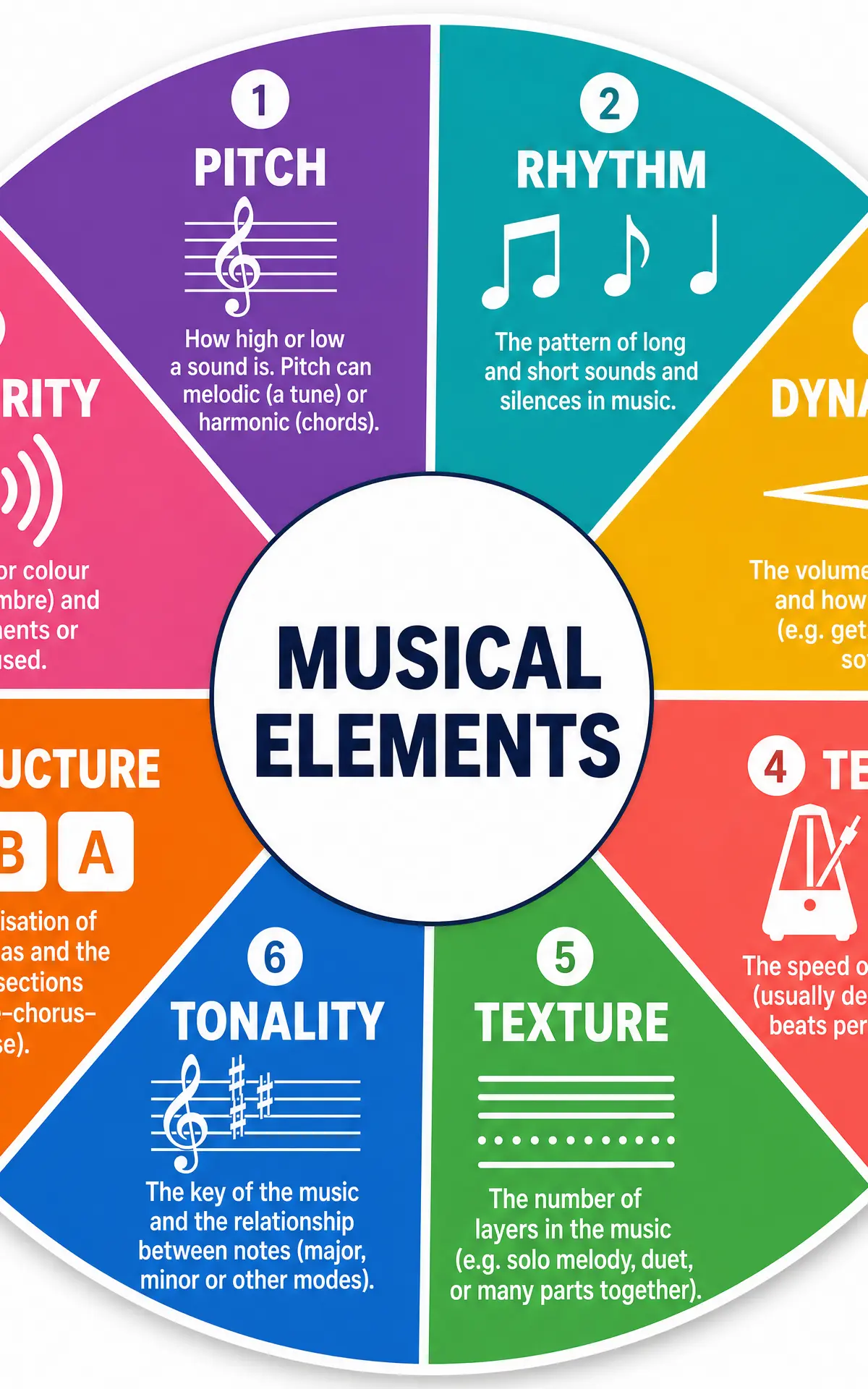
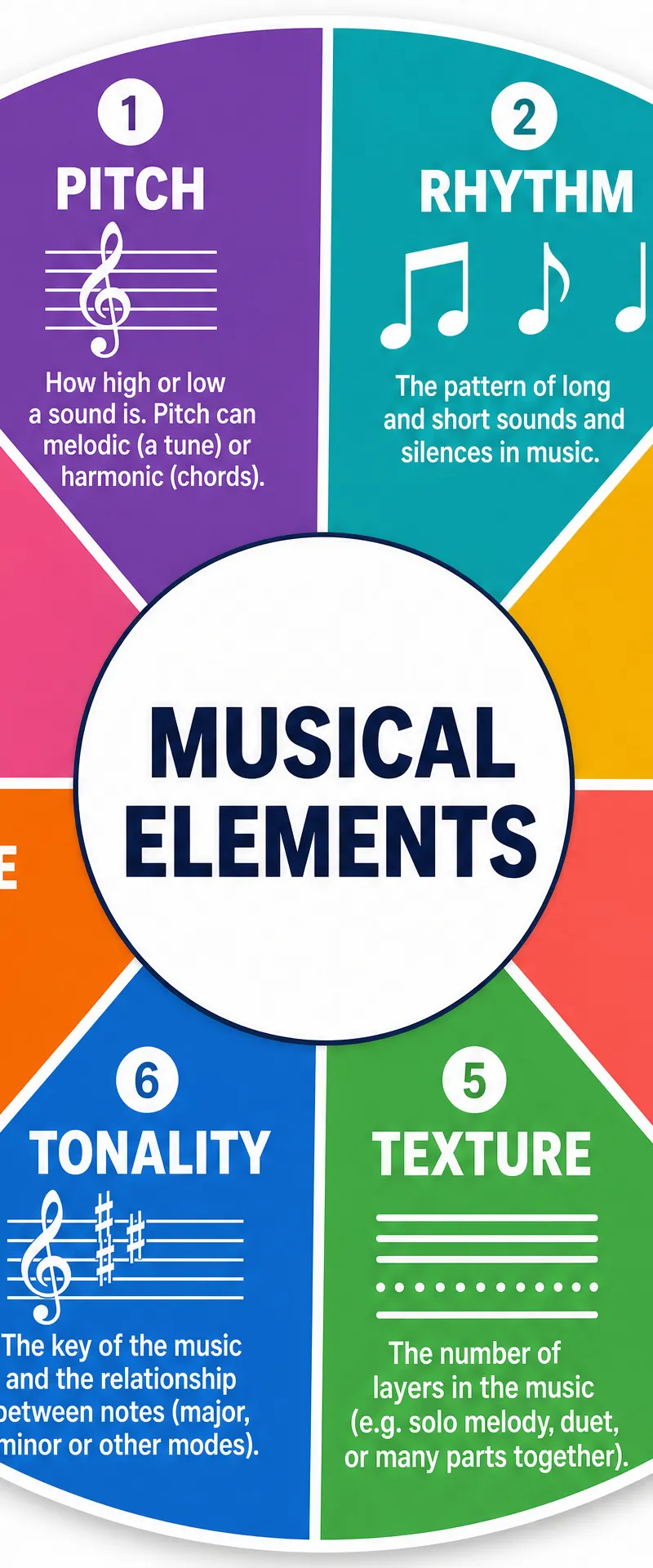
- Pitch and Melody: How high or low notes are, and how they are organised into tunes. Key concepts include intervals, scales, melodic motion (stepwise/conjunct vs. leaping/disjunct), and melodic devices like sequences and ostinati.
- Rhythm and Metre: The pattern of long and short sounds, and how beats are grouped. Essential terms include syncopation, dotted rhythms, triplets, cross-rhythms, and time signatures (simple vs. compound time).
- Structure: How a piece of music is organised into sections. Common forms include binary (AB), ternary (ABA), rondo (ABACA), strophic (A A A), verse-chorus, and through-composed.
- Texture: How different layers of sound interact. You must use specific terms: monophonic (single line), homophonic (melody and chords), polyphonic/contrapuntal (multiple independent lines), and heterophonic (simultaneous variations of one melody).
- Tempo: The speed of the music. Use Italian terms such as Largo (very slow), Andante (walking pace), Allegro (fast), and Presto (very fast).
- Dynamics: The volume of the music. Use Italian terms and symbols from pianissimo (pp) to fortissimo (ff), including crescendo (getting louder) and diminuendo (getting quieter).
- Sonority (Timbre): The quality or 'colour' of the sound produced by specific instruments or voices. This includes identifying instrument families, specific techniques (e.g., pizzicato, con sordino), and electronic effects.
- Tonality and Harmony: The key of the music (major, minor, modal, atonal) and the chords used. You must recognise primary chords (I, IV, V), cadences (perfect, imperfect, plagal, interrupted), and harmonic devices like pedal notes.
Key Practitioners and Styles
While specific set works vary by exam board, you will typically study music across four Areas of Study. Here is a general framework:
| Area of Study | Period/Style | Key Features | Relevance |
|---|---|---|---|
| Western Classical Tradition (1650-1910) | Baroque, Classical, Romantic | Functional harmony, established structures (sonata form, concerto), orchestral development | Forms the foundation of Western musical theory and notation. |
| Popular Music | Rock, Pop, Musical Theatre, Film Music | Verse-chorus structures, electronic sonorities, syncopation, hook-driven melodies | Demonstrates the evolution of music technology and commercial composition. |
| Traditional Music | Folk, World Music (e.g., Bhangra, Calypso, Samba) | Oral traditions, unique instruments (e.g., sitar, djembe), complex cross-rhythms | Highlights cultural contexts and non-Western scales/structures. |
| Western Classical Tradition (Since 1910) | 20th Century, Minimalism, Serialism | Atonality, experimental sonorities, rhythmic complexity, phase shifting | Challenges traditional rules of harmony and structure. |
Technical Vocabulary
Examiners heavily penalise vague language. You must use specialist terminology. For example:
- Instead of "getting faster", write "accelerando".
- Instead of "thick texture", write "dense polyphony" or "rich homophonic texture".
- Instead of "jumpy tune", write "disjunct melody".
- Instead of "clashing notes", write "dissonance".
Practical Skills: Listening and Appraising
Dictation Techniques
Dictation (writing down the pitch or rhythm of a melody you hear) is a challenging practical skill that requires regular practice.
- Rhythmic Dictation: Always establish the metre first. Tap your foot to the pulse. Subdivide the beat in your head to identify quavers and semiquavers. Look out for common patterns like dotted rhythms or syncopation.
- Melodic Dictation: Use the given notes as anchors. Determine if the melody moves by step (conjunct) or leap (disjunct). Use solfège (do-re-mi) or interval recognition (e.g., a perfect 4th sounds like the start of 'Amazing Grace') to identify the distance between notes.
- Chord Dictation: Listen to the bassline first, as it often plays the root of the chord. Determine if the chord is major (happy/bright) or minor (sad/dark). Identify the cadence at the end of the phrase.
Using the Skeleton Score
In Section A, you are often provided with a skeleton score (a simplified version of the sheet music).
- Follow the music: Point to the notes as the music plays. This helps you keep your place.
- Look for clues: The score will give you the key signature, time signature, and structural markers (like rehearsal letters or double bar lines).
- Annotate: During the first play-through, make quick pencil notes on the score about dynamics, instruments, or textures you hear at specific bar numbers.
Exam Component
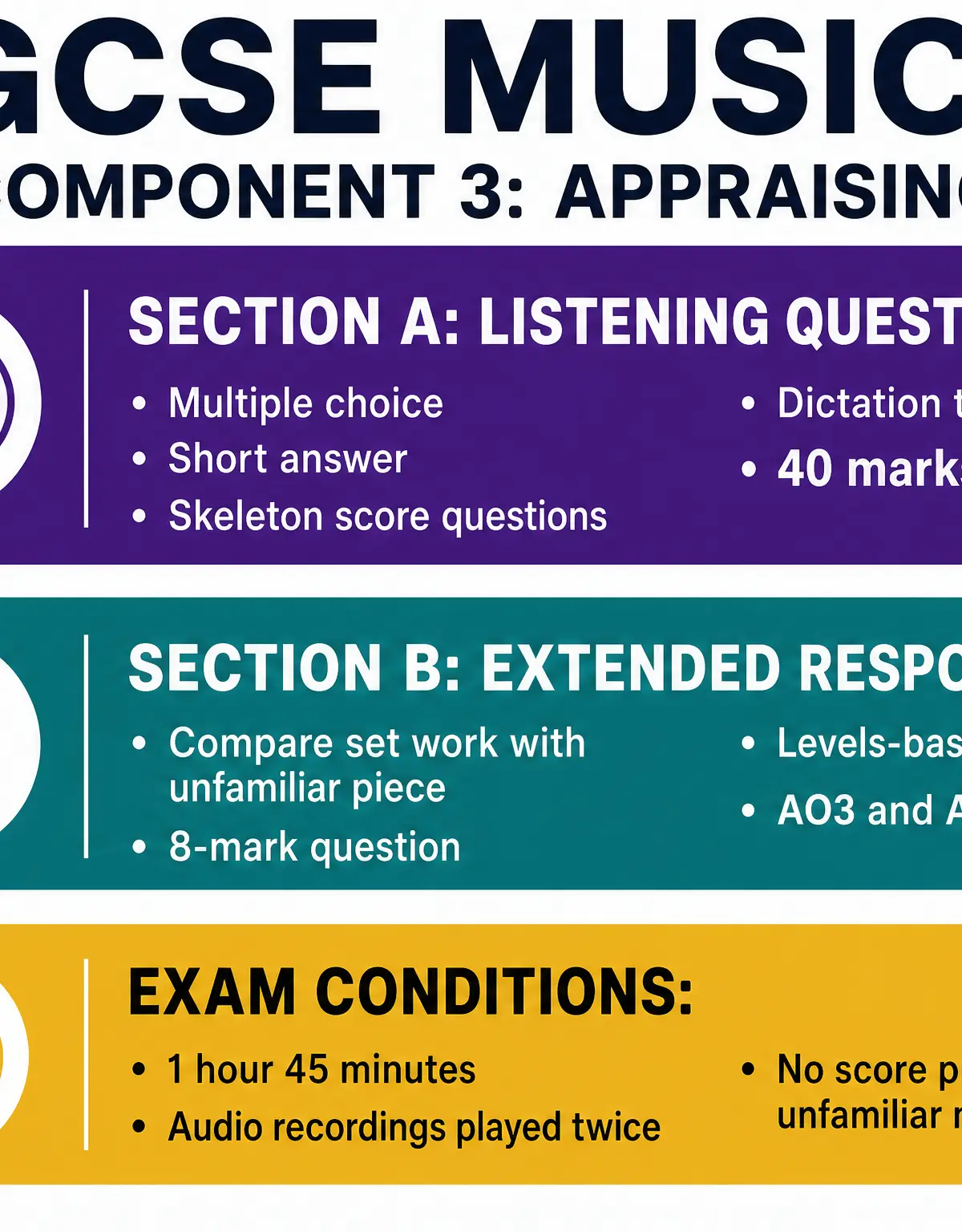
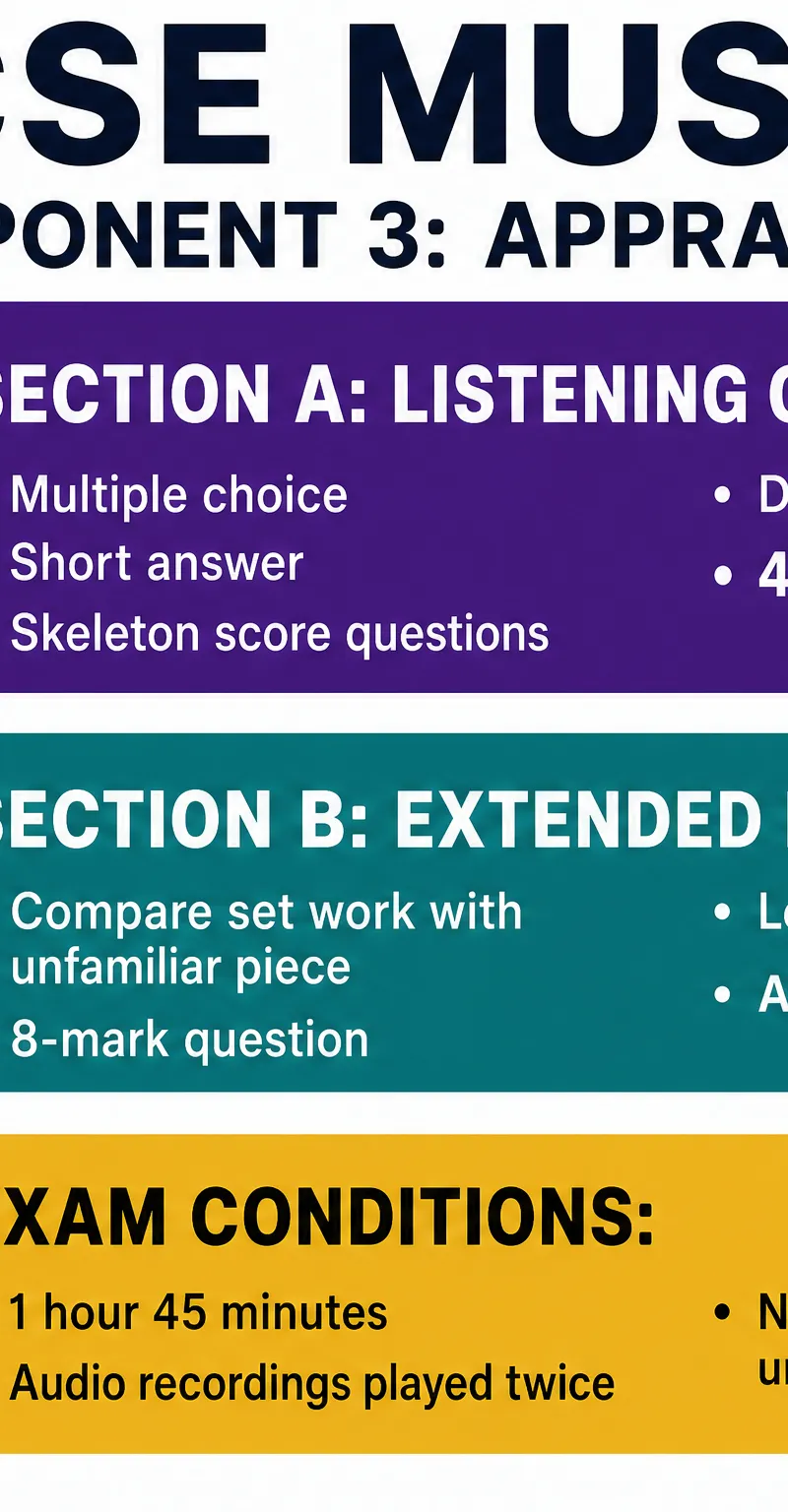
Section A: Listening Questions
This section tests your ability to quickly identify musical features in short excerpts. You will hear the music multiple times (usually 3-4 times).
- Multiple Choice: Read all options before the music starts. Eliminate obvious wrong answers during the first listen.
- Short Answer: Be concise. If a question asks for two features, only give two. Use bullet points for clarity.
Section B: Extended Response
This is the 8-mark comparison question where you must compare a set work with an unfamiliar piece.
- Levels-Based Marking: This question is marked holistically. To reach the top band (7-8 marks), you must demonstrate excellent aural perception, use sophisticated vocabulary, and make direct comparisons between the two pieces.
- Structure your answer: Use the acronym MAD T-SHIRT (Melody, Articulation, Dynamics, Texture, Structure, Harmony, Instruments/Sonority, Rhythm, Tempo) to ensure you cover a wide range of elements.
Listen to the podcast below for a complete audio guide to this topic, including an examiner's perspective on common pitfalls and a quick-fire revision quiz.
Interactive Diagrams
1 interactive diagram to visualise key concepts
Conceptual Flow Outline
Cognitive process for answering short listening questions.
Worked Examples
3 worked examples — open one to explore the question and available guidance.
Practice Questions
Try the question, then reveal an answer plan or example response
Listen to the excerpt. Identify the solo instrument playing the main melody and state the family it belongs to. (2 marks)
Hint: Listen to the sonority. Is the sound produced by bowing, blowing, or hitting? Is it made of wood or brass?
Describe the dynamic changes in the first 30 seconds of the extract. (3 marks)
This prompt needs an extract from your set text. Use the extract provided by your teacher or exam paper; this question card does not include one.
Hint: Track the volume from the very beginning, note any gradual changes, and identify the peak volume.
Explain how the composer uses musical elements to create a sense of tension and unease in this extract. (4 marks)
This prompt needs an extract from your set text. Use the extract provided by your teacher or exam paper; this question card does not include one.
Hint: Link specific musical features (harmony, pitch, rhythm, dynamics) to the emotional effect (tension).
Section B: Compare the use of sonority (instrumentation) and tempo in the set work and the unfamiliar piece. (8 marks)
Hint: Use comparative language. Structure your answer: Intro, Sonority comparison, Tempo comparison, Conclusion.
Exam technique
How to turn what you know into marks
How to approach the question
During the reading time before the audio plays, highlight the key musical elements the question is asking for (e.g., if it asks for rhythm, do not write about instruments). Use the first listen to get a general feel, the second listen to pinpoint specific details, and the final listen to check your answers.
How to structure your answer
For Section B: 1. Brief introduction identifying the pieces. 2. Paragraph 1: Direct comparison of Element A (e.g., Melody). 3. Paragraph 2: Direct comparison of Element B (e.g., Texture). 4. Paragraph 3: Direct comparison of Element C. 5. Brief evaluative conclusion.
Timing
Allow roughly 1 minute per mark for Section A. For the 8-mark Section B question, allocate 15-20 minutes to plan, listen, and write a structured response.
Common pitfalls
- Using non-musical vocabulary (e.g., 'fast' instead of 'allegro', 'bouncy' instead of 'staccato').
- Describing the mood or emotion ('it sounds sad') without explaining the musical reasons why ('it sounds sad because it is in a minor key with a slow tempo').
- Writing about the two pieces separately in Section B instead of comparing them directly.
- Losing track of where you are in the skeleton score.
What the command words want
- Analyse
- Break down the music into its constituent elements and discuss how they work together.
- Compare
- State similarities AND differences between two pieces of music.
- Explain
- Give reasons why a composer has used a specific feature, linking it to the mood, context, or overall effect.
- Describe
- State what the musical feature is doing using technical vocabulary.
- Evaluate
- Make a judgement about how effective the musical choices are, providing evidence from the audio.
- Identify
- Name the feature or instrument. Usually a one-word answer.
Watch or listen (optional)
Test your understanding of Appraising
Active recall beats re-reading. Take an instant quiz now to test what you’ve learned and lock it into long-term memory.
7 days Premium · Then the free plan continues · No card, no charge