Pearson Edexcel · GCSE · Music
Course version: Pearson-GCSE-Music · Version from Mar 2026
J S Bach: Brandenburg Concerto No. 5 in D major, 3rd Movement
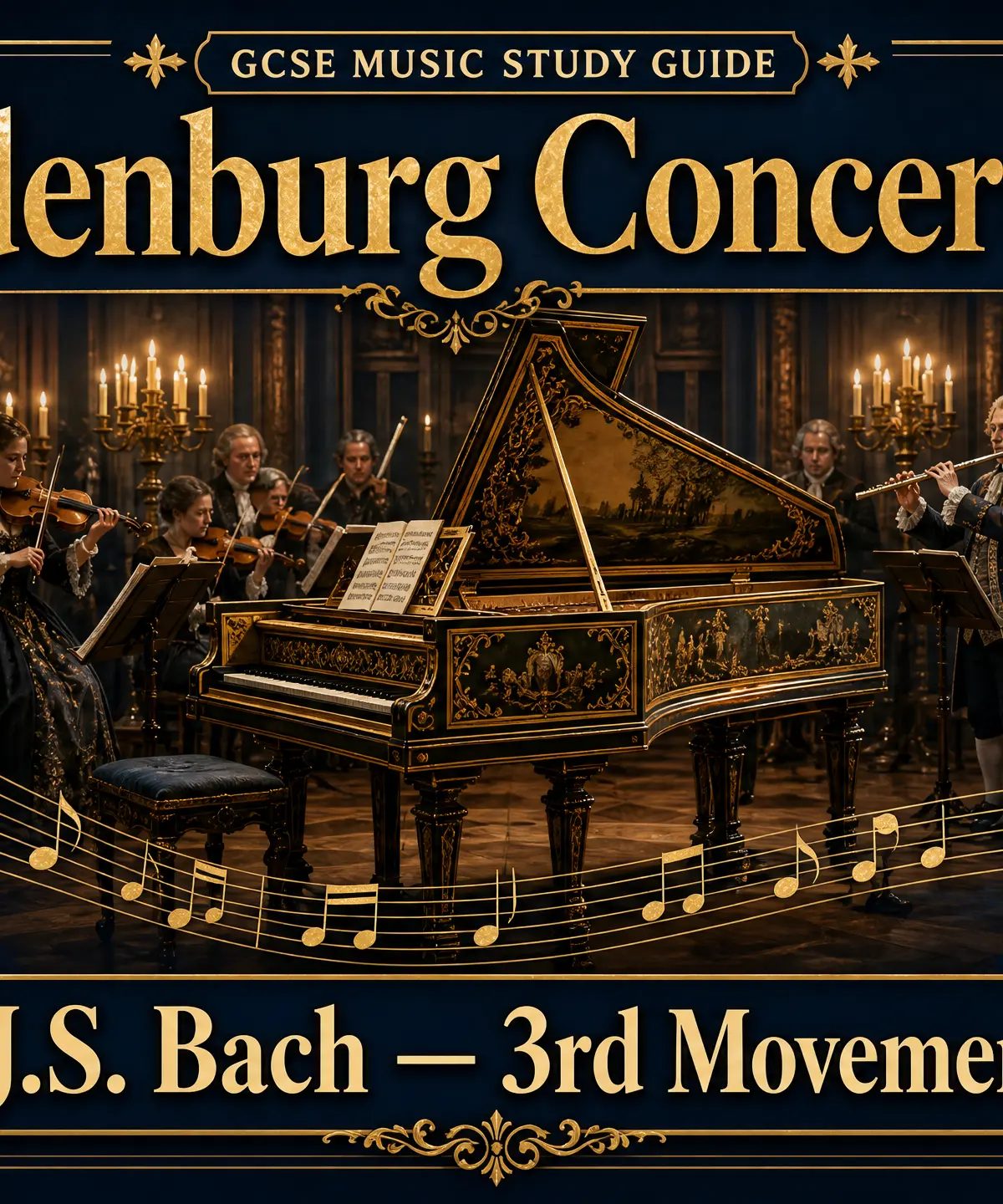
This study guide covers J.S. Bach's Brandenburg Concerto No. 5 in D major, 3rd movement, a key set work in the Instrumental Music 1700-1820 area of study. You will explore its fugal structure, Baroque stylistic features, and the unique role of the harpsichord within the Concerto Grosso format.
- 5 min read
- 3 worked examples
- 3 practice questions
- 6 key terms
Check what you remember
Read the wording for your board, then hide it and explain Concerto Grosso in your own words. Rough notes are fine. This is a self-check, with no mark or grade.
Reference: Pearson Edexcel
A Baroque concerto for a group of soloists (concertino) and a larger ensemble (ripieno).
Study Notes
Overview
J.S. Bach composed the six Brandenburg Concertos around 1721, dedicating them to the Margrave of Brandenburg. The fifth concerto is particularly notable for elevating the harpsichord from its traditional background continuo role to a virtuoso solo instrument. The third movement, which is your set work, is a lively Gigue structured as a complex fugue. Understanding this movement requires a solid grasp of Baroque musical conventions, contrapuntal textures, and specific structural devices.
Listen to the companion podcast for an in-depth audio walkthrough of this topic:
Key Knowledge & Theory
Core Concepts
1. The Concerto GrossoThe Concerto Grosso is a quintessential Baroque form that relies on the contrast between a small group of soloists (the concertino) and a larger ensemble (the ripieno). In this concerto, the concertino consists of the flute (specifically a Baroque traverso flute), violin, and harpsichord. The ripieno is a string orchestra (violins, violas, cellos, and double bass).
2. The Basso ContinuoA continuous bass line that provides the harmonic foundation of the piece. It is typically played by a bass instrument (like the cello or double bass) and a chordal instrument (like the harpsichord), which improvises chords based on figured bass notation. In this movement, the harpsichord plays a dual role: acting as a soloist and providing the continuo.
3. The GigueA lively Baroque dance, usually in compound time. This movement is in 12/8 time (compound quadruple metre), giving it a bouncy, triplet-based feel characteristic of a jig.
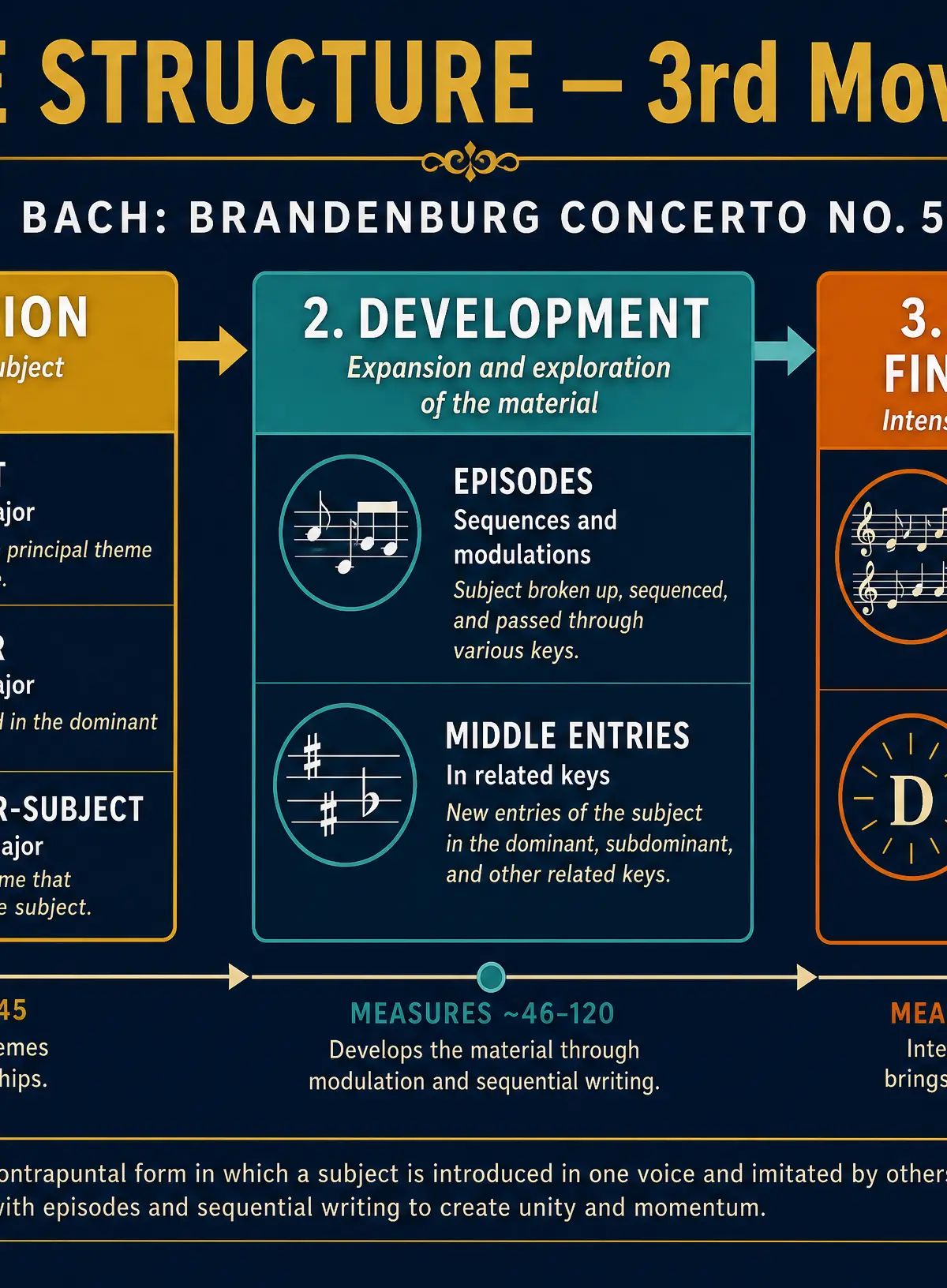
4. Fugal StructureA fugue is a complex contrapuntal form where a musical theme (the subject) is introduced by one voice and then successively imitated by others.
Technical Vocabulary
Examiners expect you to use precise terminology. You must incorporate these terms into your answers:
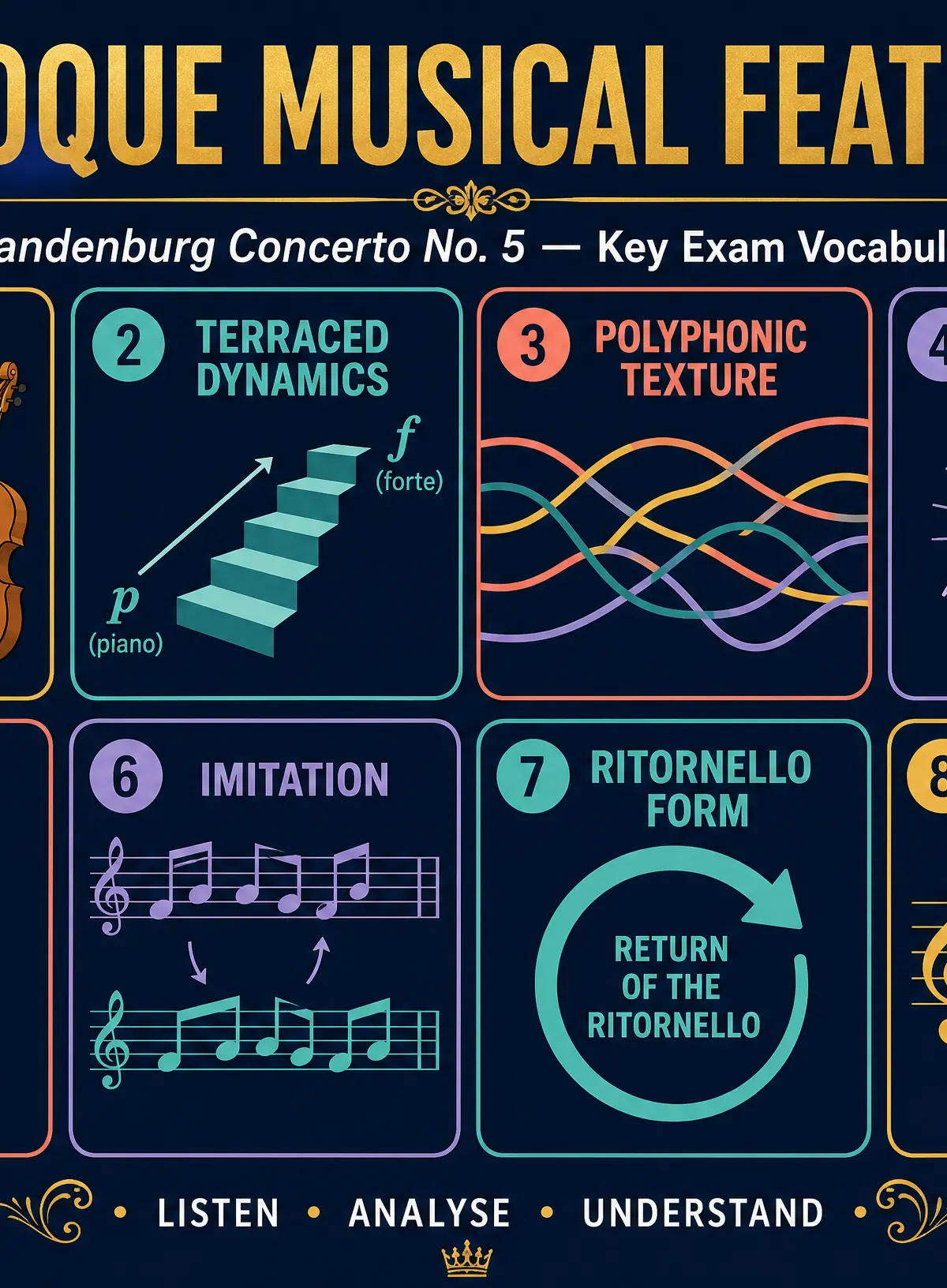
- Polyphonic / Contrapuntal: A texture consisting of two or more independent melodic lines playing simultaneously. This is the primary texture of the fugue.
- Subject: The main theme of the fugue.
- Answer: The subject repeated in response, usually transposed to the dominant key (a fifth higher).
- Countersubject: A secondary melody played against the subject or answer.
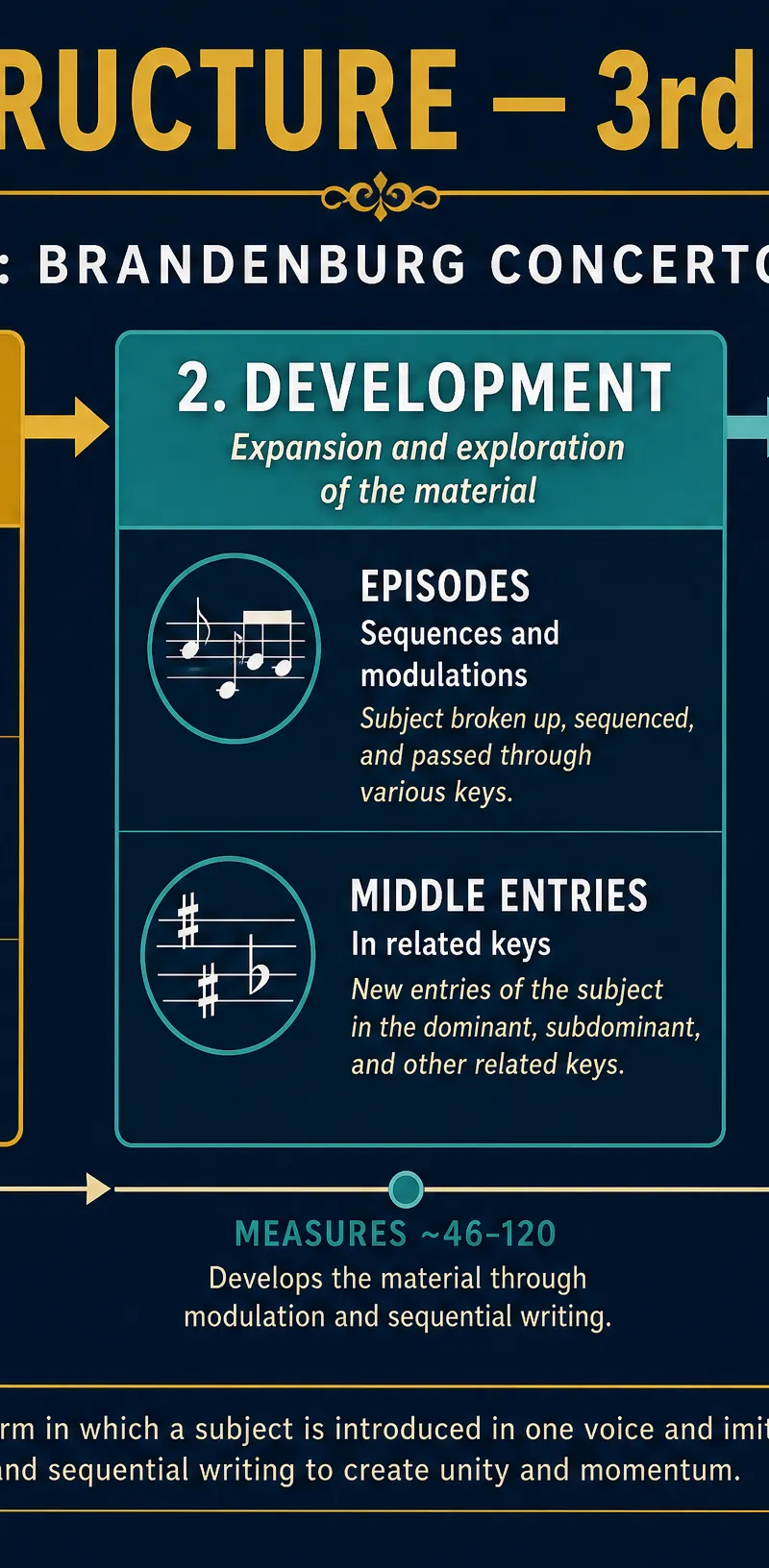
- Episode: A section of the fugue where the subject is not heard in its entirety; used to modulate to new keys and develop material.
- Stretto: When entries of the subject overlap, building tension.
- Sequence: The immediate repetition of a melodic or harmonic pattern at a higher or lower pitch.
- Imitation: Where one musical part copies another.
- Terraced Dynamics: Sudden shifts in volume (e.g., from forte to piano) without gradual crescendos or diminuendos, created by adding or removing instruments.
- Modulation: Changing from one key to another (e.g., from D major to A major).
Practical Skills & Exam Application
Listening and Analysis
When tackling listening questions, you must link what you hear to specific musical elements (MAD T SHIRT: Melody, Articulation, Dynamics, Texture, Structure, Harmony, Instrumentation, Rhythm, Tempo).
- Instrumentation: Identify the distinct timbres. Can you hear the plucked sound of the harpsichord or the breathy tone of the wooden Baroque flute? Recognize when the full ripieno is playing versus the concertino.
- Texture: Listen for the staggered entries at the beginning of the movement. The violin enters first with the subject, followed by the flute (the answer), and then the harpsichord. This clearly demonstrates the polyphonic, fugal texture.
- Rhythm: Tap the beat. You should feel the pulse divided into threes (1-and-a 2-and-a 3-and-a 4-and-a), confirming the 12/8 compound metre and the Gigue character.
Comparative Analysis
You may be asked to compare this movement with an unfamiliar piece. When doing so, structure your response to address similarities and differences across the musical elements. For example, if comparing to a Classical concerto, you might note the difference in dynamics (terraced in Baroque vs. graduated crescendos in Classical) or instrumentation (harpsichord continuo in Baroque vs. larger woodwind section and no continuo in Classical).
Exam Component
Written Exam Knowledge
Questions on this set work will typically require you to:
- Identify specific features from a short audio extract.
- Describe the musical elements used in a specific section.
- Explain how Bach creates a specific effect (e.g., how he builds tension using stretto).
- Evaluate the piece's stylistic features in relation to the Baroque period.
Preparation Strategies
- Score Reading: Practice following the score while listening. Highlight the subject entries in different colours to visualize the fugal structure.
- Vocabulary Drills: Create flashcards for the technical vocabulary. You cannot access the highest mark bands without using terms like 'polyphonic', 'basso continuo', and 'sequence'.
Visual Resources
2 diagrams and illustrations
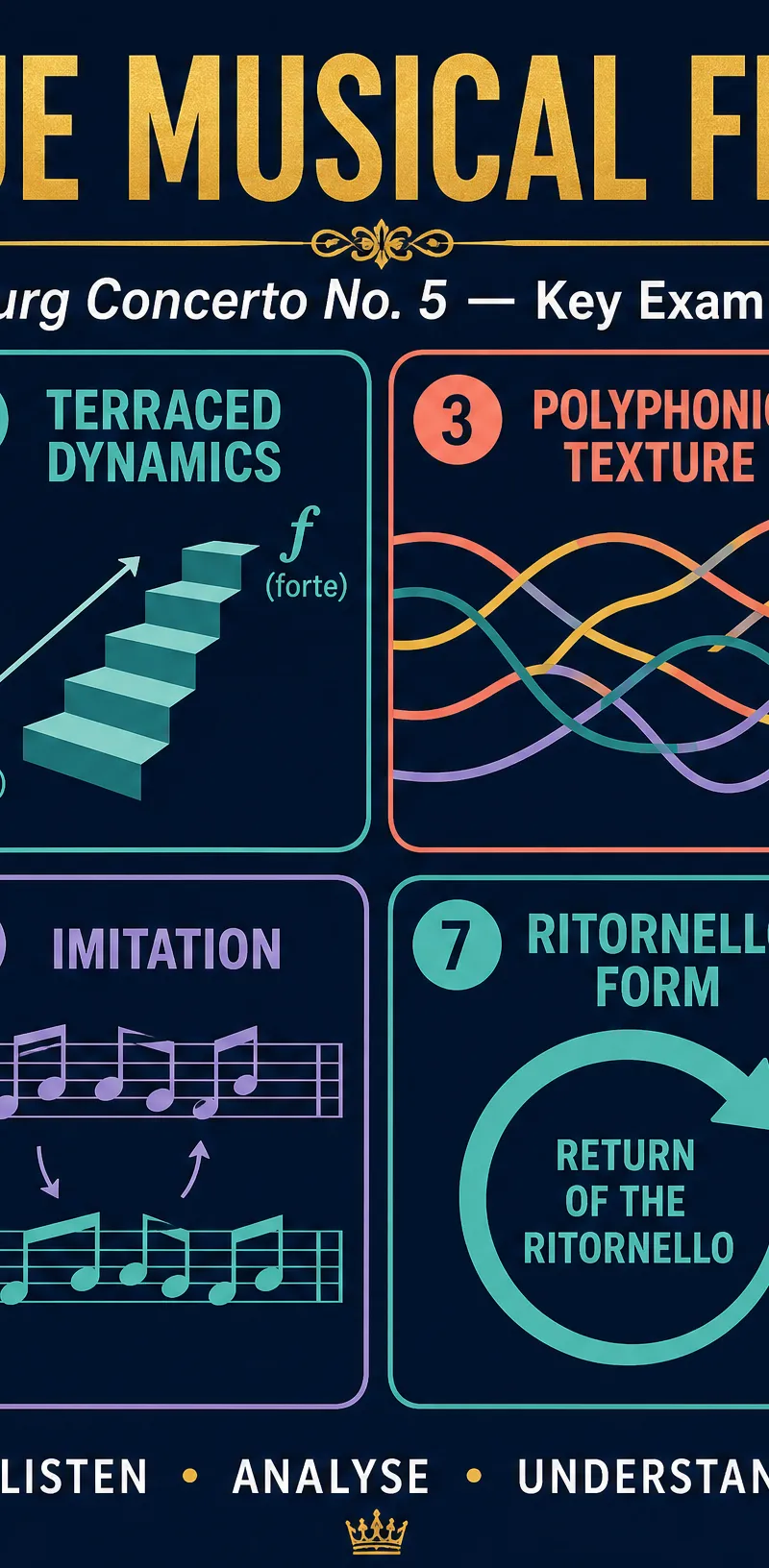
Interactive Diagrams
1 interactive diagram to visualise key concepts
Conceptual Flow Outline
Simplified Fugal Structure of the 3rd Movement
Worked Examples
3 worked examples — open one to explore the question and available guidance.
Practice Questions
Try the question, then reveal an answer plan or example response
Identify the metre of the 3rd movement and explain how it contributes to the character of the music. [2 marks]
Hint: Think about the type of dance this movement is based on and how the beats are divided.
Describe the instrumentation used in this concerto and explain how it defines the genre. [4 marks]
Hint: Remember the terms for the small solo group and the larger ensemble.
Analyse how Bach develops the musical material during the episodes of the fugue. [6 marks]
Hint: Discuss melody, harmony, and texture. What devices does he use when the full subject isn't playing?
Exam technique
How to turn what you know into marks
How to approach the question
Always read the question twice. Underline the command word and the specific musical element (e.g., 'Describe the MELODY'). Do not write about texture if the question asks about melody.
How to structure your answer
For extended answers (6+ marks), use a PEE structure: Point (identify the feature using technical vocab), Evidence (where it happens/what instrument plays it), Effect (how it contributes to the style/mood).
Timing
Allow roughly 1 minute per mark. For a 6-mark extended question, spend 1 minute planning and 5 minutes writing.
Common pitfalls
- Using vague terms like 'thick', 'busy', or 'layered' instead of 'polyphonic'.
- Confusing 'Concerto Grosso' (the genre) with 'Concertino' (the solo group).
- Describing the mood ('it sounds happy') instead of analysing the musical elements ('it is in a major key with a fast tempo').
- Forgetting to mention the harpsichord's dual role as both soloist and continuo.
What the command words want
- Analyse
- Break down the music into its component parts (MAD T SHIRT) and discuss how they interact.
- Compare
- State explicitly what is the same AND what is different between two extracts.
- Explain
- Give reasons HOW or WHY a feature is used (e.g., 'The texture is polyphonic because it is a fugue with independent voices').
- Describe
- State what is happening musically using correct terminology (e.g., 'The melody moves in sequences').
- Evaluate
- Make a judgement about the music's style, context, or effectiveness, supporting your points with specific evidence.
- Identify
- Name the feature or instrument. One word or a short phrase is sufficient.
Watch or listen (optional)
Test your understanding of J S Bach: Brandenburg Concerto No. 5 in D major, 3rd Movement
Active recall beats re-reading. Take an instant quiz now to test what you’ve learned and lock it into long-term memory.
7 days Premium · Then the free plan continues · No card, no charge