Pearson Edexcel · GCSE · Music
Course version: Pearson-GCSE-Music · Version from Mar 2026
J Williams: Main Title/Rebel Blockade Runner (Star Wars Episode IV: A New Hope)
This study guide covers John Williams' iconic Main Title and Rebel Blockade Runner from Star Wars Episode IV. It provides an in-depth analysis of the musical elements, orchestral techniques, and thematic structures that define this late-Romantic style film score, essential for the 'Music for Stage and Screen' area of study.
- 6 min read
- 3 worked examples
- 3 practice questions
- 6 key terms
Check what you remember
Read the wording for your board, then hide it and explain Leitmotif in your own words. Rough notes are fine. This is a self-check, with no mark or grade.
Reference: Pearson Edexcel
A short, recurring musical phrase associated with a particular person, place, or idea.
Study Notes
Overview
John Williams' score for Star Wars Episode IV: A New Hope (1977) is one of the most recognisable and influential film scores ever written. It revitalised the grand, late-Romantic orchestral style in cinema at a time when synthesisers and pop music were dominating film soundtracks. As a set work in the 'Music for Stage and Screen' area of study, candidates are expected to understand how Williams uses traditional orchestral forces and specific musical elements to create dramatic impact and narrative drive.
The Audio Guide
Listen to our comprehensive 4-minute revision podcast covering all key elements of this set work:
Key Knowledge & Theory
Core Concepts
The most fundamental concept in this set work is the Leitmotif. Pioneered by Richard Wagner in the 19th century, a leitmotif is a recurring musical idea (a melody, chord progression, or rhythm) associated with a particular character, place, or idea. In this extract, the main theme is the heroic leitmotif for Luke Skywalker, while a separate, shorter motif represents the Rebel Blockade Runner spaceship.
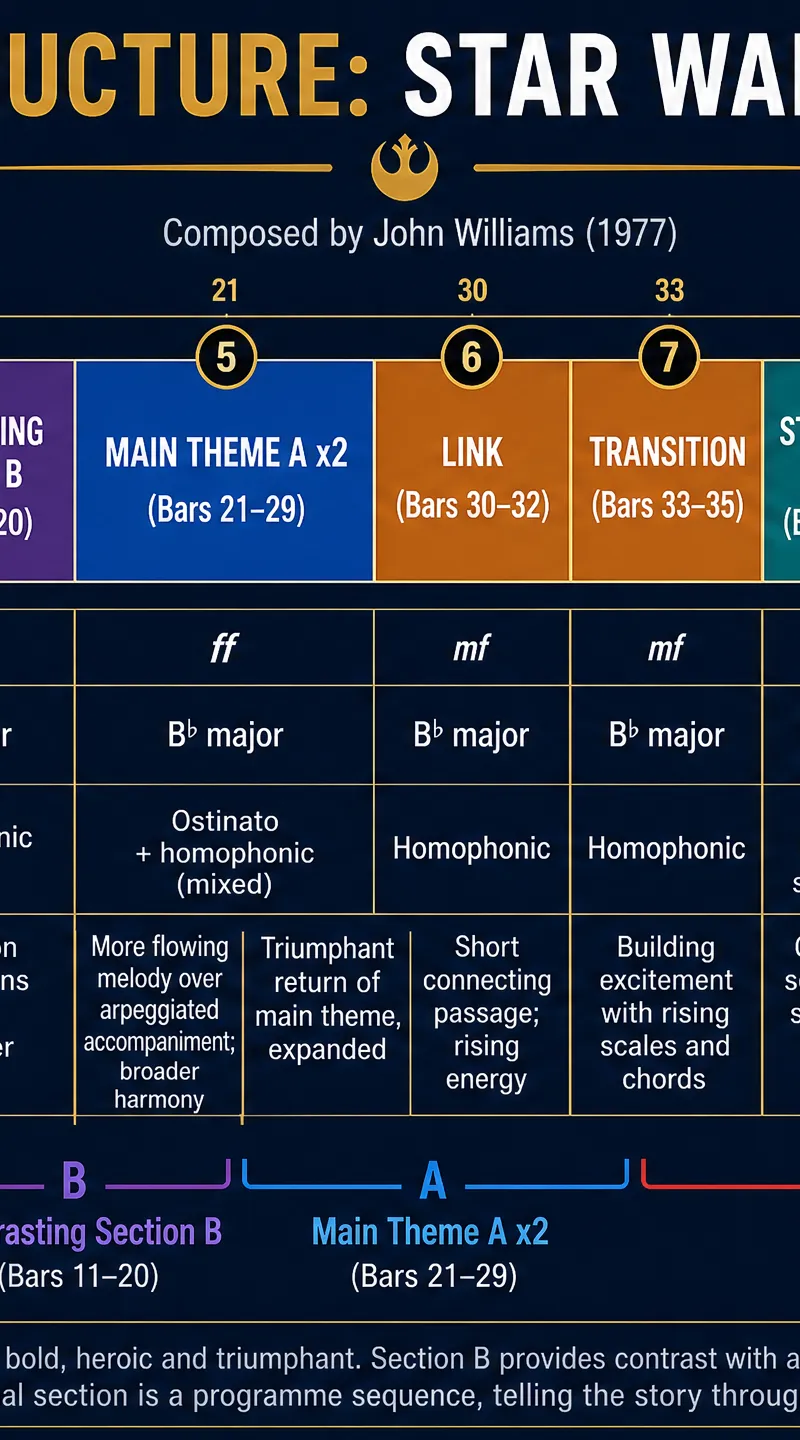
Another critical concept is Programme Music versus Absolute Music. While the first 29 bars follow a conventional musical structure (AABA), the remainder of the piece is programmatic—its structure is entirely dictated by the action happening on screen.
Key Practitioners/Composers
| Name | Period/Style | Key Works | Relevance |
|---|---|---|---|
| John Williams | Late 20th Century Film Music | Star Wars, Jaws, E.T., Jurassic Park | Composer of the set work. Master of the modern symphonic film score and leitmotif technique. |
| Richard Wagner | 19th Century Romantic | The Ring Cycle | Pioneered the leitmotif technique that Williams adopted for Star Wars. |
| Erich Korngold | Golden Age Hollywood | The Adventures of Robin Hood | Established the swashbuckling, brass-heavy symphonic style that influenced Williams. |
Technical Vocabulary
Candidates MUST use these specific terms in their appraisal answers:
- Quartal Harmony: Chords built on intervals of a fourth rather than the traditional third. Used extensively by Williams to create an open, heroic, or ambiguous sound.
- Melody-dominated homophony: The primary texture of the piece; a clear melody supported by chordal accompaniment.
- Ostinato: A persistently repeated musical phrase or rhythm. Heard prominently in the bass from bar 51 onwards.
- Inverted Tonic Pedal: A sustained or repeated tonic note placed in a high register (e.g., the violins in the opening).
- Tremolando: Rapid bowing on string instruments to create a trembling effect, building tension.
- Bitonality: The simultaneous use of two different keys, used in the battle sequence to create dissonance and chaos.
Practical Skills
Musical Analysis Techniques
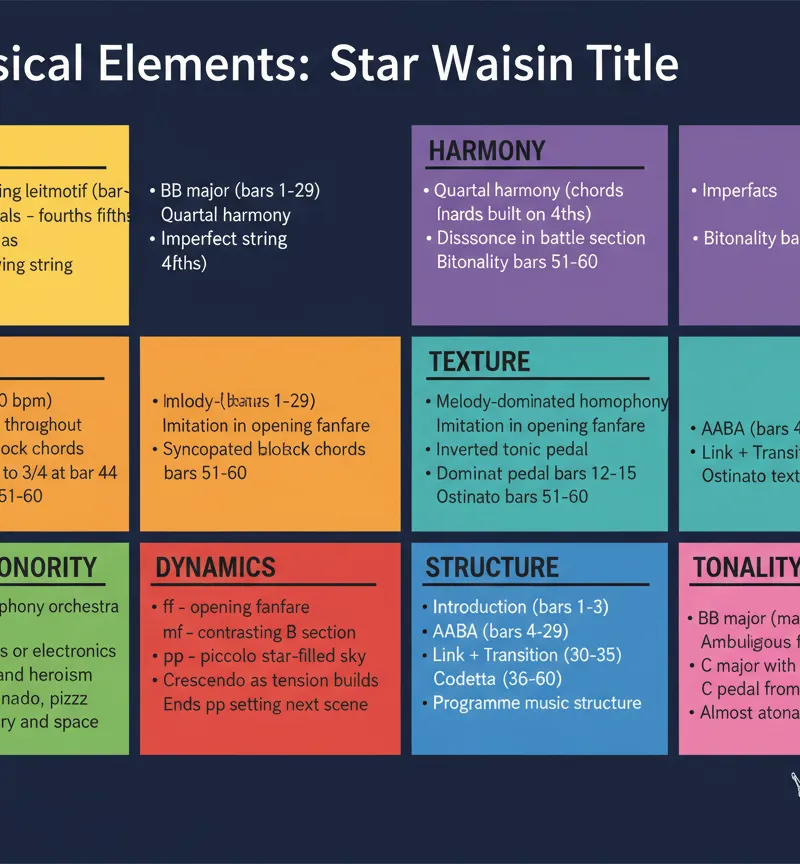
When analysing film music in the exam, candidates should systematically address the musical elements (MAD T-SHIRT: Melody, Articulation, Dynamics, Texture, Structure, Harmony, Instrumentation, Rhythm, Tonality).
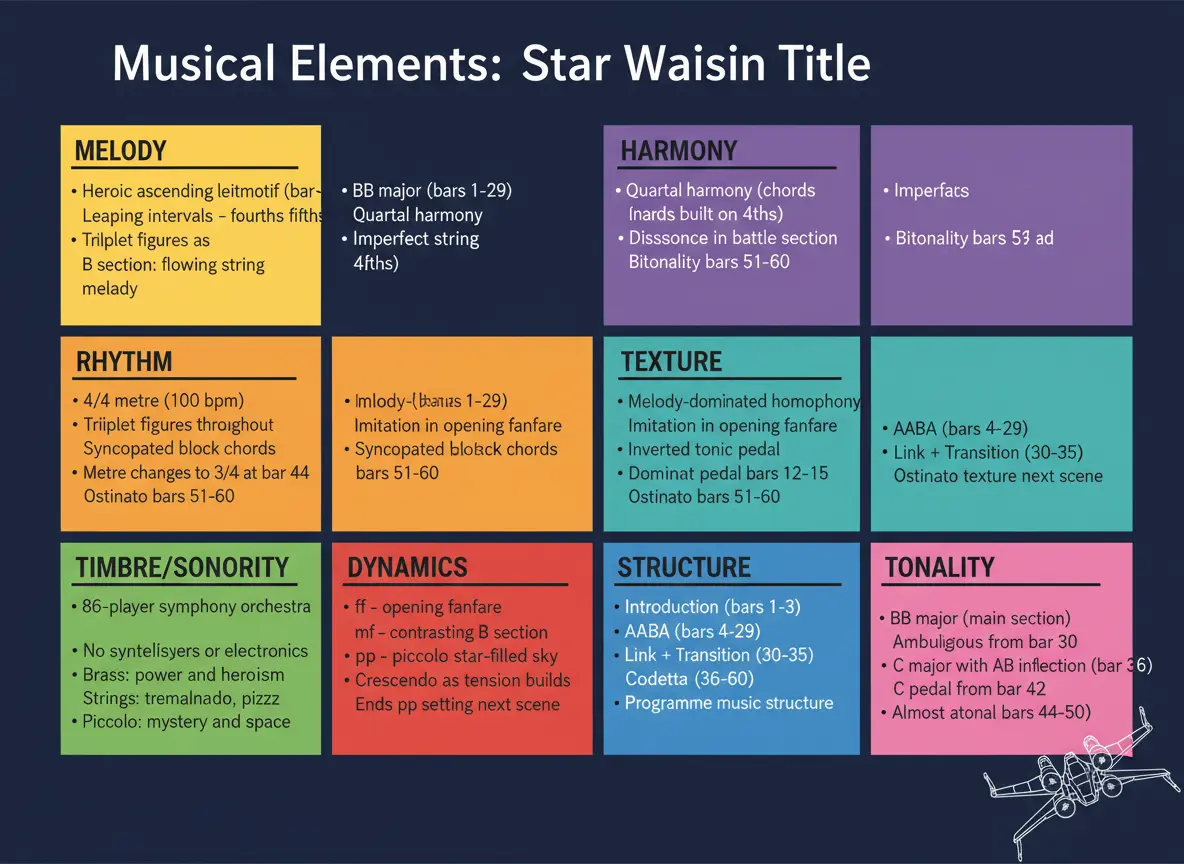
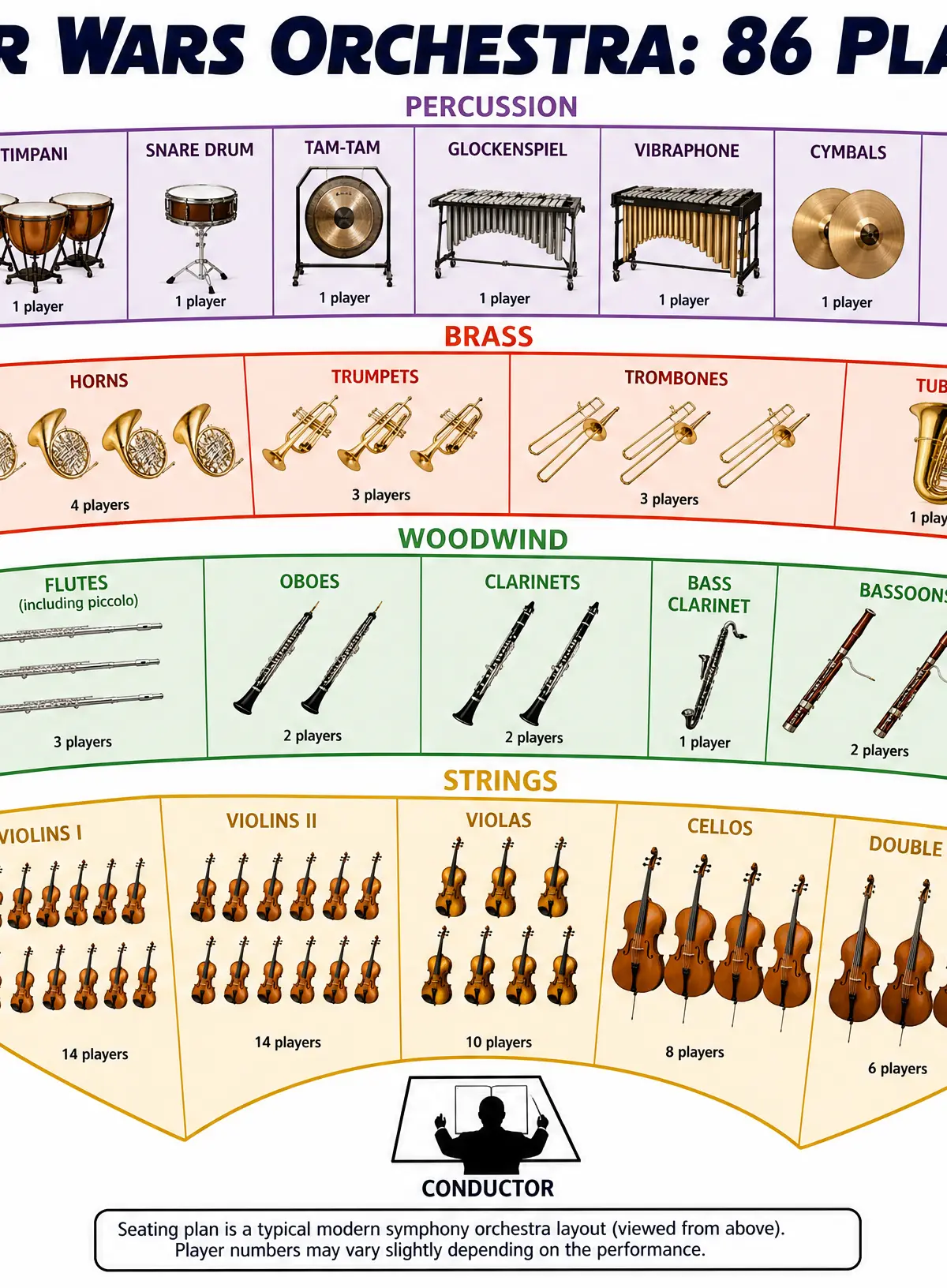
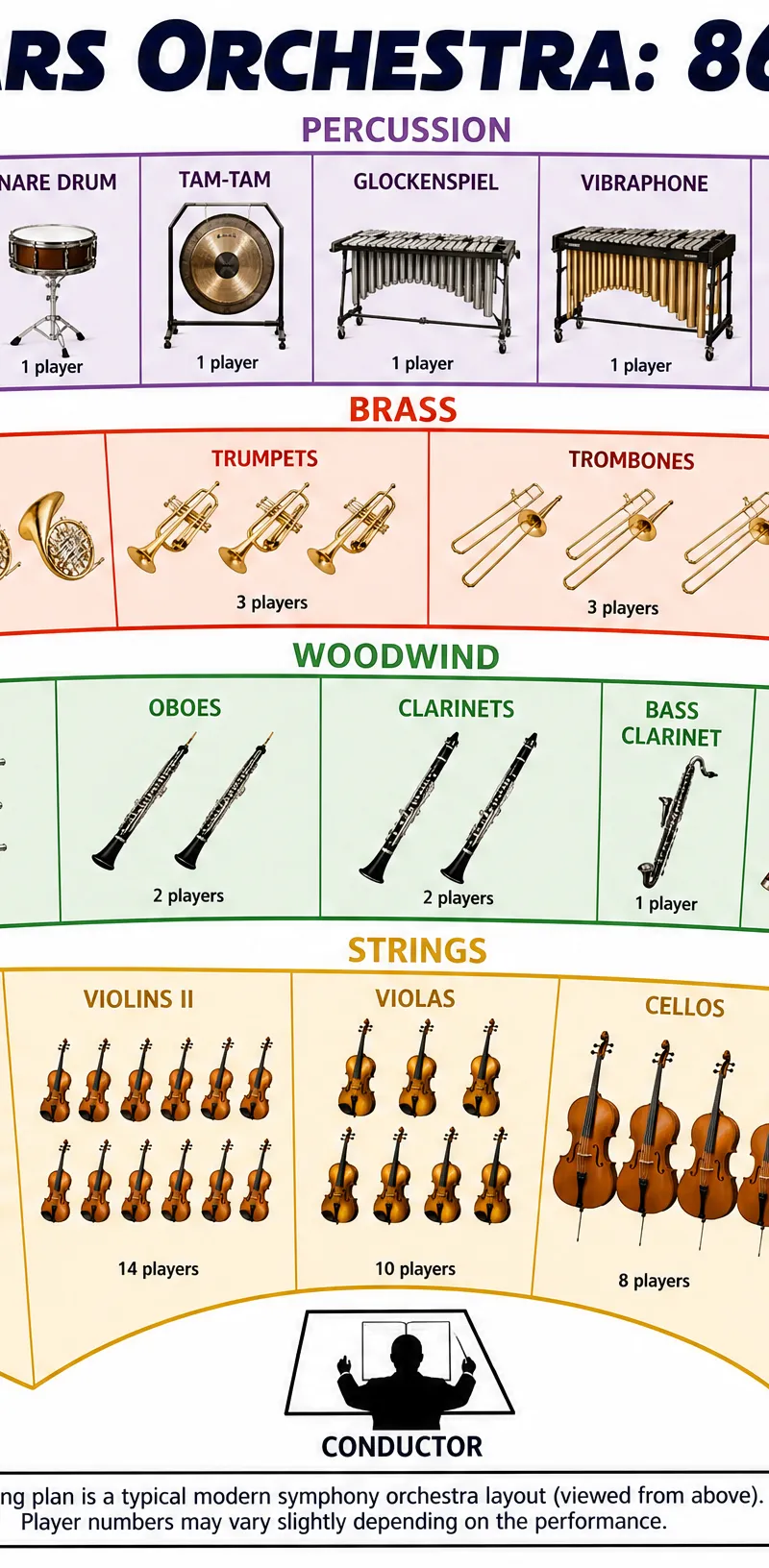
1. Instrumentation and SonorityWilliams deliberately chose a massive 86-piece symphony orchestra with no electronic effects or synthesisers.
- Brass: Used for power, heroism, and military themes (e.g., the opening fanfare and main theme).
- Strings: Used for sweeping, lyrical contrast (the B section) and tension-building techniques like tremolando.
- Woodwind: Used for rapid, rushing scale passages and the high, ethereal piccolo melody representing the vastness of space.
- Percussion: Extensive use including timpani, snare drum (military feel), and tam-tam (gong) for dramatic impact.
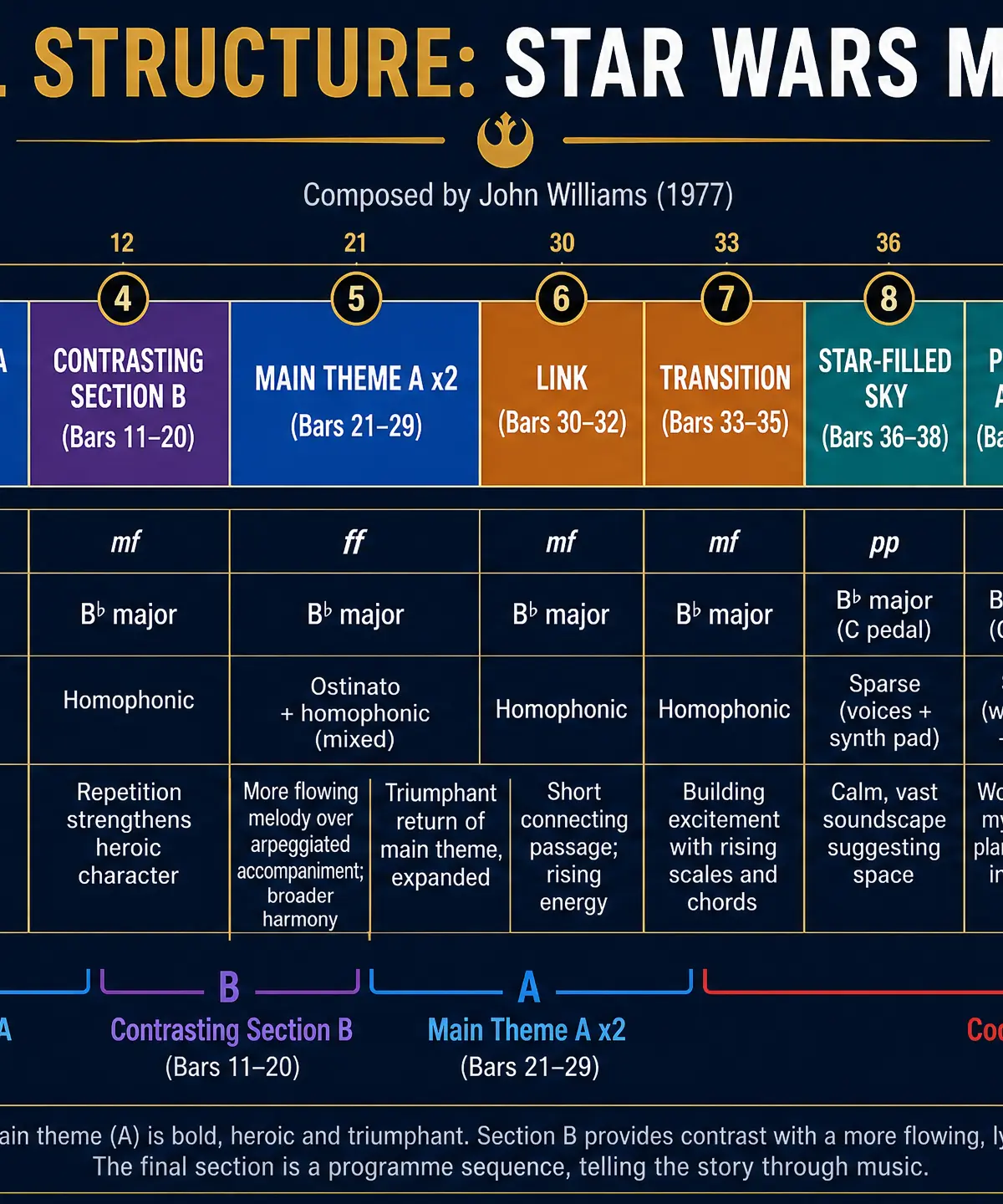
2. Structure and NarrativeThe structure directly follows the visual narrative of the film's opening sequence:
- Bars 1-3 (Introduction): 'Star Wars' logo appears. Fanfare.
- Bars 4-29 (AABA): 'Crawling' text sets the scene. The heroic main theme.
- Bars 30-35 (Link & Transition): Camera pans to a star-filled sky.
- Bars 36-38 (Star-filled sky): Piccolo melody over sustained chords.
- Bars 39-41 (Planets appear): Tension builds with rising figures.
- Bars 42-43 (Spaceship): Huge tam-tam crash and low C pedal.
- Bars 44-50 (Battle): Dissonant chords, triple metre, representing the Imperial pursuit.
- Bars 51-60 (Rebel Craft): Fast ostinato, bitonality, representing the interior action.
3. Harmony and TonalityThe piece begins firmly in B-flat major, a bright, heroic key. Williams frequently uses quartal harmony (chords built on fourths) rather than standard major/minor triads, giving the music a distinctively modern yet powerful sound. As the action shifts from the scrolling text to the space battle (from bar 30 onwards), the tonality becomes ambiguous, moving through C major (with A-flat inflections), becoming highly dissonant and almost atonal, and finally using bitonality to represent the chaos of the battle.
Exam Component
Written Exam Knowledge (Appraising)
In the appraising exam, candidates will be tested on their ability to identify these musical features aurally and explain their dramatic function. You must be able to link the musical device to the on-screen action.
- Example: Don't just state "the dynamics are fortissimo." State "the fortissimo dynamics in the brass fanfare immediately command the audience's attention and establish the epic scale of the film."
- Example: Don't just state "there is a piccolo playing." State "the high register and pianissimo dynamic of the piccolo melody create a sense of vastness and mystery as the star-filled sky is revealed."
Wider Listening Preparation
Candidates must be prepared to compare this set work with unfamiliar film music. Key comparisons to practice:
- Superman or Indiana Jones (also by John Williams) – comparing the use of brass fanfares and heroic leitmotifs.
- Pirates of the Caribbean (Klaus Badelt/Hans Zimmer) – comparing traditional orchestral scoring (Williams) with modern, synthesiser-enhanced scoring (Zimmer).
- Psycho (Bernard Herrmann) – comparing Williams' full orchestral palette with Herrmann's use of a string-only orchestra to create tension.
Visual Resources
3 diagrams and illustrations
Interactive Diagrams
1 interactive diagram to visualise key concepts
Conceptual Flow Outline
The shift from musical form to programmatic form in the Star Wars Main Title
Worked Examples
3 worked examples — open one to explore the question and available guidance.
Practice Questions
Try the question, then reveal an answer plan or example response
Name the instrument that plays the 'star-filled sky' melody in bars 36-38.
Hint: It is the highest-pitched woodwind instrument.
Describe the rhythm and metre of the main theme (bars 4-11).
Hint: Think about the time signature, the speed, and the distinctive three-note groupings.
Explain how John Williams uses orchestration and texture to create contrast between Section A (bars 4-11) and Section B (bars 11-20) of the main theme.
Hint: Compare the brass vs strings, and the loud block chords vs the flowing accompaniment.
Exam technique
How to turn what you know into marks
How to approach the question
For listening questions, use the first playing to identify the overall mood, instrumentation, and tempo. Use the second and third playings to pinpoint specific details like cadences, intervals, and rhythmic devices.
How to structure your answer
For extended responses comparing the set work to an unfamiliar piece, use a comparative structure: Point (Element) -> Set Work Evidence -> Unfamiliar Piece Evidence -> Comparison (Similarity/Difference).
Timing
Aim for roughly 1 minute per mark in the appraising paper. For a 12-mark extended response, spend 2-3 minutes planning and 10 minutes writing.
Common pitfalls
- Using non-musical terms like 'thick' or 'heavy' instead of 'polyphonic' or 'densely orchestrated'.
- Describing the music without linking it to the on-screen action (in film music questions).
- Confusing major and minor tonalities.
- Failing to reference specific bar numbers or sections when the score is provided.
What the command words want
- Analyse
- Break down a section into its musical elements and discuss how they interact.
- Compare
- Explicitly state similarities and differences between two extracts.
- Explain
- State a feature AND provide a reason for its use (e.g., 'He uses dissonant chords TO create tension').
- Describe
- Give a detailed account of a musical feature using appropriate terminology.
- Evaluate
- Make a judgement about how effective the musical choices are in achieving their purpose.
- Identify
- State a single fact, term, or instrument. No explanation needed.
Watch or listen (optional)
Test your understanding of J Williams: Main Title/Rebel Blockade Runner (Star Wars Episode IV: A New Hope)
Active recall beats re-reading. Take an instant quiz now to test what you’ve learned and lock it into long-term memory.
7 days Premium · Then the free plan continues · No card, no charge