Pearson Edexcel · GCSE · Music
Course version: Pearson-GCSE-Music · Version from Mar 2026
S Schwartz: Defying Gravity (from the cast recording of Wicked)
This study guide covers Stephen Schwartz's 'Defying Gravity' from Wicked, a key set work for GCSE Music. It explores how musical elements—pitch, tonality, structure, and sonority—are used to convey character and drama in musical theatre.
- 7 min read
- 3 worked examples
- 4 practice questions
- 6 key terms
Check what you remember
Read the wording for your board, then hide it and explain Syncopation in your own words. Rough notes are fine. This is a self-check, with no mark or grade.
Reference: Pearson Edexcel
Placing the rhythmic emphasis or accent on a weak beat or off-beat.
Study Notes
Overview
'Defying Gravity' is the spectacular Act One finale of the hit musical Wicked (2003), composed by Stephen Schwartz. As a set work within the 'Music for Stage and Screen' area of study, it provides an outstanding example of how composers use musical elements to support dramatic narrative, character development, and emotional climax. The song marks the turning point where the protagonist, Elphaba, rejects the Wizard's corrupt regime and literally takes flight, declaring her independence.
For GCSE Music, candidates must demonstrate a thorough understanding of how Schwartz manipulates pitch, tonality, structure, sonority, texture, tempo, rhythm, and dynamics to achieve these dramatic effects. Examiners consistently reward students who can move beyond simple description to precise analysis of how and why musical choices are made.
Listen and Learn: The Revision Podcast
Tune in to our comprehensive 10-minute revision podcast covering all the key musical elements and exam tips you need for this set work.
Key Knowledge & Theory
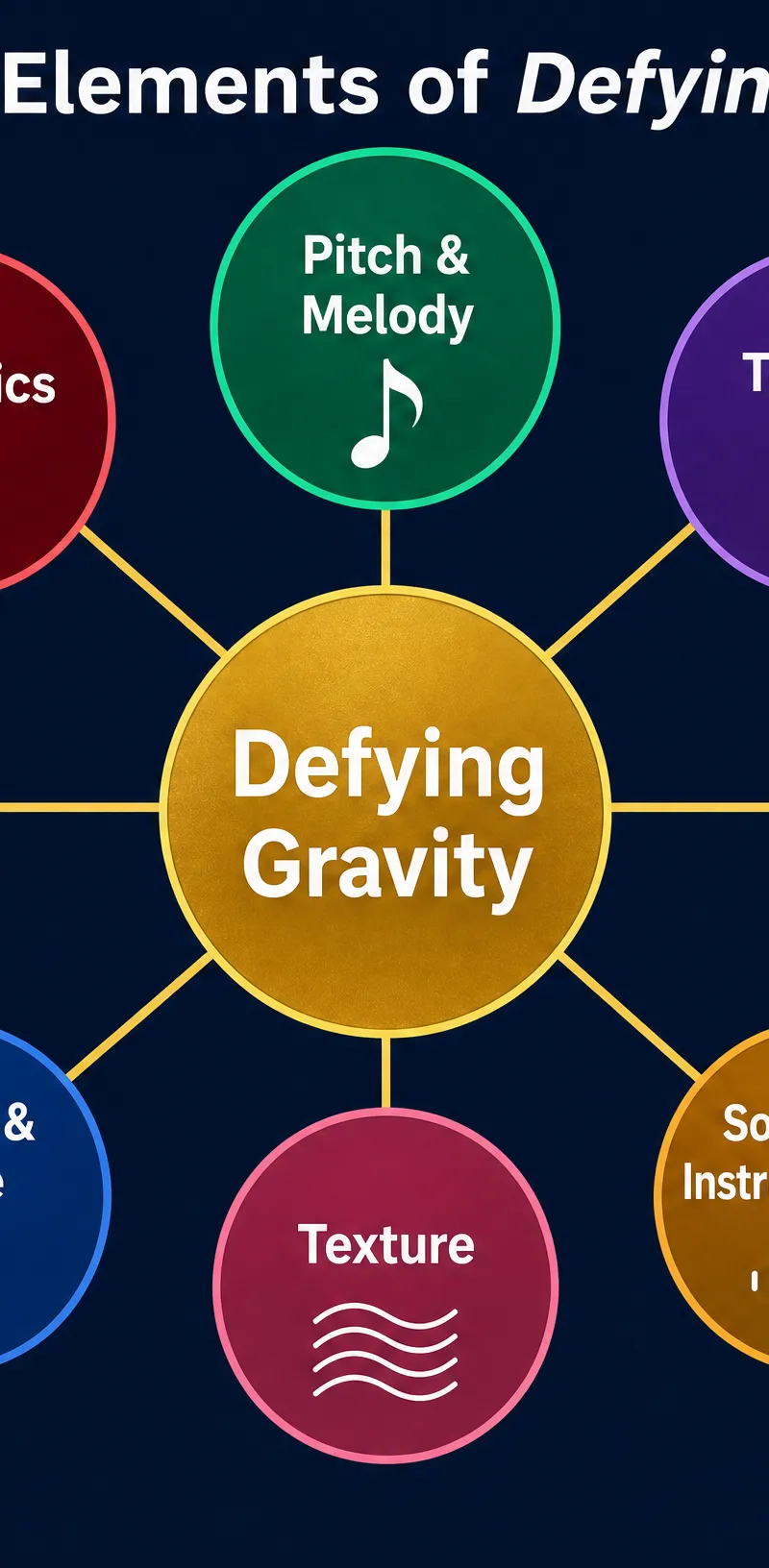
Core Musical Elements (PTSS TTRD)
To secure top marks, candidates must confidently apply the core musical elements to this piece.
**Pitch & Melody:**The melody is intrinsically linked to characterisation. Elphaba's melodic lines are characterised by wide leaps (e.g., the rising fifths and octaves in the chorus), reflecting her soaring ambition and newfound freedom. In contrast, Glinda's melodies often feature stepwise movement and narrower ranges, mirroring her conventional, cautious nature. The 'Unlimited' motif is a crucial recurring melodic idea built on a perfect fifth.
**Tonality & Harmony:**The piece demonstrates complex tonal shifts. It begins in an ambiguous, unsettled tonal center (often described as D major with chromaticism) before firmly establishing a triumphant major key (Db major) during the choruses. A significant modulation (key change) occurs in the bridge, raising the emotional stakes. Schwartz uses sus chords and augmented chords to create harmonic tension that resolves at key dramatic moments.
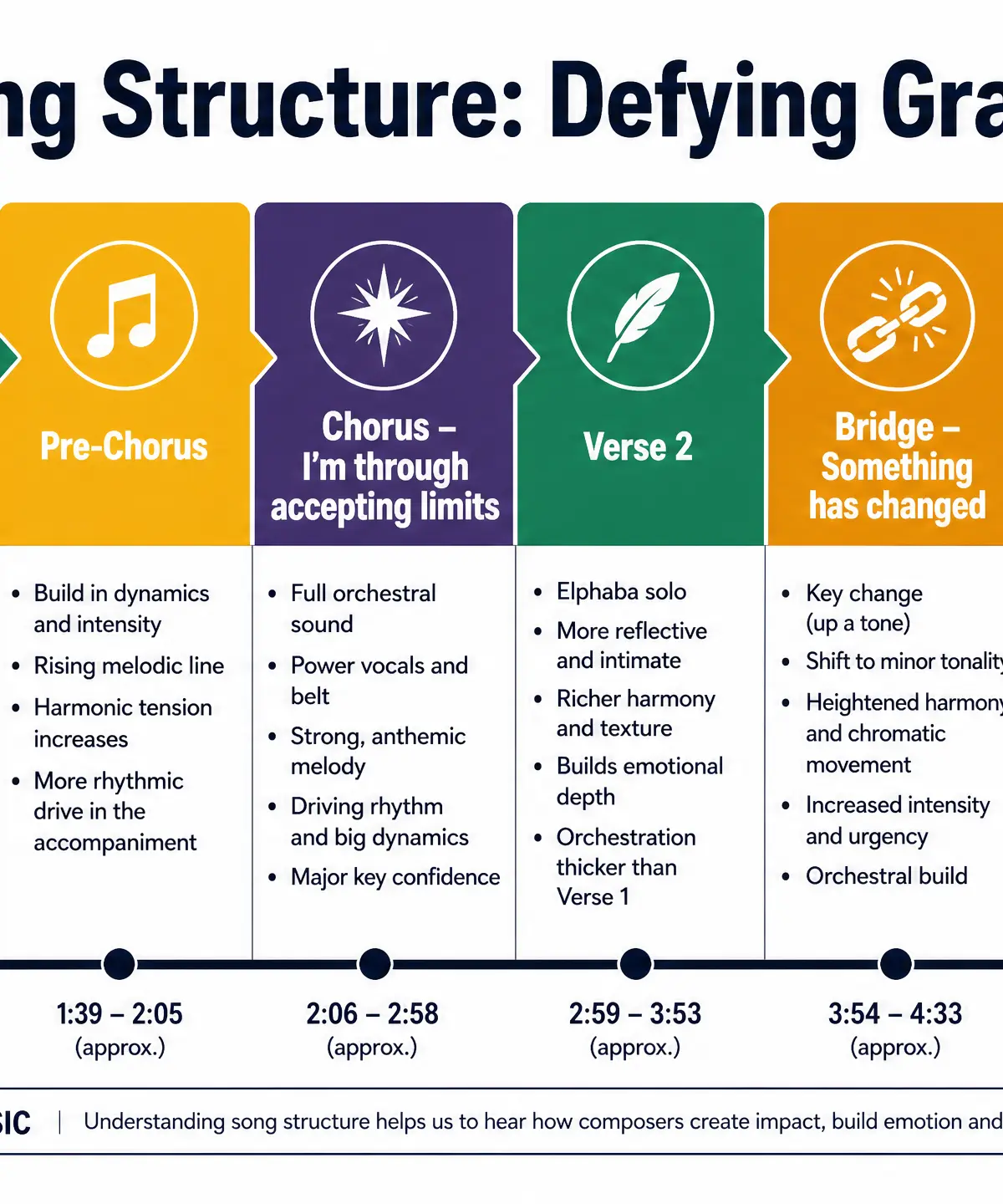
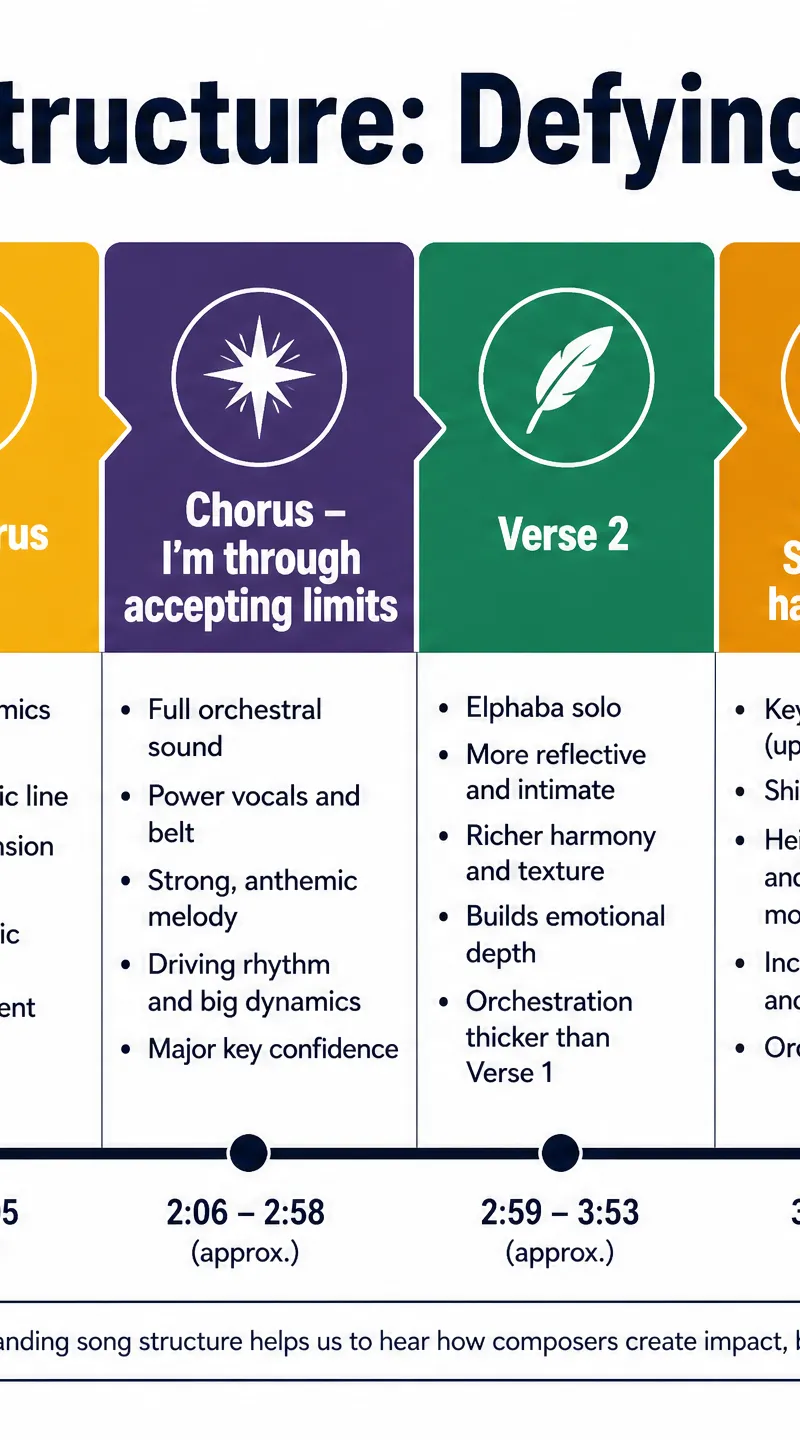
**Structure:**The song follows an extended verse-chorus structure, adapted for theatrical storytelling:
- Introduction: Recitative-like dialogue establishing tension.
- Verses & Pre-Choruses: Building momentum as Glinda and Elphaba argue.
- Choruses: The emotional core ('I'm through accepting limits').
- Bridge: A shift in focus and tonality ('Something has changed within me').
- Climax/Coda: Full orchestral power as Elphaba flies.
**Sonority (Instrumentation):**The track features a large theatre pit orchestra combining traditional acoustic instruments (strings, brass, woodwind, percussion) with modern electric instruments (electric guitars, bass, synthesisers). This creates a versatile sonic palette. The synthesisers provide a contemporary edge, while the heavy use of brass and percussion in the climax delivers the necessary power.
**Texture:**The texture varies dramatically to reflect the narrative. It begins with a sparse, melody-dominated homophony (solo voice and light accompaniment). As the argument escalates, the texture thickens. When Elphaba and Glinda sing simultaneously with different melodies and lyrics, the texture becomes polyphonic (contrapuntal). The climax features a dense, full orchestral homophonic texture.
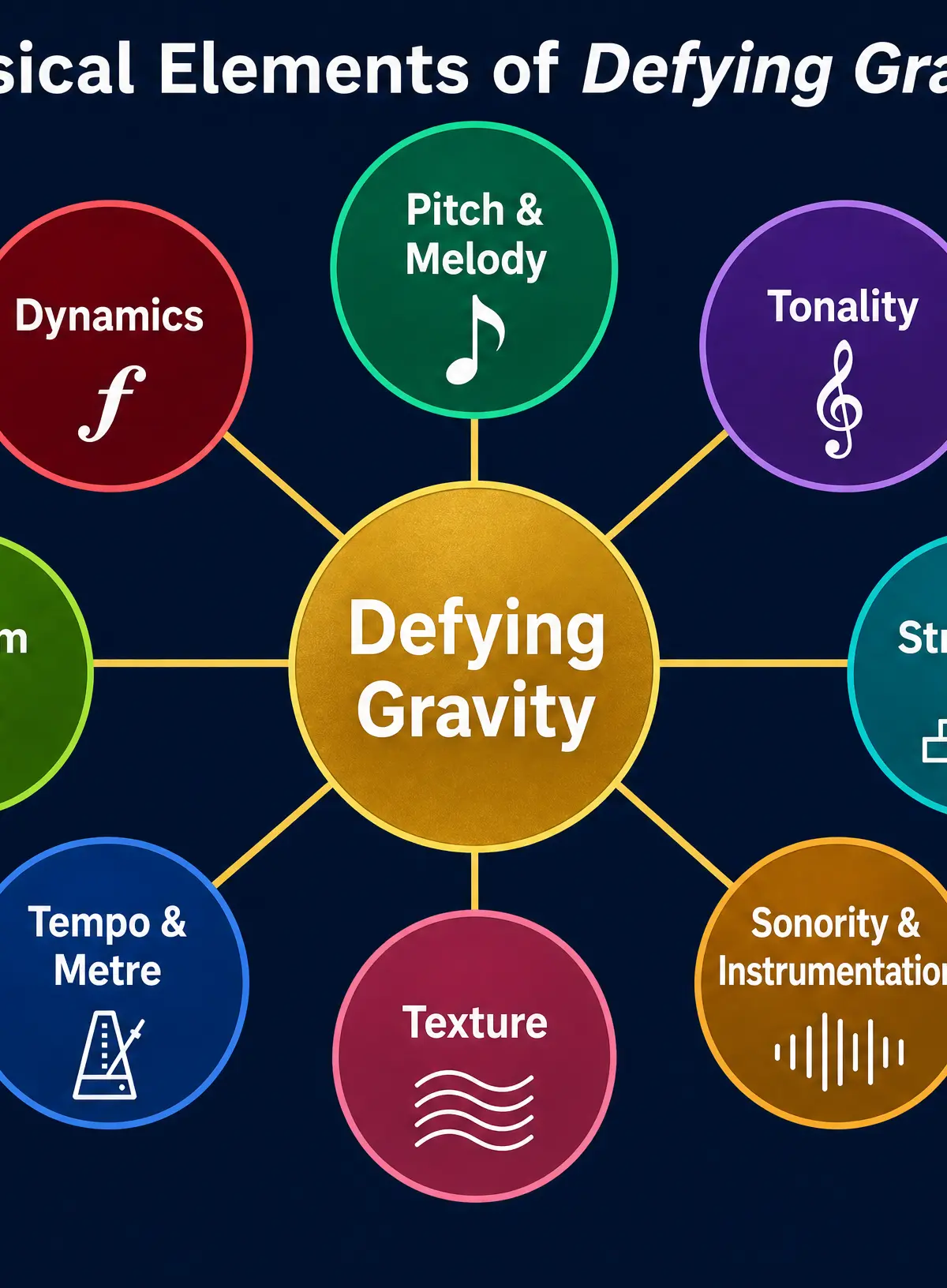
**Tempo, Metre & Rhythm:**The metre is predominantly 4/4 (common time) but shifts occasionally (e.g., 3/4 or 2/2) to accommodate the natural rhythm of the lyrics. The tempo is marked Allegro for the main body of the song but features significant use of rubato (expressive timing) in the slower, more intimate sections (like the intro). Rhythmic drive is created through syncopation in the vocal lines and driving quaver ostinatos in the accompaniment.
**Dynamics:**Dynamics are used structurally to build the climax. The piece moves from intimate piano (p) sections to massive fortissimo (ff) orchestral swells. The use of crescendo is vital in the pre-choruses to propel the music into the powerful choruses.
Key Practitioners/Artists/Composers
| Name | Role | Key Works | Relevance |
|---|---|---|---|
| Stephen Schwartz | Composer & Lyricist | Wicked, Godspell, Pippin | Understanding his style (syncopation, character-driven melody, use of synthesisers) is essential for comparison questions. |
| Idina Menzel | Original Elphaba | Wicked, Rent, Frozen | Her powerful 'belt' vocal style defines the character and requires specific vocal techniques (chest voice). |
| Kristin Chenoweth | Original Glinda | Wicked, You're a Good Man, Charlie Brown | Her classical soprano training contrasts sharply with Menzel's belt, highlighting the character differences. |
Technical Vocabulary
Candidates must use these terms accurately in their responses:
- Polyphonic: Two or more independent melodic lines playing simultaneously.
- Homophonic: Melody and chordal accompaniment.
- Syncopation: Rhythmic emphasis on the off-beat.
- Rubato: Expressive freedom with tempo; speeding up and slowing down.
- Ostinato: A continually repeated musical phrase or rhythm.
- Colla Voce: The accompaniment follows the rhythm and tempo of the singer.
- Modulation: Changing from one key to another.
- Belt: A vocal technique using chest register to sing high notes powerfully.
Practical Skills
Appraising & Listening Techniques
- Skeleton Score Navigation: Candidates must practice following a skeleton score while listening. Use structural markers (e.g., the start of the chorus) and instrumental cues (e.g., a cymbal crash or brass entry) to keep your place.
- Aural Identification: Train your ear to recognize specific instruments (e.g., the difference between an acoustic string section and a synthesised string pad) and textures (identifying the moment the texture shifts from homophonic to polyphonic).
- Comparative Listening: When practicing, listen to other Schwartz songs (like 'Corner of the Sky' from Pippin) or other modern musical theatre anthems (like 'Let It Go' from Frozen) and note similarities in orchestration and melodic shape.
Portfolio/Coursework Guidance
Assessment Criteria (Appraising Component)
Examiners award marks based on:
- AO3 (Appraise): Demonstrate and apply musical knowledge.
- AO4 (Context): Use appraising skills to make evaluative and critical judgements about music.
To achieve high bands, candidates must link musical features to their effect. It is not enough to say "the music gets louder"; you must say "a crescendo builds tension leading into the chorus, reflecting Elphaba's growing confidence."
Exam Component
Written Exam Knowledge
The listening paper will test your ability to recall facts (e.g., "Name the composer"), identify features aurally (e.g., "What is the texture here?"), and write extended responses analyzing how musical elements create an effect or mood.
Extended Response Preparation
For 6-9 mark questions, structure your answer using the P-E-E method:
- Point: Identify a specific musical feature using correct terminology.
- Evidence: Locate it in the extract (using timings or bar numbers if a score is provided).
- Effect: Explain how this feature contributes to the mood, characterisation, or dramatic narrative.
Visual Resources
2 diagrams and illustrations
Interactive Diagrams
1 interactive diagram to visualise key concepts
Conceptual Flow Outline
Structural and dynamic progression of Defying Gravity
Worked Examples
3 worked examples — open one to explore the question and available guidance.
Practice Questions
Try the question, then reveal an answer plan or example response
Identify the texture at the very beginning of the extract (the introduction).
This prompt needs an extract from your set text. Use the extract provided by your teacher or exam paper; this question card does not include one.
Hint: Listen to how many layers of sound there are. Is there a main melody with chords, or multiple melodies?
Describe the rhythmic features of the vocal melody in the chorus. (2 marks)
Hint: Think about where the emphasis falls on the beats. Is it strictly on the 1, 2, 3, 4?
Explain how the composer uses instrumentation to build excitement in the pre-chorus. (3 marks)
Hint: What happens to the orchestra? Does it stay the same size or does it change?
Analyse how Stephen Schwartz creates a sense of conflict between Elphaba and Glinda using musical elements. (6 marks)
Hint: Use the P-E-E structure. Talk about Melody (leaps vs steps) and Texture (singing over each other).
Exam technique
How to turn what you know into marks
How to approach the question
Always read the question before the audio extract plays. Highlight the specific musical elements the question asks for (e.g., 'focus on rhythm and instrumentation'). Only write about those elements.
How to structure your answer
For extended answers, use the P-E-E structure: Point (name the feature), Evidence (where it happens), Effect (why the composer did it).
Timing
Allow approximately 1-1.5 minutes per mark in the listening exam. For a 6-mark question, spend 6-8 minutes writing.
Common pitfalls
- Using vague terms like 'loud', 'fast', or 'bouncy' instead of fortissimo, allegro, or syncopated.
- Describing the lyrics or the plot of the musical without mentioning the music.
- Writing a list of features without explaining their effect on the mood or character.
- Confusing texture terms (e.g., saying 'thick' instead of polyphonic).
What the command words want
- Analyse
- Break the music down into its elements (PTSS TTRD) and discuss how they work together.
- Compare
- State how two extracts or sections are similar AND how they are different.
- Explain
- Give reasons why a musical choice was made, linking it to the dramatic context.
- Describe
- State what is happening musically using accurate vocabulary (e.g., 'The melody moves by step').
- Evaluate
- Judge how successful the musical choices are in creating the desired mood or characterisation.
- Identify
- Name the feature or instrument. Usually a one-word or short phrase answer.
Watch or listen (optional)
Test your understanding of S Schwartz: Defying Gravity (from the cast recording of Wicked)
Active recall beats re-reading. Take an instant quiz now to test what you’ve learned and lock it into long-term memory.
7 days Premium · Then the free plan continues · No card, no charge