AQA · A-Level · Physics
Course version: 7408 · Version from Sept 2016
Absorption of X-rays (A-level only): Exponential attenuation.
When a narrow beam of X-rays passes through matter, photons are removed by absorption and scattering, so the beam intensity falls.
Checked against the AQA 7408 specification (opens in a new tab) on .
- 4 key terms
Study notes
From the checked teaching notes for this specification point.
The idea
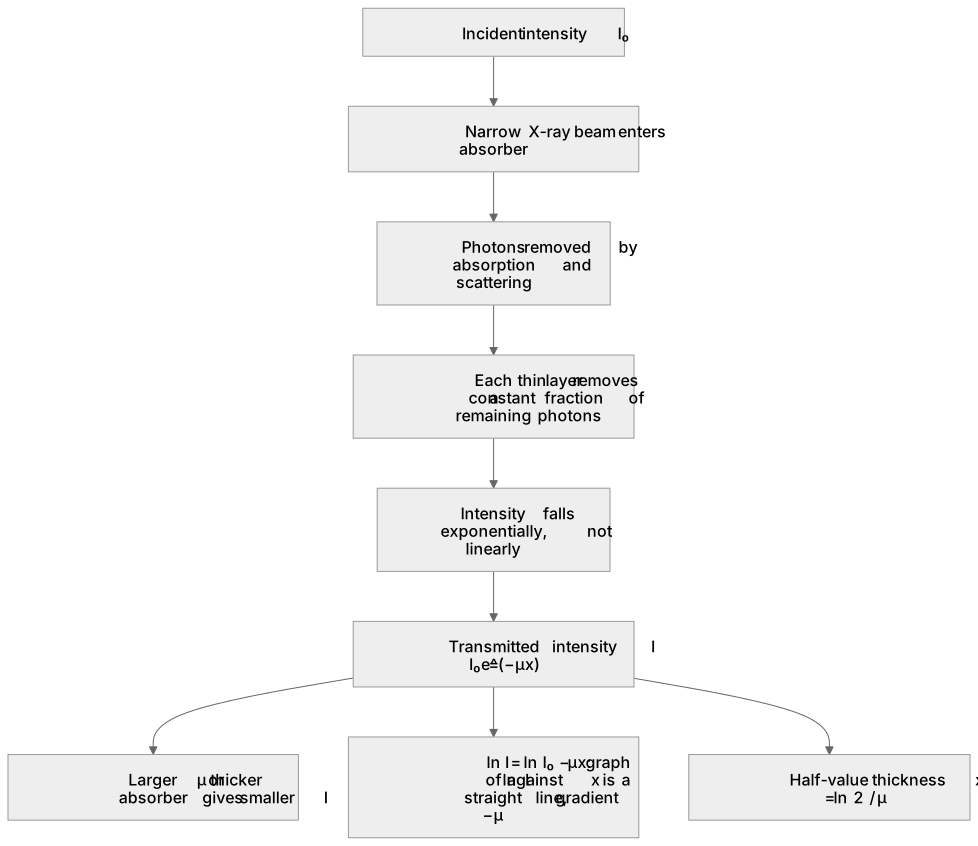
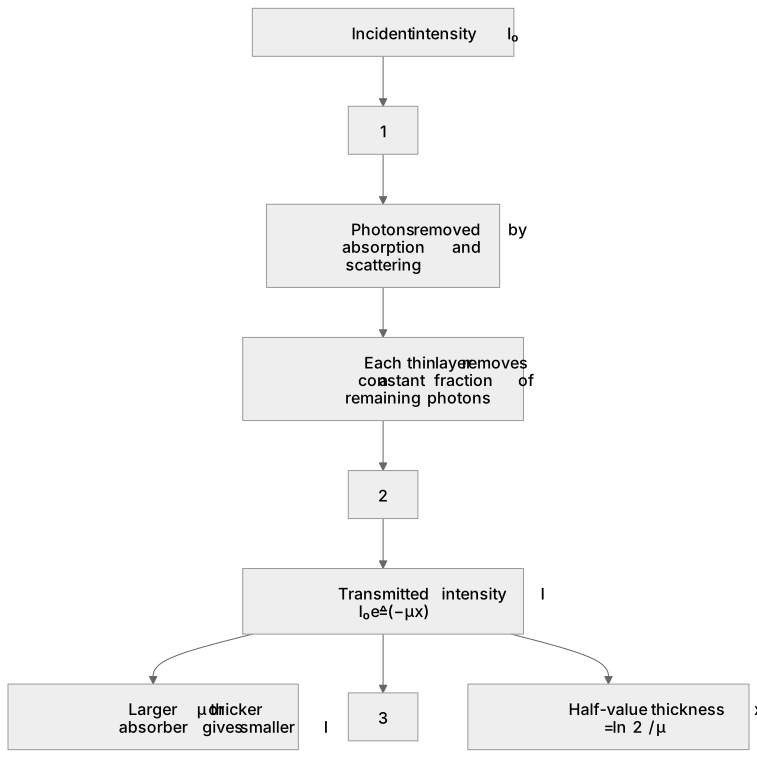
When a narrow beam of X-rays passes through matter, photons are removed by absorption and scattering, so the beam intensity falls. Because each thin layer removes a constant fraction of the photons still present, the decrease is exponential rather than linear. The transmitted intensity I after thickness x is I = I₀e^(−μx), where I₀ is the incident intensity and μ is the attenuation coefficient, measured in m⁻¹. A larger μ or a thicker absorber gives a smaller I. Taking natural logarithms gives ln I = ln I₀ − μx, so a graph of ln I against x is a straight line of gradient −μ. The half-value thickness x½, where I = I₀/2, is related to μ by x½ = ln 2 / μ. This explains why radiographers choose photon energies and shielding thicknesses carefully.
What earns the marks
- States that intensity decreases exponentially with absorber thickness because each equal layer removes the same fraction of the photons remaining.
- Recalls and applies I = I₀e^(−μx), identifying I₀ as incident intensity, I as transmitted intensity, μ as attenuation coefficient and x as thickness.
- Uses the linear form ln I = ln I₀ − μx to find μ from the gradient of a graph of ln I against x.
- Calculates half-value thickness from x½ = ln 2 / μ and explains that it is independent of the initial intensity.
- Explains that μ depends on the material and on photon energy, so comparison of absorbers requires like-for-like conditions.
- Interprets a steeper exponential curve or larger gradient as a larger attenuation coefficient and therefore a more strongly attenuating material.
Common mistakes and how to put them right
Treating attenuation as linear and subtracting a fixed intensity for each centimetre.
Put it right: The correct model is a constant fractional decrease, giving an exponential curve.
Using logarithms to base ten when the equation is written with e.
Put it right: Either use natural logarithms throughout or convert the coefficient consistently.
Forgetting to convert thickness to metres before dividing by μ, which gives a value of μ in the wrong unit.
Put it right: Convert mm or cm to m first.
Assuming half-value thickness depends on I₀.
Put it right: It is fixed by μ alone, so doubling the incident intensity does not change x½.
Exam tips
- Write the exponential equation before substituting numbers, then rearrange symbolically so the examiner can follow your method.
- When a graph of ln I against x is given, read the gradient from well-separated points on the line of best fit and quote μ with the unit m⁻¹.
- Check that your answer for transmitted intensity is less than the incident intensity; a value greater than I₀ signals a sign or rearrangement error.
- Link each calculation back to the physical situation, for example stating that a larger μ means more photons are removed per metre.
Try the lesson
The start of the Absorption of X-rays (A-level only): Exponential attenuation. lesson, made from checked teaching notes for this specification point.
Have a go first
A parallel beam of X-rays passes through a uniform absorber. Which statement describes how the intensity of the beam changes as the thickness of the absorber increases?
Listen
When a narrow beam of X-rays passes through matter, photons are removed by absorption and scattering, so the beam intensity falls. Because each thin layer removes a constant fraction of the photons still present, the decrease is exponential rather than linear. The transmitted intensity I after thickness x is I = I₀e^(−μx), where I₀ is the incident intensity and μ is the attenuation coefficient, measured in m⁻¹. A larger μ or a thicker absorber gives a smaller I. Taking natural logarithms gives ln I = ln I₀ − μx, so a graph of ln I against x is a straight line of gradient −μ. The half-value thickness x½, where I = I₀/2, is related to μ by x½ = ln 2 / μ. This explains why radiographers choose photon energies and shielding thicknesses carefully. A strong answer earns marks for these points. States that intensity decreases exponentially with absorber thickness because each equal layer removes the same fraction of the photons remaining. Recalls and applies I = I₀e^(−μx), identifying I₀ as incident intensity, I as transmitted intensity, μ as attenuation coefficient and x as thickness. Uses the linear form ln I = ln I₀ − μx to find μ from the gradient of a graph of ln I against x. Calculates half-value thickness from x½ = ln 2 / μ and explains that it is independent of the initial intensity. Exam tip: Write the exponential equation before substituting numbers, then rearrange symbolically so the examiner can follow your method.
See it
Key words
Say what each word means before you turn the card.
Exponential attenuation
Try answering aloud or in your head before turning the card.
Attenuation coefficient
Try answering aloud or in your head before turning the card.
Half-value thickness
Try answering aloud or in your head before turning the card.
Graphical analysis using natural logarithms
Try answering aloud or in your head before turning the card.
See every definition
- Exponential attenuation
- The decrease in beam intensity is exponential rather than linear because each thin layer removes a constant fraction of the photons still present.
- Attenuation coefficient
- The quantity μ in I = I₀e^(−μx), measured in m⁻¹, where a larger value or a thicker absorber gives a smaller transmitted intensity.
- Half-value thickness
- The thickness x½ at which I = I₀/2, related to μ by x½ = ln 2 / μ and independent of the initial intensity.
- Graphical analysis using natural logarithms
- Taking natural logarithms gives ln I = ln I₀ − μx, so a graph of ln I against x is a straight line of gradient −μ.
Label the diagram
Some boxes have lost their names. Pick the right name for each number.
1Box 1
2Box 2
3Box 3
There is more to this lesson
The full lesson goes on to check your understanding and help you earn the marks. Create a free account to carry on, with your progress saved.
A week of Premium from your first lesson · Then the free plan continues · No card, no charge
Test your understanding of Absorption of X-rays (A-level only): Exponential attenuation.
Active recall beats re-reading. Take an instant quiz now to test what you’ve learned and lock it into long-term memory.
A week of Premium from your first lesson · Then the free plan continues · No card, no charge