AQA · A-Level · Physics
Course version: 7408 · Version from Sept 2016
Students will be expected to identify the carrier frequency and the…
Full specification wording
Amplitude (AM) and frequency modulation (FM) techniques (A-level only): Students will be expected to identify the carrier frequency and the information frequency from a graph of the variation of signal voltage with time.
An amplitude-modulated signal is a fast carrier oscillation whose amplitude is slowly varied by the information signal.
Checked against the AQA 7408 specification (opens in a new tab) on .
- Point 4 of 5
- 3 key terms
Study notes
From the checked teaching notes for this specification point.
The idea
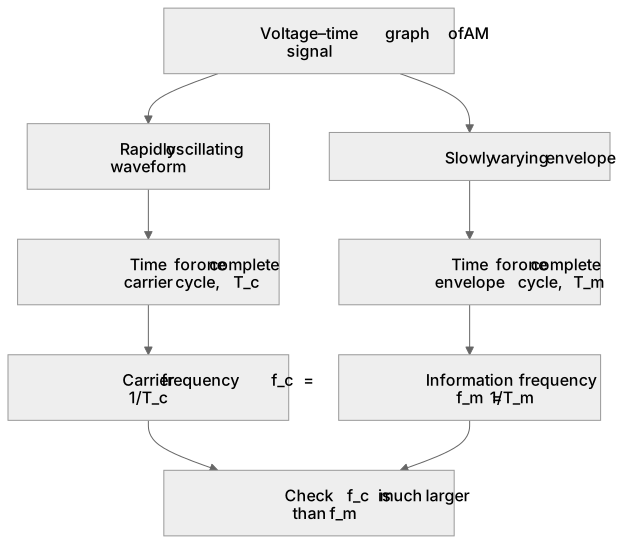
An amplitude-modulated signal is a fast carrier oscillation whose amplitude is slowly varied by the information signal. On a voltage–time graph the carrier appears as rapid oscillations, so its frequency is found from the short time for one complete carrier cycle: f_c = 1/T_c. The information frequency is the slow variation of the envelope, found from the longer time for one complete envelope cycle: f_m = 1/T_m. For example, if the carrier completes one cycle in 2.0 × 10⁻⁶ s then f_c = 5.0 × 10⁵ Hz, while an envelope cycle of 2.0 × 10⁻³ s gives f_m = 5.0 × 10² Hz. In FM the carrier frequency changes rather than the amplitude, but the same timing method identifies the information frequency from the pattern of frequency change.
What earns the marks
- Recognise that the rapidly oscillating waveform is the carrier and that its frequency is the reciprocal of the time for one complete carrier cycle.
- Recognise that the slower envelope, or the repeating pattern of frequency change in FM, represents the information signal.
- Read times from the graph using the scale, including any multiplier in the axis units, and convert to seconds before taking reciprocals.
- Calculate carrier frequency from f_c = 1/T_c and information frequency from f_m = 1/T_m, giving units of hertz.
- For FM, measure the time for one complete cycle of the repeating frequency pattern rather than the time for one carrier oscillation.
- Check that the carrier frequency is much larger than the information frequency, as expected for a practical communication system.
Common mistakes and how to put them right
Using the time for one envelope cycle as the carrier period.
Put it right by measuring the much shorter time between successive carrier peaks.
Forgetting to convert milliseconds, microseconds or nanoseconds to seconds before taking the reciprocal.
Put it right by applying the appropriate power of ten first.
Counting the number of carrier cycles in a fixed time and calling that the frequency without dividing by the time.
Put it right by dividing the number of cycles by the total time, or by using the period of one cycle.
Exam tips
- Mark two successive corresponding points on the carrier and read the time interval carefully against the grid.
- State clearly which feature of the graph you are timing, so the examiner can follow your reasoning.
- Give answers in hertz and use standard form where the frequency is very large or very small.
Try the lesson
The start of the Amplitude (AM) and frequency modulation (FM) techniques (A-level only): Students will be expected to identify the carrier frequency and the information frequency from a graph of the variation of signal voltage with time. lesson, made from checked teaching notes for this specification point.
Have a go first
An amplitude-modulated signal is displayed on an oscilloscope. The fast oscillations of the carrier wave repeat every 2.0 µs, and the slow variation of the envelope repeats every 50 µs. What is the carrier frequency of this signal?
Listen
An amplitude-modulated signal is a fast carrier oscillation whose amplitude is slowly varied by the information signal. On a voltage–time graph the carrier appears as rapid oscillations, so its frequency is found from the short time for one complete carrier cycle: f_c = 1/T_c. The information frequency is the slow variation of the envelope, found from the longer time for one complete envelope cycle: f_m = 1/T_m. For example, if the carrier completes one cycle in 2.0 × 10⁻⁶ s then f_c = 5.0 × 10⁵ Hz, while an envelope cycle of 2.0 × 10⁻³ s gives f_m = 5.0 × 10² Hz. In FM the carrier frequency changes rather than the amplitude, but the same timing method identifies the information frequency from the pattern of frequency change. A strong answer earns marks for these points. Recognise that the rapidly oscillating waveform is the carrier and that its frequency is the reciprocal of the time for one complete carrier cycle. Recognise that the slower envelope, or the repeating pattern of frequency change in FM, represents the information signal. Read times from the graph using the scale, including any multiplier in the axis units, and convert to seconds before taking reciprocals. Calculate carrier frequency from f_c = 1/T_c and information frequency from f_m = 1/T_m, giving units of hertz. A common slip: Using the time for one envelope cycle as the carrier period. Instead, measuring the much shorter time between successive carrier peaks. Exam tip: Mark two successive corresponding points on the carrier and read the time interval carefully against the grid.
See it
Key words
Say what each word means before you turn the card.
Carrier wave
Try answering aloud or in your head before turning the card.
Information signal
Try answering aloud or in your head before turning the card.
Frequency and period relationship
Try answering aloud or in your head before turning the card.
See every definition
- Carrier wave
- The rapidly oscillating waveform whose frequency is the reciprocal of the time for one complete carrier cycle.
- Information signal
- The slower envelope, or the repeating pattern of frequency change in FM, representing the information signal.
- Frequency and period relationship
- Frequency is the reciprocal of the time for one complete cycle, so carrier frequency is found from f_c = 1/T_c and information frequency from f_m = 1/T_m.
Label the diagram
Some boxes have lost their names. Pick the right name for each number.

1Box 1
2Box 2
3Box 3
There is more to this lesson
The full lesson goes on to check your understanding and help you earn the marks. Create a free account to carry on, with your progress saved.
A week of Premium from your first lesson · Then the free plan continues · No card, no charge
Test your understanding of Amplitude (AM) and frequency modulation (FM) techniques (A-level only): Students will be expected to identify the carrier frequency and the information frequency from a graph of the variation of signal voltage with time.
Active recall beats re-reading. Take an instant quiz now to test what you’ve learned and lock it into long-term memory.
A week of Premium from your first lesson · Then the free plan continues · No card, no charge