AQA · A-Level · Physics
Course version: 7408 · Version from Sept 2016
Application of the conservation laws for charge, baryon number, lepton…
Full specification wording
Applications of conservation laws: Application of the conservation laws for charge, baryon number, lepton number and strangeness to particle interactions.
Particle interactions must satisfy conservation laws.
Checked against the AQA 7408 specification (opens in a new tab) on .
- Point 2 of 3
- 4 key terms
Study notes
From the checked teaching notes for this specification point.
The idea
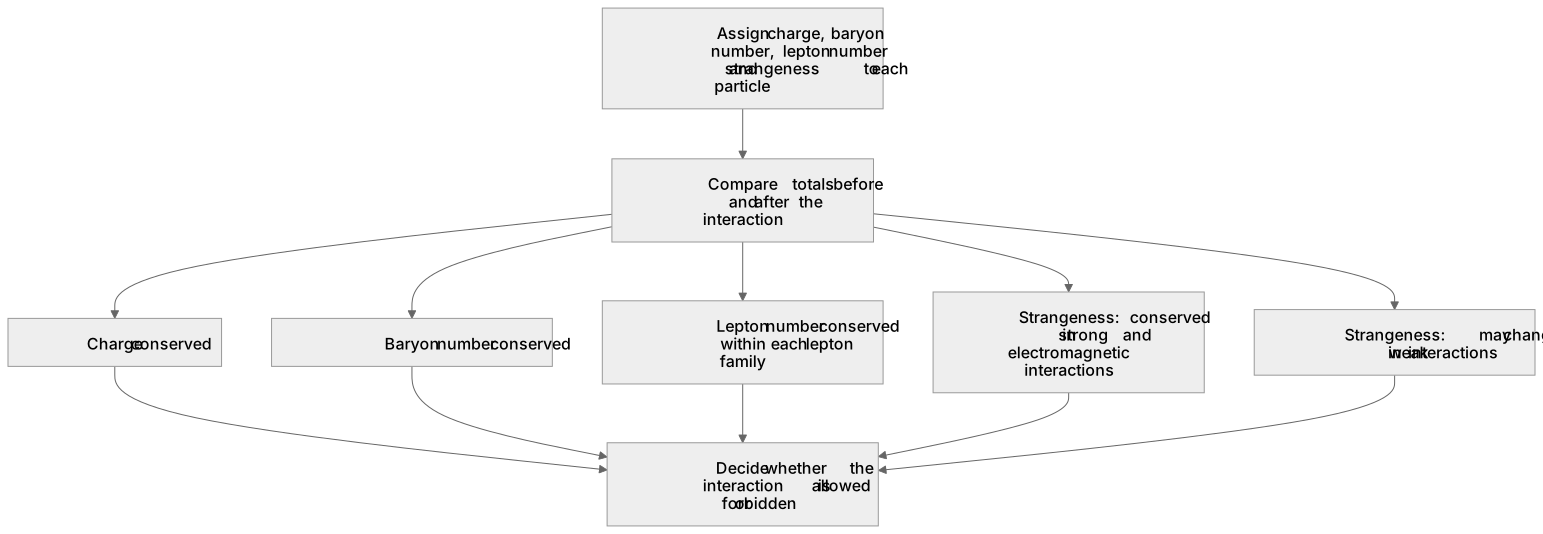
Particle interactions must satisfy conservation laws. Charge and baryon number are always conserved. Lepton number is conserved within each lepton family. Strangeness is conserved in strong and electromagnetic interactions but may change in weak interactions. To test an interaction, assign charge, baryon number, lepton number and strangeness to each particle, then compare totals. For example, in the strong interaction π⁻ + p → K⁰ + Λ, strangeness is conserved because the initial strangeness is 0 and the final strangeness is 0 (K⁰ is +1, Λ is −1). In a weak decay such as Λ → p + π⁻, strangeness changes from −1 to 0, which is allowed because the interaction is weak.
What earns the marks
- Assign charge to each particle and show that the total charge before and after an interaction is equal.
- Assign baryon number 1 to baryons, −1 to antibaryons and 0 to mesons and leptons, then show that the total is unchanged.
- Assign lepton number 1 to leptons, −1 to antileptons and 0 to hadrons, then show that the total is unchanged within each lepton family.
- Assign strangeness 0 to non-strange particles, −1 to strange particles such as K⁻ and Λ, and +1 to particles such as K⁺ and K⁰, then compare totals.
- State that strangeness is conserved in strong and electromagnetic interactions but can change in weak interactions.
- Use conservation laws to decide whether a proposed interaction is allowed or forbidden.
- Identify the interaction type from the particles involved and the conservation behaviour, for example a change in strangeness indicates a weak interaction.
- Apply the laws to examples such as β decay, pion–nucleon scattering and strange-particle decays.
Common mistakes and how to put them right
Giving mesons a baryon number of 1.
Put it right: Mesons have baryon number 0.
Treating strangeness as always conserved.
Put it right: Strangeness can change in weak interactions.
Confusing lepton number with baryon number.
Put it right: Assign lepton number only to leptons and antileptons.
Forgetting that antiparticles have opposite baryon number, lepton number and strangeness to their particles.
Exam tips
- Make a table of charge, baryon number, lepton number and strangeness for each particle before comparing totals.
- State the interaction type first, then use it to decide whether strangeness must be conserved.
- Check each conservation law separately rather than combining them in one step.
- Use the quark composition of hadrons to check baryon number and strangeness when unsure.
Try the lesson
The start of the Applications of conservation laws: Application of the conservation laws for charge, baryon number, lepton number and strangeness to particle interactions. lesson, made from checked teaching notes for this specification point.
Have a go first
Which of the following proposed particle interactions violates the conservation of baryon number?
Listen
Particle interactions must satisfy conservation laws. Charge and baryon number are always conserved. Lepton number is conserved within each lepton family. Strangeness is conserved in strong and electromagnetic interactions but may change in weak interactions. To test an interaction, assign charge, baryon number, lepton number and strangeness to each particle, then compare totals. For example, in the strong interaction π⁻ + p → K⁰ + Λ, strangeness is conserved because the initial strangeness is 0 and the final strangeness is 0 (K⁰ is +1, Λ is −1). In a weak decay such as Λ → p + π⁻, strangeness changes from −1 to 0, which is allowed because the interaction is weak. A strong answer earns marks for these points. Assign charge to each particle and show that the total charge before and after an interaction is equal. Assign baryon number 1 to baryons, −1 to antibaryons and 0 to mesons and leptons, then show that the total is unchanged. Assign lepton number 1 to leptons, −1 to antileptons and 0 to hadrons, then show that the total is unchanged within each lepton family. Assign strangeness 0 to non-strange particles, −1 to strange particles such as K⁻ and Λ, and +1 to particles such as K⁺ and K⁰, then compare totals. A common slip: Giving mesons a baryon number of 1. Instead, mesons have baryon number 0. Exam tip: Make a table of charge, baryon number, lepton number and strangeness for each particle before comparing totals.
See it
Key words
Say what each word means before you turn the card.
Charge and baryon number conservation
Try answering aloud or in your head before turning the card.
Lepton number conservation
Try answering aloud or in your head before turning the card.
Strangeness and the weak interaction
Try answering aloud or in your head before turning the card.
Conservation laws in particle physics
Try answering aloud or in your head before turning the card.
See every definition
- Charge and baryon number conservation
- Charge and baryon number are always conserved, so the totals before and after an interaction are equal.
- Lepton number conservation
- Lepton number is conserved within each lepton family, with 1 for leptons, −1 for antileptons and 0 for hadrons.
- Strangeness and the weak interaction
- Strangeness is conserved in strong and electromagnetic interactions but may change in weak interactions.
- Conservation laws in particle physics
- Particle interactions must satisfy conservation laws, and comparing totals decides whether a proposed interaction is allowed or forbidden.
Label the diagram
Some boxes have lost their names. Pick the right name for each number.
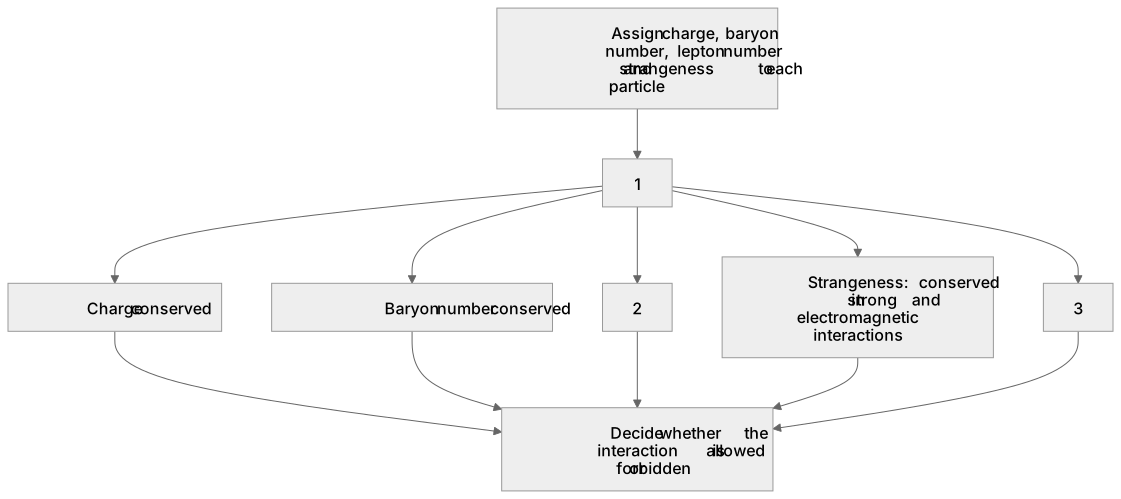
1Box 1
2Box 2
3Box 3
There is more to this lesson
The full lesson goes on to check your understanding and help you earn the marks. Create a free account to carry on, with your progress saved.
A week of Premium from your first lesson · Then the free plan continues · No card, no charge
Test your understanding of Applications of conservation laws: Application of the conservation laws for charge, baryon number, lepton number and strangeness to particle interactions.
Active recall beats re-reading. Take an instant quiz now to test what you’ve learned and lock it into long-term memory.
A week of Premium from your first lesson · Then the free plan continues · No card, no charge