AQA · A-Level · Physics
Course version: 7408 · Version from Sept 2016
Ray diagram to show the image formation in normal adjustment.
Full specification wording
Astronomical telescope consisting of two converging lenses (A-level only): Ray diagram to show the image formation in normal adjustment.
Draw a set of parallel rays entering the objective lens at an angle to the principal axis, rather than from a finite object.
Checked against the AQA 7408 specification (opens in a new tab) on .
- Point 1 of 2
- 4 key terms
Study notes
From the checked teaching notes for this specification point.
The idea
Draw a set of parallel rays entering the objective lens at an angle to the principal axis, rather than from a finite object. Initial logic and parameters are validated. An astronomical telescope in normal adjustment uses a long focal length objective and short focal length eyepiece. The non-axial parallel rays form a real intermediate image at the objective's focal plane. The eyepiece is positioned so this image lies at its principal focus. Rays leave the eyepiece parallel, allowing viewing without accommodation. The intermediate image sits exactly at the shared focal plane of both lenses.
What earns the marks
- Draws two converging lenses on a common principal axis with the objective of longer focal length than the eyepiece.
- Shows non-axial parallel rays from a distant object incident on the objective lens.
- Locates the real intermediate image at the focal plane of the objective.
- Places the intermediate image at the principal focus of the eyepiece so emergent rays are parallel.
Common mistakes and how to put them right
Drawing rays from a finite object point on the axis.
Put it right: Draw parallel rays entering at an angle to the principal axis.
Drawing the intermediate image beyond the eyepiece focal point.
Put it right by placing it at the eyepiece principal focus for normal adjustment.
Showing emergent rays converging or diverging.
Put it right by drawing them parallel to each other.
Exam tips
- Use a ruler and draw rays as straight lines with arrowheads showing direction.
- Mark focal points clearly with F or F′ so the examiner can follow your construction.
Try the lesson
The start of the Astronomical telescope consisting of two converging lenses (A-level only): Ray diagram to show the image formation in normal adjustment. lesson, made from checked teaching notes for this specification point.
Have a go first
In a ray diagram of an astronomical telescope in normal adjustment, where is the final image formed?
Listen
Draw a set of parallel rays entering the objective lens at an angle to the principal axis, rather than from a finite object. Initial logic and parameters are validated. An astronomical telescope in normal adjustment uses a long focal length objective and short focal length eyepiece. The non-axial parallel rays form a real intermediate image at the objective's focal plane. The eyepiece is positioned so this image lies at its principal focus. Rays leave the eyepiece parallel, allowing viewing without accommodation. The intermediate image sits exactly at the shared focal plane of both lenses. A strong answer earns marks for these points. Draws two converging lenses on a common principal axis with the objective of longer focal length than the eyepiece. Shows non-axial parallel rays from a distant object incident on the objective lens. Locates the real intermediate image at the focal plane of the objective. Places the intermediate image at the principal focus of the eyepiece so emergent rays are parallel. A common slip: Drawing rays from a finite object point on the axis. Instead, draw parallel rays entering at an angle to the principal axis. Exam tip: Use a ruler and draw rays as straight lines with arrowheads showing direction.
See it
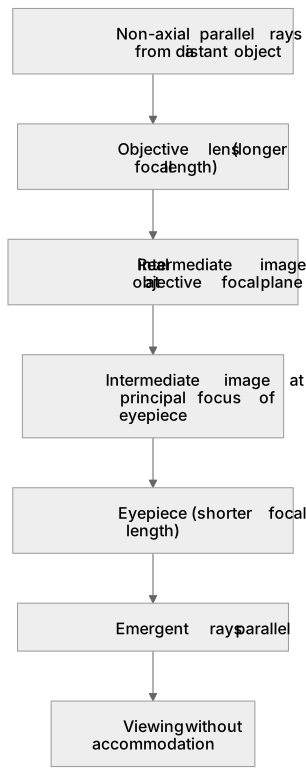
Put it in order
Put these steps in the order they happen.
- 1. Viewing without accommodation
- 2. Emergent rays parallel
- 3. Real intermediate image at objective focal plane
- 4. Eyepiece (shorter focal length)
- 5. Non-axial parallel rays from a distant object
- 6. Objective lens (longer focal length)
- 7. Intermediate image at principal focus of eyepiece
Key words
Say what each word means before you turn the card.
Normal adjustment
Try answering aloud or in your head before turning the card.
Intermediate image
Try answering aloud or in your head before turning the card.
Objective
Try answering aloud or in your head before turning the card.
Eyepiece
Try answering aloud or in your head before turning the card.
See every definition
- Normal adjustment
- The eyepiece is positioned so the intermediate image lies at its principal focus, and rays leave the eyepiece parallel, allowing viewing without accommodation.
- Intermediate image
- A real image formed at the objective's focal plane by non-axial parallel rays, sitting exactly at the shared focal plane of both lenses.
- Objective
- A converging lens of longer focal length than the eyepiece, on a common principal axis, on which non-axial parallel rays from a distant object are incident.
- Eyepiece
- A converging lens of short focal length placed so the intermediate image lies at its principal focus, so emergent rays are parallel.
Label the diagram
Some boxes have lost their names. Pick the right name for each number.
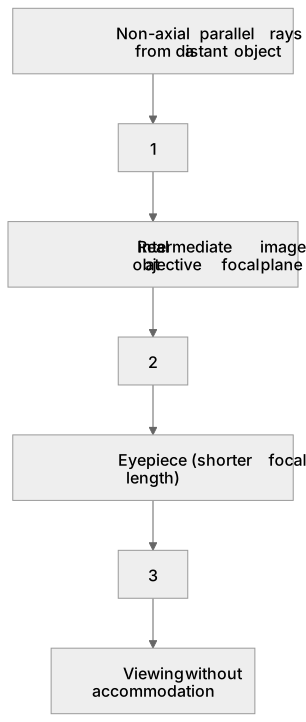
1Box 1
2Box 2
3Box 3
There is more to this lesson
The full lesson goes on to check your understanding and help you earn the marks. Create a free account to carry on, with your progress saved.
A week of Premium from your first lesson · Then the free plan continues · No card, no charge
Test your understanding of Astronomical telescope consisting of two converging lenses (A-level only): Ray diagram to show the image formation in normal adjustment.
Active recall beats re-reading. Take an instant quiz now to test what you’ve learned and lock it into long-term memory.
A week of Premium from your first lesson · Then the free plan continues · No card, no charge