AQA · A-Level · Physics
Course version: 7408 · Version from Sept 2016
Electric current as the rate of flow of charge; potential difference as…
Full specification wording
Basics of electricity: Electric current as the rate of flow of charge; potential difference as work done per unit charge.
Electric current is the rate of flow of charge, I = ΔQ/Δt, so one ampere is one coulomb per second.
Checked against the AQA 7408 specification (opens in a new tab) on .
- 4 key terms
Study notes
From the checked teaching notes for this specification point.
The idea
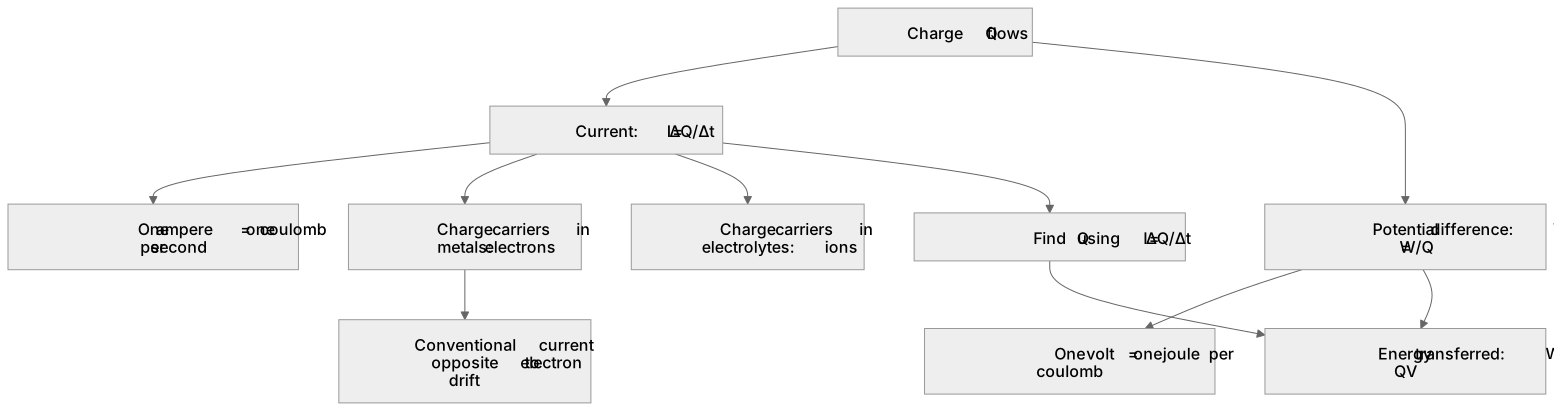
Electric current is the rate of flow of charge, I = ΔQ/Δt, so one ampere is one coulomb per second. In a metal, electrons drift through the lattice; in an electrolyte, positive and negative ions move in opposite directions. Potential difference is the work done per unit charge, V = W/Q, so one volt is one joule per coulomb. When charge Q moves through a component with potential difference V, the work done is W = QV.
For example: A 12 V battery driving 2.0 A for 5.0 s transfers charge Q = It = 10 C and energy W = QV = 120 J. These definitions underpin circuit analysis and energy transfer calculations.
What earns the marks
- States current as rate of flow of charge: I = ΔQ/Δt, with Q in coulombs, t in seconds, I in amperes.
- Explains that one ampere equals one coulomb per second.
- Defines potential difference as work done per unit charge: V = W/Q, with W in joules, Q in coulombs, V in volts.
- Explains that one volt equals one joule per coulomb.
- Applies W = QV to calculate energy transferred when charge moves through a potential difference.
- Describes charge carriers in metals as electrons and in electrolytes as ions, and notes conventional current direction.
- Uses consistent units and prefixes when substituting into I = ΔQ/Δt or V = W/Q.
Common mistakes and how to put them right
Confusing current with charge.
Put it right by writing I = ΔQ/Δt and checking units.
Reversing the definition of potential difference as charge per unit work done.
Put it right by stating V = W/Q and checking that the unit is J C⁻¹.
Using the wrong time interval or forgetting to convert minutes to seconds.
Put it right by converting all times to seconds before calculating charge or current.
Assuming conventional current direction is the same as electron flow in metals.
Put it right by stating that conventional current is opposite to electron drift.
Exam tips
- Write the defining equation before substituting numbers; this makes the physics clear and helps secure method marks.
- Check units carefully: convert mA to A, minutes to seconds, and kJ to J before calculating.
- When explaining definitions, use the phrase 'per unit charge' or 'per second' precisely, as these are the key ideas being tested.
- For energy transfer questions, identify Q first using I = ΔQ/Δt, then use W = QV.
Try the lesson
The start of the Basics of electricity: Electric current as the rate of flow of charge; potential difference as work done per unit charge. lesson, made from checked teaching notes for this specification point.
Have a go first
A steady current of 2.0 A flows through a wire for 5.0 s. What is the total charge that passes a point in the wire?
Listen
Electric current is the rate of flow of charge, I = ΔQ/Δt, so one ampere is one coulomb per second. In a metal, electrons drift through the lattice; in an electrolyte, positive and negative ions move in opposite directions. Potential difference is the work done per unit charge, V = W/Q, so one volt is one joule per coulomb. When charge Q moves through a component with potential difference V, the work done is W = QV. For example, a 12 V battery driving 2.0 A for 5.0 s transfers charge Q = It = 10 C and energy W = QV = 120 J. These definitions underpin circuit analysis and energy transfer calculations. A strong answer earns marks for these points. States current as rate of flow of charge: I = ΔQ/Δt, with Q in coulombs, t in seconds, I in amperes. Explains that one ampere equals one coulomb per second. Defines potential difference as work done per unit charge: V = W/Q, with W in joules, Q in coulombs, V in volts. Explains that one volt equals one joule per coulomb. A common slip: Confusing current with charge: current is the rate of flow of charge, not the total charge. Instead, writing I = ΔQ/Δt and checking units. Exam tip: Write the defining equation before substituting numbers; this makes the physics clear and helps secure method marks.
See it
Key words
Say what each word means before you turn the card.
Electric current
Try answering aloud or in your head before turning the card.
Potential difference
Try answering aloud or in your head before turning the card.
Charge carriers and current direction
Try answering aloud or in your head before turning the card.
Energy transfer in circuits
Try answering aloud or in your head before turning the card.
See every definition
- Electric current
- The rate of flow of charge, given by I = ΔQ/Δt, so one ampere is one coulomb per second.
- Potential difference
- The work done per unit charge, given by V = W/Q, so one volt is one joule per coulomb.
- Charge carriers and current direction
- In a metal, electrons drift through the lattice; in an electrolyte, positive and negative ions move in opposite directions, and conventional current direction is noted.
- Energy transfer in circuits
- When charge Q moves through a component with potential difference V, the work done is W = QV.
Label the diagram
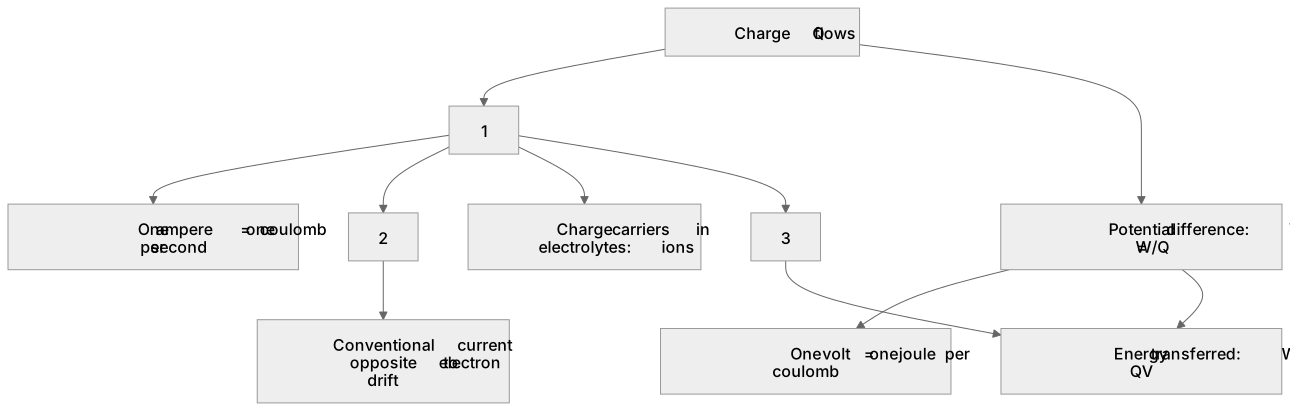
Some boxes have lost their names. Pick the right name for each number.
1Box 1
2Box 2
3Box 3
There is more to this lesson
The full lesson goes on to check your understanding and help you earn the marks. Create a free account to carry on, with your progress saved.
A week of Premium from your first lesson · Then the free plan continues · No card, no charge
Test your understanding of Basics of electricity: Electric current as the rate of flow of charge; potential difference as work done per unit charge.
Active recall beats re-reading. Take an instant quiz now to test what you’ve learned and lock it into long-term memory.
A week of Premium from your first lesson · Then the free plan continues · No card, no charge