AQA · A-Level · Physics
Course version: 7408 · Version from Sept 2016
Interpretation of gradients and areas under graphs where appropriate.
Full specification wording
Capacitor charge and discharge (A-level only): Interpretation of gradients and areas under graphs where appropriate.
Graphs summarise how capacitor quantities change with time.
Checked against the AQA 7408 specification (opens in a new tab) on .
- Point 3 of 5
- 4 key terms
Study notes
From the checked teaching notes for this specification point.
The idea
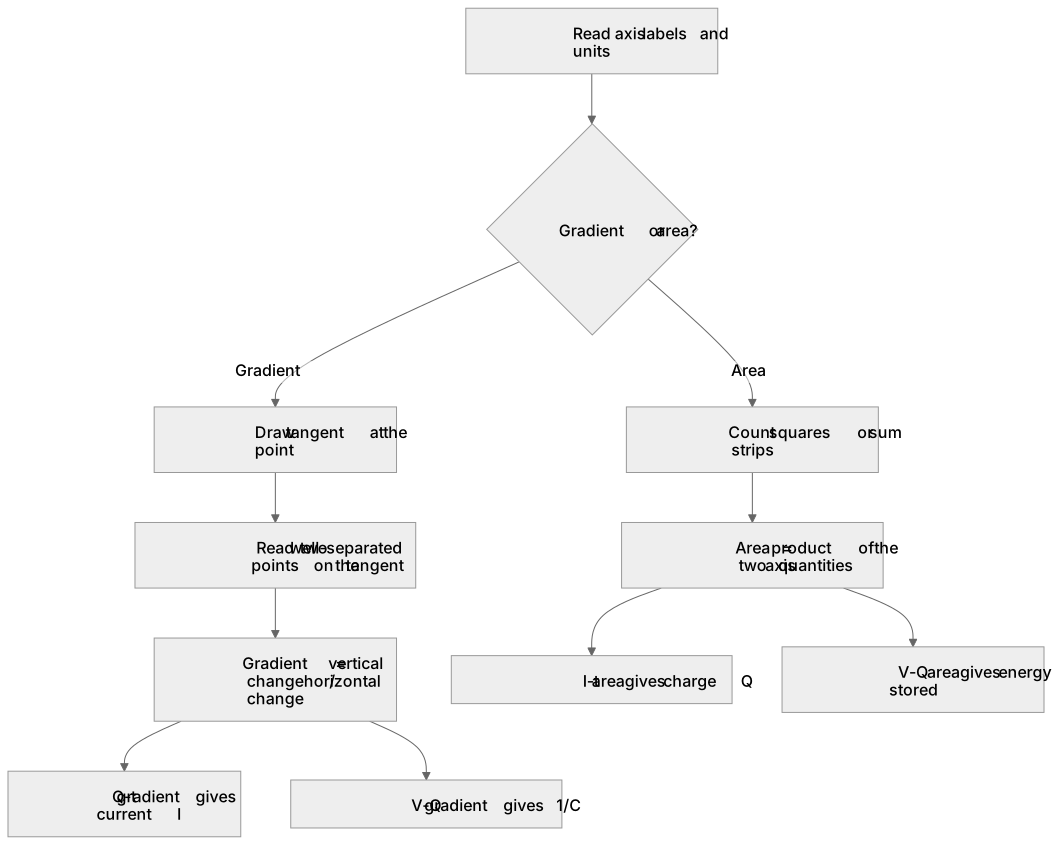
Graphs summarise how capacitor quantities change with time. A gradient is the rate of change of the vertical quantity with respect to the horizontal quantity, found by drawing a tangent and dividing the vertical change by the horizontal change. An area under a graph is found by counting squares or by approximating with strips, and it equals the product of the two axis quantities. In capacitor work, a graph of charge Q against time has gradient equal to current I, because I = ΔQ/Δt. A graph of current I against time has area equal to charge Q, because Q = IΔt. A graph of potential difference V against charge Q has gradient equal to 1/C, since V = Q/C, and its area equals the energy stored, since W = ½QV. Always read axis labels and units before choosing a method.
What earns the marks
- Identifies the gradient as the rate of change of the vertical quantity with respect to the horizontal quantity, and states the unit as the vertical unit divided by the horizontal unit.
- Draws a tangent at the required point and reads two well-separated points on the tangent to calculate the gradient, rather than using two data points on a curve.
- Recognises that the area under a graph equals the product of the two axis quantities, and estimates it by counting squares or by summing strips.
- Applies the capacitor relationships: gradient of Q–t gives current I; area under I–t gives charge Q; gradient of V–Q gives 1/C; area under V–Q gives energy stored ½QV.
- Checks that the sign and magnitude of a gradient or area are physically sensible for the process, for example a discharging capacitor has a negative dQ/dt and therefore a negative current.
- Uses consistent SI units throughout, converting millicoulombs to coulombs, microfarads to farads and milliseconds to seconds before calculating.
Common mistakes and how to put them right
Using two points on a curved graph to find a gradient instead of drawing a tangent at the required point.
Put it right: Draw a tangent that touches the curve at that point and to read two points on the tangent itself.
Confusing the roles of gradient and area, for example treating the area under a Q–t graph as current.
Put it right: Check the units, since the area under Q–t has units C·s, which is not current.
Forgetting to convert prefixes before calculating, such as using microfarads as farads.
Put it right: Convert every quantity to SI base or coherent units first, so that 47 μF becomes 47 × 10⁻⁶ F.
Exam tips
- Annotate the graph with the tangent or the counted squares so the examiner can see your method, and state the coordinates you used.
- Quote the gradient or area with its unit, and comment on what the value means physically in the context of the capacitor.
- When estimating an area, show the number of squares and the value of one square, then multiply, so partial credit is clear.
Try the lesson
The start of the Capacitor charge and discharge (A-level only): Interpretation of gradients and areas under graphs where appropriate. lesson, made from checked teaching notes for this specification point.
Have a go first
A capacitor discharges through a resistor. A graph is plotted of charge Q on the capacitor against time t. What does the gradient of this graph represent?
Listen
Graphs summarise how capacitor quantities change with time. A gradient is the rate of change of the vertical quantity with respect to the horizontal quantity, found by drawing a tangent and dividing the vertical change by the horizontal change. An area under a graph is found by counting squares or by approximating with strips, and it equals the product of the two axis quantities. In capacitor work, a graph of charge Q against time has gradient equal to current I, because I = ΔQ/Δt. A graph of current I against time has area equal to charge Q, because Q = IΔt. A graph of potential difference V against charge Q has gradient equal to 1/C, since V = Q/C, and its area equals the energy stored, since W = ½QV. Always read axis labels and units before choosing a method. A strong answer earns marks for these points. Identifies the gradient as the rate of change of the vertical quantity with respect to the horizontal quantity, and states the unit as the vertical unit divided by the horizontal unit. Draws a tangent at the required point and reads two well-separated points on the tangent to calculate the gradient, rather than using two data points on a curve. Recognises that the area under a graph equals the product of the two axis quantities, and estimates it by counting squares or by summing strips. Applies the capacitor relationships: gradient of Q–t gives current I; area under I–t gives charge Q; gradient of V–Q gives 1/C; area under V–Q gives energy stored ½QV. A common slip: Using two points on a curved graph to find a gradient instead of drawing a tangent at the required point. Instead, draw a tangent that touches the curve at that point and to read two points on the tangent itself. Exam tip: Annotate the graph with the tangent or the counted squares so the examiner can see your method, and state the coordinates you used.
See it
Key words
Say what each word means before you turn the card.
Gradient
Try answering aloud or in your head before turning the card.
Area under a graph
Try answering aloud or in your head before turning the card.
Tangent
Try answering aloud or in your head before turning the card.
Unit analysis
Try answering aloud or in your head before turning the card.
See every definition
- Gradient
- The rate of change of the vertical quantity with respect to the horizontal quantity, found by drawing a tangent and dividing the vertical change by the horizontal change.
- Area under a graph
- Found by counting squares or by approximating with strips, and it equals the product of the two axis quantities.
- Tangent
- Drawn at the required point, with two well-separated points read on it to calculate the gradient rather than using two data points on a curve.
- Unit analysis
- A check on the meaning of a gradient or area, since the gradient's unit is the vertical unit divided by the horizontal unit and the area's unit is the product of the two axis quantities.
There is more to this lesson
The full lesson goes on to check your understanding and help you earn the marks. Create a free account to carry on, with your progress saved.
A week of Premium from your first lesson · Then the free plan continues · No card, no charge
Test your understanding of Capacitor charge and discharge (A-level only): Interpretation of gradients and areas under graphs where appropriate.
Active recall beats re-reading. Take an instant quiz now to test what you’ve learned and lock it into long-term memory.
A week of Premium from your first lesson · Then the free plan continues · No card, no charge