AQA · A-Level · Physics
Course version: 7408 · Version from Sept 2016
Brightness is a subjective scale of measurement.
Full specification wording
Classification by luminosity (A-level only): Brightness is a subjective scale of measurement.
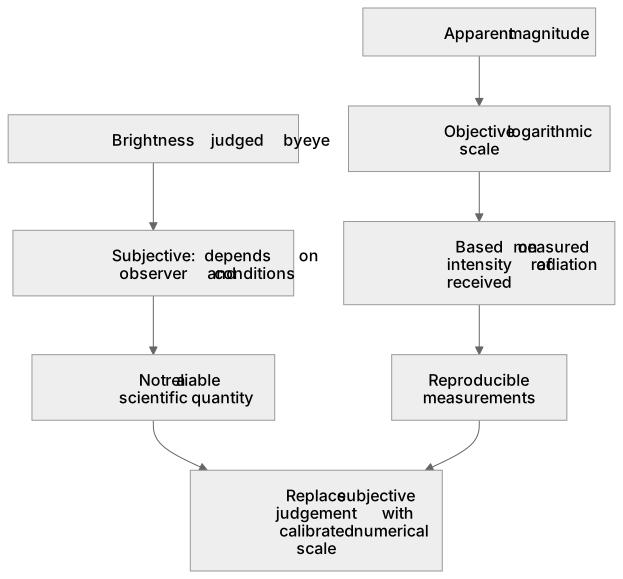
Brightness as perceived by the human eye is subjective: it depends on the observer, viewing conditions and the eye's response, so it is not a reliable scientific quantity.
Checked against the AQA 7408 specification (opens in a new tab) on .
- Point 5 of 5
- 4 key terms
Study notes
From the checked teaching notes for this specification point.
The idea
Brightness as perceived by the human eye is subjective: it depends on the observer, viewing conditions and the eye's response, so it is not a reliable scientific quantity. Apparent magnitude is the objective, logarithmic scale astronomers use instead. It compares the intensity of radiation received from a star with a reference value, so measurements are reproducible. For example, two observers might disagree about which of two nearby stars looks brighter, but a light meter or CCD detector gives the same intensity ratio every time. The magnitude scale therefore replaces subjective judgement with a calibrated numerical scale.
What earns the marks
- State that brightness judged by eye is subjective because it depends on the observer and conditions.
- Contrast subjective brightness with apparent magnitude, which is an objective logarithmic scale.
- Explain that apparent magnitude is based on measured intensity of radiation received, not on human perception.
- Give a method of making the comparison objective, such as using a light meter, CCD detector or calibrated photometer.
- Recognise that the magnitude scale is defined so that a difference of 1 corresponds to an intensity ratio of 2.51.
Common mistakes and how to put them right
Claiming that apparent magnitude is subjective.
Put it right by stating that apparent magnitude is an objective measure based on received intensity.
Confusing brightness with luminosity.
Put it right by stating that luminosity is the total power radiated by a star, while brightness or apparent magnitude depends on distance and observed intensity.
Assuming the eye responds linearly to intensity.
Put it right by noting that human perception is not a reliable linear measure, which is why a logarithmic scale is used.
Exam tips
- Use the word subjective only for human perception, and objective for measured quantities such as apparent magnitude.
- When comparing stars, refer to intensity or apparent magnitude rather than how bright they look.
- Link the logarithmic nature of the magnitude scale to the need for an objective measure.
Try the lesson
The start of the Classification by luminosity (A-level only): Brightness is a subjective scale of measurement. lesson, made from checked teaching notes for this specification point.
Have a go first
Why is brightness described as a subjective scale of measurement when classifying stars by luminosity?
Listen
Brightness as perceived by the human eye is subjective: it depends on the observer, viewing conditions and the eye's response, so it is not a reliable scientific quantity. Apparent magnitude is the objective, logarithmic scale astronomers use instead. It compares the intensity of radiation received from a star with a reference value, so measurements are reproducible. For example, two observers might disagree about which of two nearby stars looks brighter, but a light meter or CCD detector gives the same intensity ratio every time. The magnitude scale therefore replaces subjective judgement with a calibrated numerical scale. A strong answer earns marks for these points. State that brightness judged by eye is subjective because it depends on the observer and conditions. Contrast subjective brightness with apparent magnitude, which is an objective logarithmic scale. Explain that apparent magnitude is based on measured intensity of radiation received, not on human perception. Give a method of making the comparison objective, such as using a light meter, CCD detector or calibrated photometer. A common slip: Claiming that apparent magnitude is subjective. Instead, stating that apparent magnitude is an objective measure based on received intensity. Exam tip: Use the word subjective only for human perception, and objective for measured quantities such as apparent magnitude.
See it
Key words
Say what each word means before you turn the card.
Brightness
Try answering aloud or in your head before turning the card.
Apparent magnitude
Try answering aloud or in your head before turning the card.
Intensity of radiation received
Try answering aloud or in your head before turning the card.
Logarithmic scale
Try answering aloud or in your head before turning the card.
See every definition
- Brightness
- A subjective scale of measurement that depends on the observer, viewing conditions and the eye's response, so it is not a reliable scientific quantity.
- Apparent magnitude
- The objective, logarithmic scale astronomers use instead, comparing the intensity of radiation received from a star with a reference value so measurements are reproducible.
- Intensity of radiation received
- The measured quantity on which apparent magnitude is based, rather than human perception, giving the same intensity ratio every time with a light meter or CCD detector.
- Logarithmic scale
- The nature of the magnitude scale, used because human perception is not a reliable linear measure, replacing subjective judgement with a calibrated numerical scale.
Label the diagram
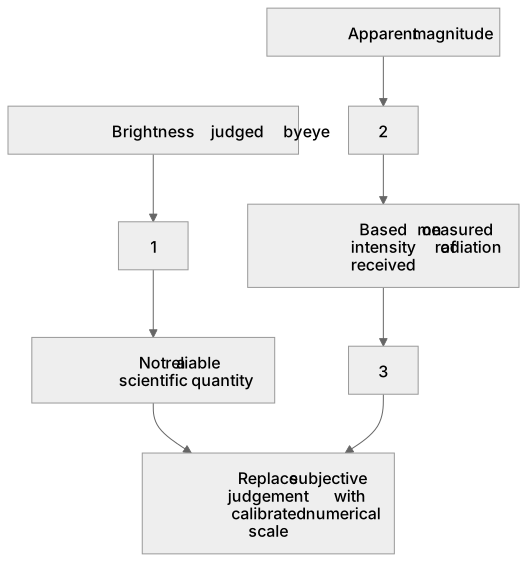
Some boxes have lost their names. Pick the right name for each number.
1Box 1
2Box 2
3Box 3
There is more to this lesson
The full lesson goes on to check your understanding and help you earn the marks. Create a free account to carry on, with your progress saved.
A week of Premium from your first lesson · Then the free plan continues · No card, no charge
Test your understanding of Classification by luminosity (A-level only): Brightness is a subjective scale of measurement.
Active recall beats re-reading. Take an instant quiz now to test what you’ve learned and lock it into long-term memory.
A week of Premium from your first lesson · Then the free plan continues · No card, no charge