AQA · A-Level · Physics
Course version: 7408 · Version from Sept 2016
Classification by luminosity (A-level only): The Hipparcos scale.
The Hipparcos scale is the historical magnitude system used to classify how bright stars appear from Earth.
Checked against the AQA 7408 specification (opens in a new tab) on .
- Point 2 of 5
- 4 key terms
Study notes
From the checked teaching notes for this specification point.
The idea
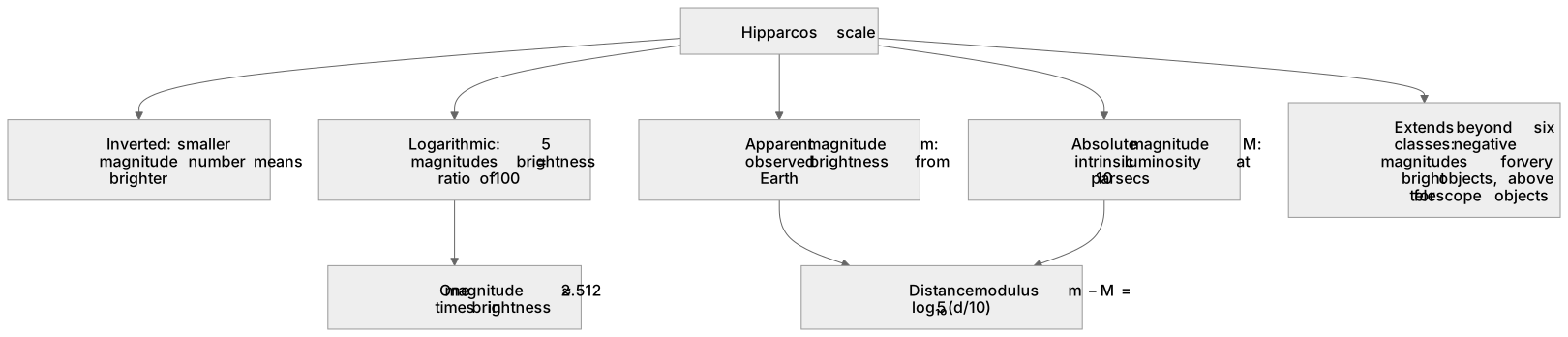
The Hipparcos scale is the historical magnitude system used to classify how bright stars appear from Earth. Hipparchus ranked naked-eye stars into six classes, with first magnitude being the brightest and sixth the faintest. The scale is inverted: a smaller magnitude number means a brighter object. It is logarithmic, so a difference of five magnitudes corresponds to a brightness ratio of exactly 100, meaning each step is about 2.512 times in brightness. Apparent magnitude m describes observed brightness, while absolute magnitude M describes intrinsic luminosity at a standard distance of 10 parsecs. The distance modulus m − M = 5 log₁₀(d/10) links them. Astronomers still use this scale, extending it to negative magnitudes for very bright objects such as Sirius and to values above 6 for objects seen with telescopes.
What earns the marks
- State that the Hipparcos scale is an inverted scale: smaller magnitude values correspond to brighter objects, so magnitude 1 is brighter than magnitude 6.
- Explain that the scale is logarithmic, with a difference of 5 magnitudes corresponding to a brightness ratio of 100, so one magnitude corresponds to a brightness ratio of 100^(1/5) ≈ 2.512.
- Distinguish between apparent magnitude, which measures observed brightness from Earth, and absolute magnitude, which measures intrinsic luminosity at a standard distance of 10 parsecs.
- Use the distance modulus relationship m − M = 5 log₁₀(d/10) to connect apparent magnitude, absolute magnitude and distance in parsecs.
- Recognise that the scale extends beyond the original six classes, including negative magnitudes for very bright objects and values greater than 6 for faint objects observed with telescopes.
Common mistakes and how to put them right
Treating a larger magnitude number as brighter.
Put it right by remembering the scale is inverted, so a smaller number means a brighter object.
Assuming the scale is linear, so that a difference of 2 magnitudes means twice the brightness.
Put it right by applying the logarithmic relationship where 5 magnitudes correspond to a factor of 100 in brightness.
Confusing apparent magnitude with absolute magnitude.
Put it right by defining apparent magnitude as observed brightness and absolute magnitude as brightness at a standard distance of 10 parsecs.
Exam tips
- When comparing brightness, convert magnitude differences into brightness ratios using the factor 100 for every 5 magnitudes, or 2.512 per single magnitude.
- Always state whether a magnitude value is apparent or absolute, and give the standard distance of 10 parsecs when defining absolute magnitude.
- Show the distance modulus calculation clearly, substituting values into m − M = 5 log₁₀(d/10) and solving for the required quantity.
Try the lesson
The start of the Classification by luminosity (A-level only): The Hipparcos scale. lesson, made from checked teaching notes for this specification point.
Have a go first
On the Hipparcos scale of apparent magnitude, which star is recorded as the brighter one?
Listen
The Hipparcos scale is the historical magnitude system used to classify how bright stars appear from Earth. Hipparchus ranked naked-eye stars into six classes, with first magnitude being the brightest and sixth the faintest. The scale is inverted: a smaller magnitude number means a brighter object. It is logarithmic, so a difference of five magnitudes corresponds to a brightness ratio of exactly 100, meaning each step is about 2.512 times in brightness. Apparent magnitude m describes observed brightness, while absolute magnitude M describes intrinsic luminosity at a standard distance of 10 parsecs. The distance modulus m − M = 5 log₁₀(d/10) links them. Astronomers still use this scale, extending it to negative magnitudes for very bright objects such as Sirius and to values above 6 for objects seen with telescopes. A strong answer earns marks for these points. State that the Hipparcos scale is an inverted scale: smaller magnitude values correspond to brighter objects, so magnitude 1 is brighter than magnitude 6. Explain that the scale is logarithmic, with a difference of 5 magnitudes corresponding to a brightness ratio of 100, so one magnitude corresponds to a brightness ratio of 100^(1/5) ≈ 2.512. Distinguish between apparent magnitude, which measures observed brightness from Earth, and absolute magnitude, which measures intrinsic luminosity at a standard distance of 10 parsecs. Use the distance modulus relationship m − M = 5 log₁₀(d/10) to connect apparent magnitude, absolute magnitude and distance in parsecs. A common slip: Treating a larger magnitude number as brighter. Instead, remembering the scale is inverted, so a smaller number means a brighter object. Exam tip: When comparing brightness, convert magnitude differences into brightness ratios using the factor 100 for every 5 magnitudes, or 2.512 per single magnitude.
See it
Key words
Say what each word means before you turn the card.
Inverted magnitude ordering
Try answering aloud or in your head before turning the card.
Logarithmic brightness scale
Try answering aloud or in your head before turning the card.
Apparent versus absolute magnitude
Try answering aloud or in your head before turning the card.
Distance modulus and parsecs
Try answering aloud or in your head before turning the card.
See every definition
- Inverted magnitude ordering
- A smaller magnitude number means a brighter object, so magnitude 1 is brighter than magnitude 6.
- Logarithmic brightness scale
- A difference of five magnitudes corresponds to a brightness ratio of exactly 100, so each step is about 2.512 times in brightness.
- Apparent versus absolute magnitude
- Apparent magnitude m describes observed brightness, while absolute magnitude M describes intrinsic luminosity at a standard distance of 10 parsecs.
- Distance modulus and parsecs
- The relationship m − M = 5 log₁₀(d/10) links apparent magnitude, absolute magnitude and distance in parsecs.
Label the diagram
Some boxes have lost their names. Pick the right name for each number.
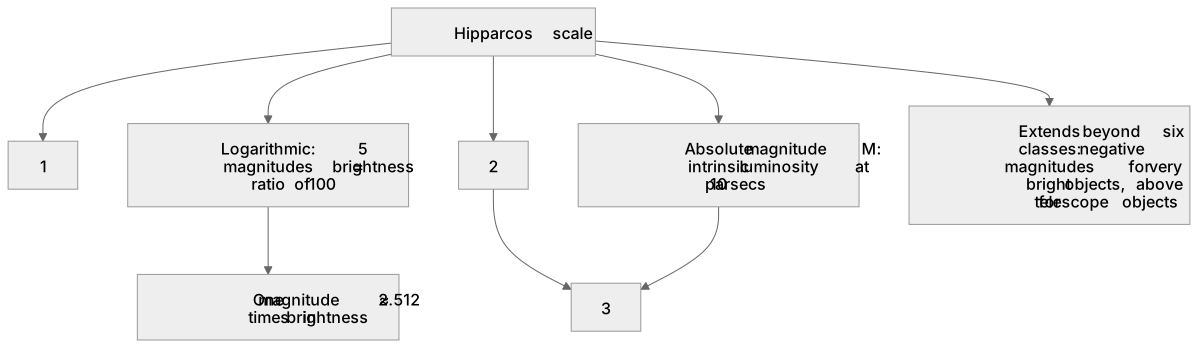
1Box 1
2Box 2
3Box 3
There is more to this lesson
The full lesson goes on to check your understanding and help you earn the marks. Create a free account to carry on, with your progress saved.
A week of Premium from your first lesson · Then the free plan continues · No card, no charge
Test your understanding of Classification by luminosity (A-level only): The Hipparcos scale.
Active recall beats re-reading. Take an instant quiz now to test what you’ve learned and lock it into long-term memory.
A week of Premium from your first lesson · Then the free plan continues · No card, no charge