AQA · A-Level · Physics
Course version: 7408 · Version from Sept 2016
Classification of particles: Conservation of baryon number.
Baryon number is a conserved quantum number that tracks baryons.
Checked against the AQA 7408 specification (opens in a new tab) on .
- Point 4 of 15
- 4 key terms
Study notes
From the checked teaching notes for this specification point.
The idea
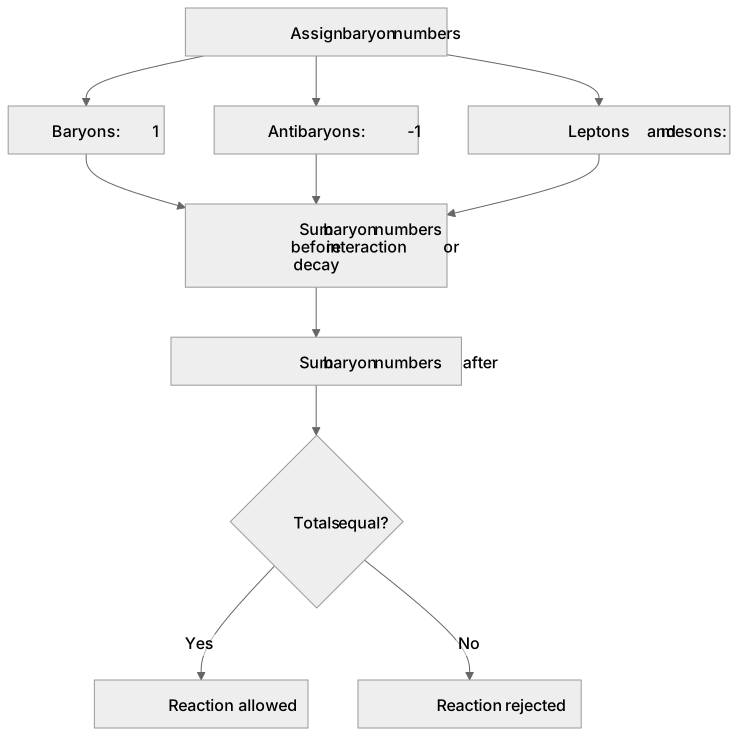
Baryon number is a conserved quantum number that tracks baryons. Assign each baryon, such as a proton or neutron, a baryon number of 1, and each antibaryon, such as an antiproton, a baryon number of −1. Leptons and mesons have baryon number 0. In any particle interaction or decay, the total baryon number before must equal the total baryon number after. For example, in beta-minus decay a neutron (baryon number 1) becomes a proton (baryon number 1) plus an electron and an antineutrino, both with baryon number 0, so the total remains 1. This conservation law explains why a proton cannot simply decay into a positron and a photon, and it constrains which reactions are possible.
What earns the marks
- State that baryons have baryon number 1 and antibaryons have baryon number −1.
- State that leptons and mesons have baryon number 0.
- Apply conservation by summing baryon numbers on each side of an interaction or decay equation.
- Use conservation to reject a proposed reaction whose totals differ, or to deduce an unknown particle's baryon number.
- Recognise that baryon number conservation applies to all particle interactions, including strong, electromagnetic and weak processes.
Common mistakes and how to put them right
Treating mesons as baryons and giving them baryon number 1.
Put it right by assigning mesons baryon number 0 because they are quark–antiquark pairs.
Forgetting the negative sign for antibaryons.
Put it right by writing −1 for each antibaryon such as an antiproton.
Balancing charge and energy but ignoring baryon number.
Put it right by checking baryon number totals separately for every reaction.
Exam tips
- Write the baryon number beneath each particle in an equation before adding, so the totals are visible to the examiner.
- If a question asks whether a reaction is possible, check baryon number conservation explicitly and state the before and after totals.
- When a particle is unknown, use the difference in baryon number totals to deduce its value, then identify a suitable particle.
Try the lesson
The start of the Classification of particles: Conservation of baryon number. lesson, made from checked teaching notes for this specification point.
Have a go first
A neutron has a baryon number of 1. What is the baryon number of an antiproton?
Listen
Baryon number is a conserved quantum number that tracks baryons. Assign each baryon, such as a proton or neutron, a baryon number of 1, and each antibaryon, such as an antiproton, a baryon number of −1. Leptons and mesons have baryon number 0. In any particle interaction or decay, the total baryon number before must equal the total baryon number after. For example, in beta-minus decay a neutron (baryon number 1) becomes a proton (baryon number 1) plus an electron and an antineutrino, both with baryon number 0, so the total remains 1. This conservation law explains why a proton cannot simply decay into a positron and a photon, and it constrains which reactions are possible. A strong answer earns marks for these points. State that baryons have baryon number 1 and antibaryons have baryon number −1. State that leptons and mesons have baryon number 0. Apply conservation by summing baryon numbers on each side of an interaction or decay equation. Use conservation to reject a proposed reaction whose totals differ, or to deduce an unknown particle's baryon number. A common slip: Treating mesons as baryons and giving them baryon number 1. Instead, assigning mesons baryon number 0 because they are quark–antiquark pairs. Exam tip: Write the baryon number beneath each particle in an equation before adding, so the totals are visible to the examiner.
See it
Key words
Say what each word means before you turn the card.
Baryon number
Try answering aloud or in your head before turning the card.
Conservation of baryon number
Try answering aloud or in your head before turning the card.
Baryon number of leptons and mesons
Try answering aloud or in your head before turning the card.
Baryon number of antibaryons
Try answering aloud or in your head before turning the card.
See every definition
- Baryon number
- A conserved quantum number that tracks baryons, with each baryon assigned 1 and each antibaryon assigned −1.
- Conservation of baryon number
- In any particle interaction or decay, the total baryon number before must equal the total baryon number after.
- Baryon number of leptons and mesons
- Both leptons and mesons have baryon number 0.
- Baryon number of antibaryons
- Each antibaryon, such as an antiproton, is assigned a baryon number of −1.
Label the diagram
Some boxes have lost their names. Pick the right name for each number.
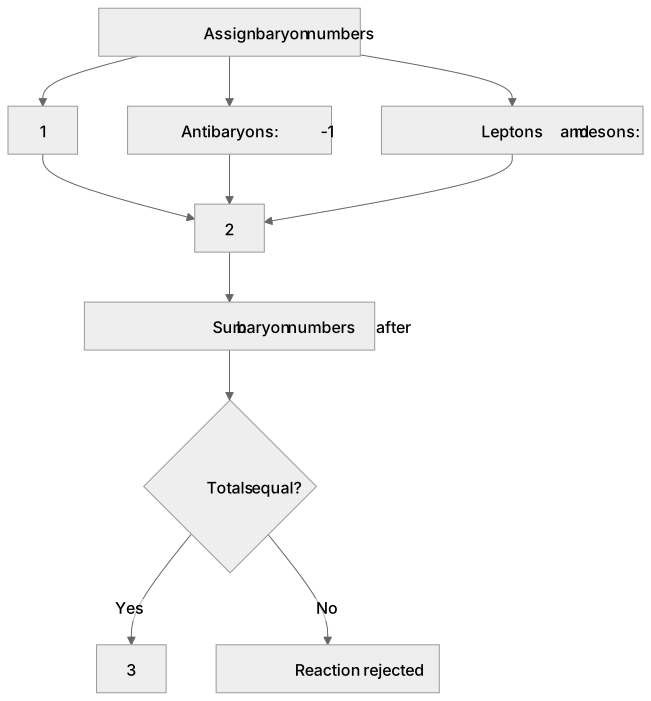
1Box 1
2Box 2
3Box 3
There is more to this lesson
The full lesson goes on to check your understanding and help you earn the marks. Create a free account to carry on, with your progress saved.
A week of Premium from your first lesson · Then the free plan continues · No card, no charge
Test your understanding of Classification of particles: Conservation of baryon number.
Active recall beats re-reading. Take an instant quiz now to test what you’ve learned and lock it into long-term memory.
A week of Premium from your first lesson · Then the free plan continues · No card, no charge