AQA · A-Level · Physics
Course version: 7408 · Version from Sept 2016
Classification of particles: Hadrons are subject to the strong interaction.
Hadrons are particles made of quarks and antiquarks, and they experience the strong interaction.
Checked against the AQA 7408 specification (opens in a new tab) on .
- Point 1 of 15
- 4 key terms
Study notes
From the checked teaching notes for this specification point.
The idea
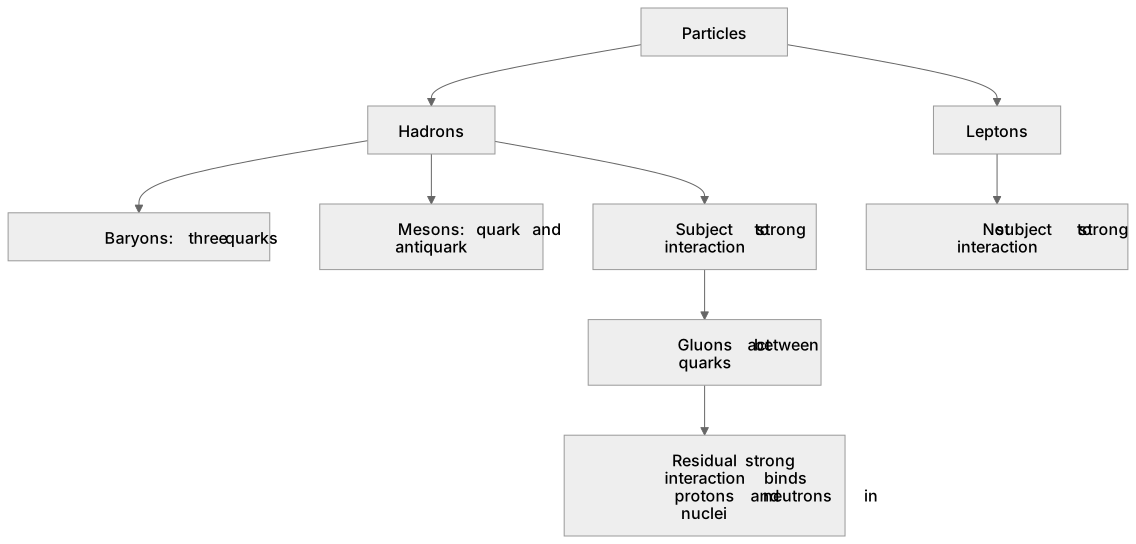
Hadrons are particles made of quarks and antiquarks, and they experience the strong interaction. The strong interaction is carried by gluons and acts between quarks, which means it holds the quarks together inside protons and neutrons. Its residual effect also binds protons and neutrons together in nuclei. Hadrons are divided into baryons, such as protons and neutrons, which contain three quarks, and mesons, such as pions and kaons, which contain a quark and an antiquark. Leptons, such as electrons and neutrinos, are not hadrons and do not feel the strong interaction. The strong interaction is short range, acting over distances comparable with the size of a nucleus, and it is attractive between quarks at those separations.
What earns the marks
- Hadrons are composite particles made of quarks and/or antiquarks.
- Baryons contain three quarks, for example a proton is uud and a neutron is udd.
- Mesons contain a quark and an antiquark, for example a π⁺ is u d̄.
- The strong interaction is mediated by gluons and acts between quarks.
- The residual strong interaction binds protons and neutrons together in the nucleus.
- Leptons are not subject to the strong interaction because they do not contain quarks.
- The strong interaction is short range, of the order of nuclear dimensions.
Common mistakes and how to put them right
Stating that leptons feel the strong interaction.
Put it right: Leptons do not contain quarks and therefore do not experience the strong interaction.
Confusing baryons and mesons.
Put it right: Remember that baryons contain three quarks while mesons contain a quark–antiquark pair.
Saying the strong interaction acts directly between protons and neutrons.
Put it right: Gluons act between quarks, and the residual strong interaction between nucleons is a consequence of quark-level interactions.
Describing the strong interaction as long range.
Put it right: It is short range, acting over nuclear distances.
Exam tips
- When classifying a particle, first decide whether it is a hadron or a lepton, then whether it is a baryon or a meson.
- Use quark compositions to justify why a particle is subject to the strong interaction.
- Link the exchange particle to the interaction: gluon for strong, photon for electromagnetic, W⁺ or W⁻ for weak.
- Remember that the strong interaction is responsible for binding quarks into hadrons and for the stability of nuclei.
Try the lesson
The start of the Classification of particles: Hadrons are subject to the strong interaction. lesson, made from checked teaching notes for this specification point.
Have a go first
Which of the following statements correctly describes a fundamental property of all hadrons?
Listen
Hadrons are particles made of quarks and antiquarks, and they experience the strong interaction. The strong interaction is carried by gluons and acts between quarks, which means it holds the quarks together inside protons and neutrons. Its residual effect also binds protons and neutrons together in nuclei. Hadrons are divided into baryons, such as protons and neutrons, which contain three quarks, and mesons, such as pions and kaons, which contain a quark and an antiquark. Leptons, such as electrons and neutrinos, are not hadrons and do not feel the strong interaction. The strong interaction is short range, acting over distances comparable with the size of a nucleus, and it is attractive between quarks at those separations. A strong answer earns marks for these points. Hadrons are composite particles made of quarks and/or antiquarks. Baryons contain three quarks, for example a proton is uud and a neutron is udd. Mesons contain a quark and an antiquark, for example a π⁺ is u d̄. The strong interaction is mediated by gluons and acts between quarks. A common slip: Stating that leptons feel the strong interaction. Instead, leptons do not contain quarks and therefore do not experience the strong interaction. Exam tip: When classifying a particle, first decide whether it is a hadron or a lepton, then whether it is a baryon or a meson.
See it
Key words
Say what each word means before you turn the card.
Hadrons
Try answering aloud or in your head before turning the card.
Baryons
Try answering aloud or in your head before turning the card.
Mesons
Try answering aloud or in your head before turning the card.
Gluons
Try answering aloud or in your head before turning the card.
See every definition
- Hadrons
- Particles made of quarks and antiquarks, divided into baryons, which contain three quarks, and mesons, which contain a quark and an antiquark.
- Baryons
- Hadrons such as protons and neutrons, which contain three quarks.
- Mesons
- Hadrons such as pions and kaons, which contain a quark and an antiquark.
- Gluons
- Exchange particles that carry the strong interaction and act between quarks, holding the quarks together inside protons and neutrons.
Label the diagram
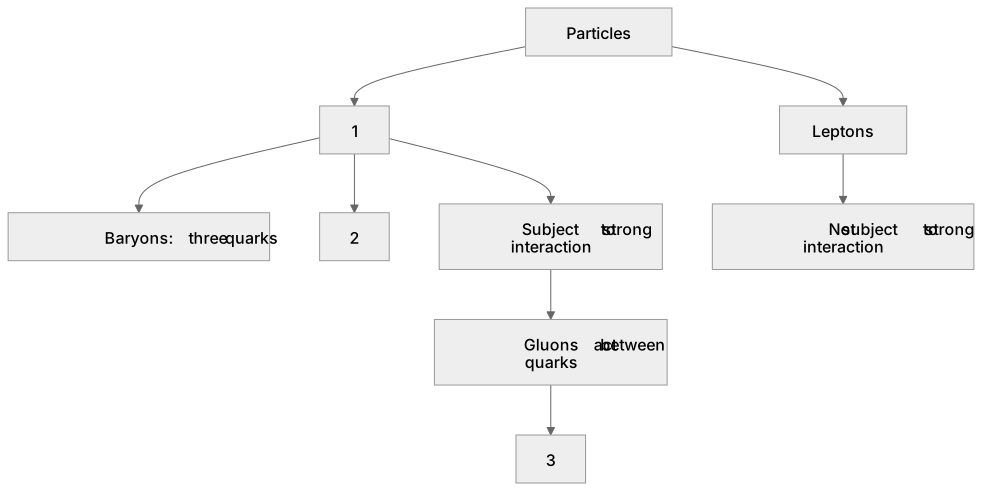
Some boxes have lost their names. Pick the right name for each number.
1Box 1
2Box 2
3Box 3
There is more to this lesson
The full lesson goes on to check your understanding and help you earn the marks. Create a free account to carry on, with your progress saved.
A week of Premium from your first lesson · Then the free plan continues · No card, no charge
Test your understanding of Classification of particles: Hadrons are subject to the strong interaction.
Active recall beats re-reading. Take an instant quiz now to test what you’ve learned and lock it into long-term memory.
A week of Premium from your first lesson · Then the free plan continues · No card, no charge