AQA · A-Level · Physics
Course version: 7408 · Version from Sept 2016
Leptons: electron, muon, neutrino (electron and muon types only) and their…
Full specification wording
Classification of particles: Leptons: electron, muon, neutrino (electron and muon types only) and their antiparticles.
Leptons are fundamental particles that do not feel the strong interaction.
Checked against the AQA 7408 specification (opens in a new tab) on .
- Point 8 of 15
- 4 key terms
Study notes
From the checked teaching notes for this specification point.
The idea
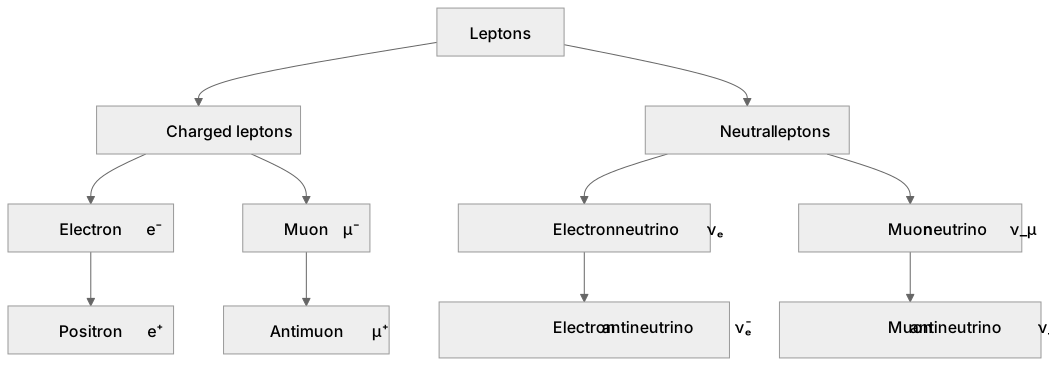
Leptons are fundamental particles that do not feel the strong interaction. The specification names the electron (e⁻), the muon (μ⁻), the electron neutrino (νₑ) and the muon neutrino (ν_μ), together with their antiparticles: the positron (e⁺), the antimuon (μ⁺), the electron antineutrino (ν̄ₑ) and the muon antineutrino (ν̄_μ). Each particle and its antiparticle have equal mass but opposite electric charge and opposite lepton number. Neutrinos are electrically neutral and have very small mass. A concrete method is to sort a particle list into quarks, leptons and exchange bosons, then pair each lepton with its antiparticle and check charge sums to zero.
What earns the marks
- Leptons are fundamental particles, meaning they have no internal quark structure, unlike protons and neutrons.
- The named charged leptons are the electron and the muon; each has a corresponding antiparticle with opposite charge.
- The named neutral leptons are the electron neutrino and the muon neutrino; each has a corresponding antineutrino.
- Antiparticles have the same mass as their particles but opposite electric charge and opposite lepton number.
- Neutrinos are neutral and interact only via the weak interaction, so they are hard to detect.
- The specification restricts neutrino types to electron and muon types, so tau neutrinos are not required here.
Common mistakes and how to put them right
Treating the neutrino as its own antiparticle.
Put it right: The neutrino and antineutrino are distinct, with opposite lepton number.
Describing the muon as a meson because of its mass.
Put it right: The muon is a lepton, not a hadron.
Giving the positron the same charge sign as the electron.
Put it right: The positron has charge 1⁺ while the electron has charge 1⁻.
Exam tips
- Learn a table of particle, symbol, charge and antiparticle so you can answer recall questions quickly.
- When asked to classify a particle, state whether it is fundamental and whether it feels the strong interaction.
- Use the correct symbols and Unicode superscript charges, for example e⁻, e⁺, μ⁻, μ⁺, νₑ and ν̄ₑ.
Try the lesson
The start of the Classification of particles: Leptons: electron, muon, neutrino (electron and muon types only) and their antiparticles. lesson, made from checked teaching notes for this specification point.
Have a go first
Which of the following particles is a lepton?
Listen
Leptons are fundamental particles that do not feel the strong interaction. The specification names the electron (e⁻), the muon (μ⁻), the electron neutrino (νₑ) and the muon neutrino (ν_μ), together with their antiparticles: the positron (e⁺), the antimuon (μ⁺), the electron antineutrino (ν̄ₑ) and the muon antineutrino (ν̄_μ). Each particle and its antiparticle have equal mass but opposite electric charge and opposite lepton number. Neutrinos are electrically neutral and have very small mass. A concrete method is to sort a particle list into quarks, leptons and exchange bosons, then pair each lepton with its antiparticle and check charge sums to zero. A strong answer earns marks for these points. Leptons are fundamental particles, meaning they have no internal quark structure, unlike protons and neutrons. The named charged leptons are the electron and the muon; each has a corresponding antiparticle with opposite charge. The named neutral leptons are the electron neutrino and the muon neutrino; each has a corresponding antineutrino. Antiparticles have the same mass as their particles but opposite electric charge and opposite lepton number. A common slip: Treating the neutrino as its own antiparticle. Instead, the neutrino and antineutrino are distinct, with opposite lepton number. Exam tip: Learn a table of particle, symbol, charge and antiparticle so you can answer recall questions quickly.
See it
Key words
Say what each word means before you turn the card.
Fundamental particles
Try answering aloud or in your head before turning the card.
Lepton families
Try answering aloud or in your head before turning the card.
Antiparticles
Try answering aloud or in your head before turning the card.
Neutrinos
Try answering aloud or in your head before turning the card.
See every definition
- Fundamental particles
- Particles that have no internal quark structure, unlike protons and neutrons.
- Lepton families
- The named charged leptons are the electron and the muon, and the named neutral leptons are the electron neutrino and the muon neutrino.
- Antiparticles
- Each has the same mass as its particle but opposite electric charge and opposite lepton number.
- Neutrinos
- Electrically neutral particles with very small mass that interact only via the weak interaction, so they are hard to detect.
Label the diagram
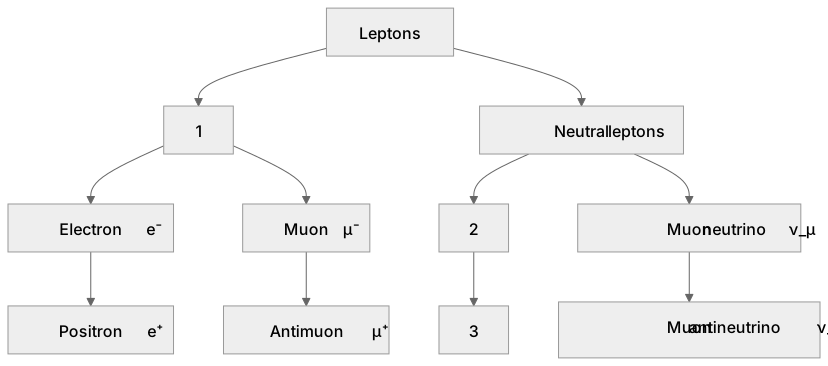
Some boxes have lost their names. Pick the right name for each number.
1Box 1
2Box 2
3Box 3
There is more to this lesson
The full lesson goes on to check your understanding and help you earn the marks. Create a free account to carry on, with your progress saved.
A week of Premium from your first lesson · Then the free plan continues · No card, no charge
Test your understanding of Classification of particles: Leptons: electron, muon, neutrino (electron and muon types only) and their antiparticles.
Active recall beats re-reading. Take an instant quiz now to test what you’ve learned and lock it into long-term memory.
A week of Premium from your first lesson · Then the free plan continues · No card, no charge