AQA · A-Level · Physics
Course version: 7408 · Version from Sept 2016
Strangeness (symbol s) as a quantum number to reflect the fact that…
Full specification wording
Classification of particles: Strangeness (symbol s) as a quantum number to reflect the fact that strange particles are always created in pairs.
Strangeness is a quantum number, symbol s, invented to explain why certain particles such as kaons and hyperons appear only in pairs when produced.
Checked against the AQA 7408 specification (opens in a new tab) on .
- Point 12 of 15
- 4 key terms
Study notes
From the checked teaching notes for this specification point.
The idea
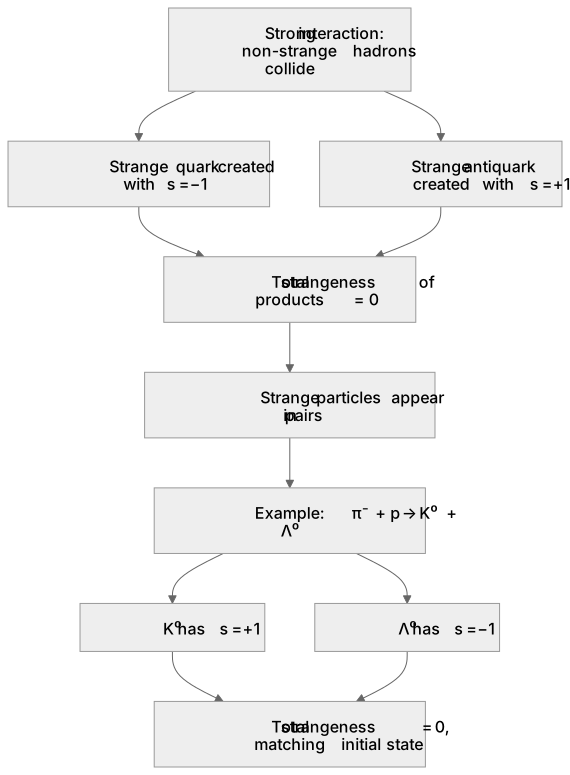
Strangeness is a quantum number, symbol s, invented to explain why certain particles such as kaons and hyperons appear only in pairs when produced. Each strange quark carries s = −1 and each strange antiquark carries s = +1, so a K⁺ (u s̄) has s = +1 while a K⁻ (ū s) has s = −1. Because the strong interaction creates a strange quark and a strange antiquark together, the total strangeness of the products starts at zero, matching the zero strangeness of the colliding hadrons. For example, in π⁻ + p → K⁰ + Λ⁰ the K⁰ has s = +1 and the Λ⁰ has s = −1, giving a total of zero. Strangeness is therefore a bookkeeping number that reflects pair production and is conserved in strong and electromagnetic interactions but not in weak decays.
What earns the marks
- Strangeness is a quantum number with symbol s, assigned to hadrons containing strange quarks.
- A strange quark has s = −1 and a strange antiquark has s = +1, so mesons such as K⁺ and K⁻ have opposite strangeness values.
- Strange particles are produced in pairs in strong interactions because a strange quark and a strange antiquark must be created together.
- The total strangeness of the initial state and the final state is equal in a strong production reaction, typically zero for collisions of non-strange particles.
- Strangeness values are determined from quark content and are used to classify particles as strange or non-strange.
- The pair-production rule explains why isolated single strange particles are not seen emerging directly from high-energy collisions of non-strange particles.
Common mistakes and how to put them right
Treating strangeness as a measure of mass or lifetime rather than a quantum number.
Put it right by linking s directly to the number of strange quarks and antiquarks.
Assigning the same sign of strangeness to a particle and its antiparticle.
Put it right by remembering that antiparticles have opposite strangeness.
Assuming a single strange particle can be produced from non-strange colliding particles.
Put it right by checking that total strangeness is zero before and after a strong production event.
Exam tips
- Write the quark content of each hadron before quoting its strangeness, so the sign of s is justified rather than guessed.
- When a question gives a production reaction, add the strangeness values on each side to show explicitly that the totals match.
- Use the symbol s consistently and distinguish it from seconds or distance by the context of the particle reaction.
Try the lesson
The start of the Classification of particles: Strangeness (symbol s) as a quantum number to reflect the fact that strange particles are always created in pairs. lesson, made from checked teaching notes for this specification point.
Have a go first
Which statement explains why strangeness was introduced as a quantum number for strange particles?
Listen
Strangeness is a quantum number, symbol s, invented to explain why certain particles such as kaons and hyperons appear only in pairs when produced. Each strange quark carries s = −1 and each strange antiquark carries s = +1, so a K⁺ (u s̄) has s = +1 while a K⁻ (ū s) has s = −1. Because the strong interaction creates a strange quark and a strange antiquark together, the total strangeness of the products starts at zero, matching the zero strangeness of the colliding hadrons. For example, in π⁻ + p → K⁰ + Λ⁰ the K⁰ has s = +1 and the Λ⁰ has s = −1, giving a total of zero. Strangeness is therefore a bookkeeping number that reflects pair production and is conserved in strong and electromagnetic interactions but not in weak decays. A strong answer earns marks for these points. Strangeness is a quantum number with symbol s, assigned to hadrons containing strange quarks. A strange quark has s = −1 and a strange antiquark has s = +1, so mesons such as K⁺ and K⁻ have opposite strangeness values. Strange particles are produced in pairs in strong interactions because a strange quark and a strange antiquark must be created together. The total strangeness of the initial state and the final state is equal in a strong production reaction, typically zero for collisions of non-strange particles. A common slip: Treating strangeness as a measure of mass or lifetime rather than a quantum number. Instead, linking s directly to the number of strange quarks and antiquarks. Exam tip: Write the quark content of each hadron before quoting its strangeness, so the sign of s is justified rather than guessed.
See it
Key words
Say what each word means before you turn the card.
Strangeness
Try answering aloud or in your head before turning the card.
Strange quark
Try answering aloud or in your head before turning the card.
Pair production
Try answering aloud or in your head before turning the card.
Conservation of strangeness
Try answering aloud or in your head before turning the card.
See every definition
- Strangeness
- A quantum number, symbol s, invented to explain why certain particles such as kaons and hyperons appear only in pairs when produced.
- Strange quark
- Carries s = −1, while a strange antiquark carries s = +1.
- Pair production
- The strong interaction creates a strange quark and a strange antiquark together, so the total strangeness of the products starts at zero.
- Conservation of strangeness
- Strangeness is conserved in strong and electromagnetic interactions but not in weak decays.
Label the diagram
Some boxes have lost their names. Pick the right name for each number.
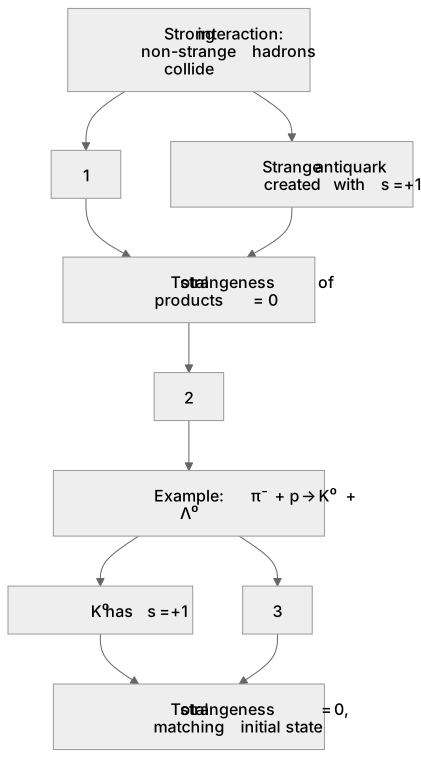
1Box 1
2Box 2
3Box 3
There is more to this lesson
The full lesson goes on to check your understanding and help you earn the marks. Create a free account to carry on, with your progress saved.
A week of Premium from your first lesson · Then the free plan continues · No card, no charge
Test your understanding of Classification of particles: Strangeness (symbol s) as a quantum number to reflect the fact that strange particles are always created in pairs.
Active recall beats re-reading. Take an instant quiz now to test what you’ve learned and lock it into long-term memory.
A week of Premium from your first lesson · Then the free plan continues · No card, no charge