AQA · A-Level · Physics
Course version: 7408 · Version from Sept 2016
The muon as a particle that decays into an electron.
Full specification wording
Classification of particles: The muon as a particle that decays into an electron.
The muon is a fundamental lepton, identical to the electron in charge and weak interaction but about 207 times more massive.
Checked against the AQA 7408 specification (opens in a new tab) on .
- Point 10 of 15
- 4 key terms
Study notes
From the checked teaching notes for this specification point.
The idea
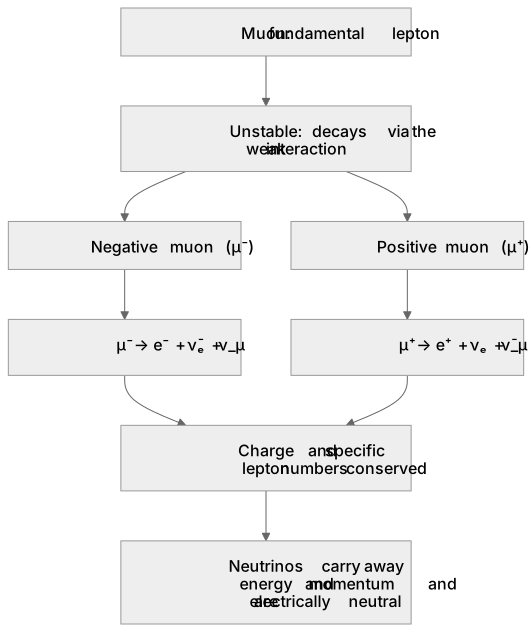
The muon is a fundamental lepton, identical to the electron in charge and weak interaction but about 207 times more massive. Being unstable, a muon decays by the weak interaction. A negative muon (μ⁻) transforms into an electron (e⁻) plus a muon neutrino and an electron antineutrino. A positive muon (μ⁺) gives a positron (e⁺) with an electron neutrino and a muon antineutrino. Charge, lepton number and energy-momentum are conserved. For example, in μ⁻ → e⁻ + ν̄ₑ + ν_μ, the electron antineutrino balances the electron lepton number, while the muon neutrino conserves the muon lepton number. Recognising the muon as a lepton that decays into an electron links particle classification to conservation laws and the weak interaction.
What earns the marks
- Identifies the muon as a lepton, a fundamental particle with charge -1 (or +1 for the antiparticle) and a rest mass about 207 times that of the electron.
- States that the muon is unstable and decays via the weak interaction.
- Writes a correct decay equation such as μ⁻ → e⁻ + ν̄ₑ + ν_μ, or μ⁺ → e⁺ + νₑ + ν̄_μ.
- Checks conservation of charge and specific lepton numbers (electron and muon lepton numbers) in the decay.
- Explains that the decay products include neutrinos, which carry away energy and momentum and are electrically neutral.
Common mistakes and how to put them right
Treating the muon as a hadron or baryon because it is heavy.
Put it right: The muon is a lepton and does not interact via the strong force.
Writing the decay as muon to electron only, which violates lepton-number conservation.
Put it right: Include the correct neutrinos.
Confusing the neutrino flavours in the decay equation.
Put it right: Ensure the electron antineutrino balances the electron's lepton number, and the muon neutrino conserves the initial muon's lepton number (for μ⁻ decay).
Exam tips
- Learn the full decay equation with correct neutrino flavours, then practise checking charge and specific lepton numbers line by line.
- When asked to explain stability or decay, name the interaction explicitly: the weak interaction is responsible for muon decay.
Try the lesson
The start of the Classification of particles: The muon as a particle that decays into an electron. lesson, made from checked teaching notes for this specification point.
Have a go first
A muon is unstable and decays. Which particle is produced when a muon decays?
Listen
The muon is a fundamental lepton, identical to the electron in charge and weak interaction but about 207 times more massive. Being unstable, a muon decays by the weak interaction. A negative muon (μ⁻) transforms into an electron (e⁻) plus a muon neutrino and an electron antineutrino. A positive muon (μ⁺) gives a positron (e⁺) with an electron neutrino and a muon antineutrino. Charge, lepton number and energy-momentum are conserved. For example, in μ⁻ → e⁻ + ν̄ₑ + ν_μ, the electron antineutrino balances the electron lepton number, while the muon neutrino conserves the muon lepton number. Recognising the muon as a lepton that decays into an electron links particle classification to conservation laws and the weak interaction. A strong answer earns marks for these points. Identifies the muon as a lepton, a fundamental particle with charge -1 (or +1 for the antiparticle) and a rest mass about 207 times that of the electron. States that the muon is unstable and decays via the weak interaction. Writes a correct decay equation such as μ⁻ → e⁻ + ν̄ₑ + ν_μ, or μ⁺ → e⁺ + νₑ + ν̄_μ. Checks conservation of charge and specific lepton numbers (electron and muon lepton numbers) in the decay. A common slip: Treating the muon as a hadron or baryon because it is heavy. Instead, the muon is a lepton and does not interact via the strong force. Exam tip: Learn the full decay equation with correct neutrino flavours, then practise checking charge and specific lepton numbers line by line.
See it
Key words
Say what each word means before you turn the card.
muon
Try answering aloud or in your head before turning the card.
weak interaction
Try answering aloud or in your head before turning the card.
lepton number
Try answering aloud or in your head before turning the card.
conservation laws
Try answering aloud or in your head before turning the card.
See every definition
- muon
- A fundamental lepton, identical to the electron in charge and weak interaction but about 207 times more massive, which is unstable and decays by the weak interaction.
- weak interaction
- The interaction responsible for muon decay, in which a negative muon transforms into an electron plus a muon neutrino and an electron antineutrino.
- lepton number
- A quantity conserved in particle interactions, with the electron antineutrino balancing the electron lepton number and the muon neutrino conserving the muon lepton number.
- conservation laws
- Charge, lepton number and energy-momentum are conserved in particle interactions such as the decay of a muon into an electron.
Label the diagram
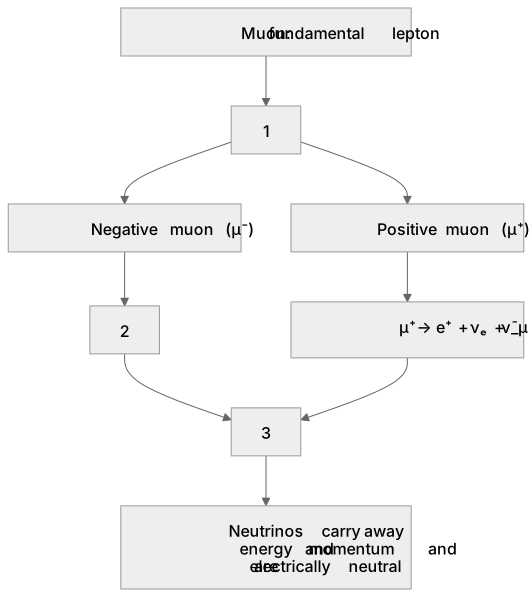
Some boxes have lost their names. Pick the right name for each number.
1Box 1
2Box 2
3Box 3
There is more to this lesson
The full lesson goes on to check your understanding and help you earn the marks. Create a free account to carry on, with your progress saved.
A week of Premium from your first lesson · Then the free plan continues · No card, no charge
Test your understanding of Classification of particles: The muon as a particle that decays into an electron.
Active recall beats re-reading. Take an instant quiz now to test what you’ve learned and lock it into long-term memory.
A week of Premium from your first lesson · Then the free plan continues · No card, no charge