AQA · A-Level · Physics
Course version: 7408 · Version from Sept 2016
The pion as the exchange particle of the strong nuclear force.
Full specification wording
Classification of particles: The pion as the exchange particle of the strong nuclear force.
The strong nuclear force binds nucleons inside the nucleus.
Checked against the AQA 7408 specification (opens in a new tab) on .
- Point 6 of 15
- 4 key terms
Study notes
From the checked teaching notes for this specification point.
The idea
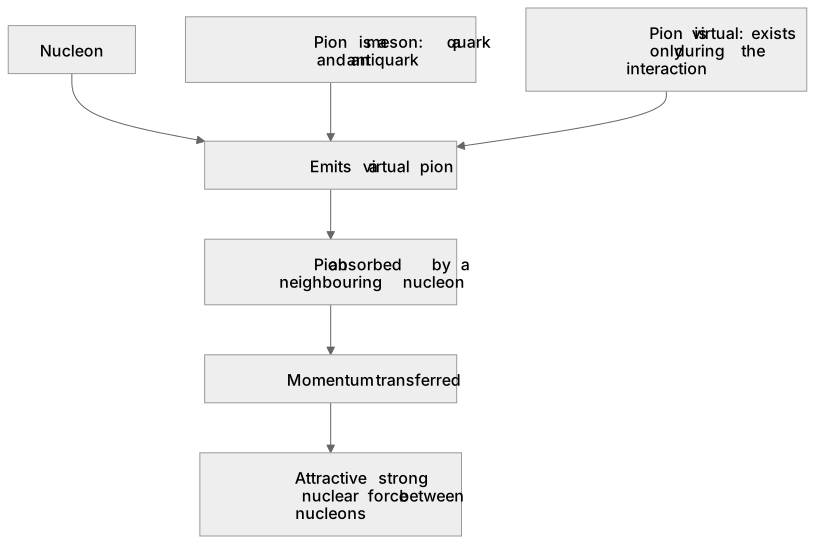
The strong nuclear force binds nucleons inside the nucleus. In AQA A-level Physics, the attractive part of this force is modelled as a short-range interaction mediated by the exchange of pions. Pions are mesons made of a quark and an antiquark. A nucleon emits a virtual pion, which is absorbed by a neighbouring nucleon; this exchange transfers momentum and produces an attractive force. The strong force is attractive at separations around 1 fm and becomes negligible beyond roughly 3 fm. While the strong force is repulsive below 0.5 fm to prevent nuclear collapse, this repulsive core is not explained by pion exchange. Pions are virtual exchange particles, meaning they exist only during the interaction and are not permanent constituents of the nucleus.
What earns the marks
- Pions are mesons composed of a quark and an antiquark, for example π⁺ is u d̄ and π⁻ is ū d.
- The attractive strong nuclear force between nucleons is modelled as the exchange of virtual pions.
- Exchange of a virtual particle transfers momentum and produces an attractive force between the nucleons.
- The strong force has a short range, being attractive around 1 fm and negligible beyond 3 fm, with a repulsive core below 0.5 fm (though repulsion is not due to pion exchange).
- Pions are virtual, so they are not counted as permanent constituents of the nucleus and are not observed directly in the exchange process.
- The strong force acts equally between protons and neutrons, consistent with pion exchange being possible between all nucleon pairs.
Common mistakes and how to put them right
Treating pions as permanent particles inside the nucleus.
Put it right by describing them as virtual exchange particles that exist only during the interaction.
Attributing the repulsive core of the strong force to pion exchange.
Put it right by stating pion exchange only models the attractive residual force between nucleons.
Claiming the strong force has infinite range.
Put it right by stating that pion exchange gives a short range of a few femtometres, unlike the infinite range of the electromagnetic force.
Exam tips
- Link the exchange particle explicitly to the attractive nature of the strong force, but avoid claiming pion exchange causes the repulsive core below 0.5 fm.
- Use the correct symbols π⁺, π⁻ and π⁰ and state the quark composition of at least one pion when describing the exchange.
- When explaining nuclear stability, refer to the balance between the short-range strong force and the longer-range electrostatic repulsion.
Try the lesson
The start of the Classification of particles: The pion as the exchange particle of the strong nuclear force. lesson, made from checked teaching notes for this specification point.
Have a go first
Which of the following statements correctly describes the role of the pion in nuclear interactions?
Listen
The strong nuclear force binds nucleons inside the nucleus. In AQA A-level Physics, the attractive part of this force is modelled as a short-range interaction mediated by the exchange of pions. Pions are mesons made of a quark and an antiquark. A nucleon emits a virtual pion, which is absorbed by a neighbouring nucleon; this exchange transfers momentum and produces an attractive force. The strong force is attractive at separations around 1 fm and becomes negligible beyond roughly 3 fm. While the strong force is repulsive below 0.5 fm to prevent nuclear collapse, this repulsive core is not explained by pion exchange. Pions are virtual exchange particles, meaning they exist only during the interaction and are not permanent constituents of the nucleus. A strong answer earns marks for these points. Pions are mesons composed of a quark and an antiquark, for example π⁺ is u d̄ and π⁻ is ū d. The attractive strong nuclear force between nucleons is modelled as the exchange of virtual pions. Exchange of a virtual particle transfers momentum and produces an attractive force between the nucleons. The strong force has a short range, being attractive around 1 fm and negligible beyond 3 fm, with a repulsive core below 0.5 fm (though repulsion is not due to pion exchange). A common slip: Treating pions as permanent particles inside the nucleus. Instead, describing them as virtual exchange particles that exist only during the interaction. Exam tip: Link the exchange particle explicitly to the attractive nature of the strong force, but avoid claiming pion exchange causes the repulsive core below 0.5 fm.
See it
Key words
Say what each word means before you turn the card.
Pion
Try answering aloud or in your head before turning the card.
Virtual exchange particles
Try answering aloud or in your head before turning the card.
Quark structure of mesons
Try answering aloud or in your head before turning the card.
Range and strength of the strong nuclear force
Try answering aloud or in your head before turning the card.
See every definition
- Pion
- A meson made of a quark and an antiquark, acting as the exchange particle of the strong nuclear force.
- Virtual exchange particles
- Particles that exist only during the interaction and are not permanent constituents of the nucleus.
- Quark structure of mesons
- Mesons are composed of a quark and an antiquark, for example π⁺ is u d̄ and π⁻ is ū d.
- Range and strength of the strong nuclear force
- Attractive around 1 fm and negligible beyond roughly 3 fm, with a repulsive core below 0.5 fm that is not due to pion exchange.
Label the diagram
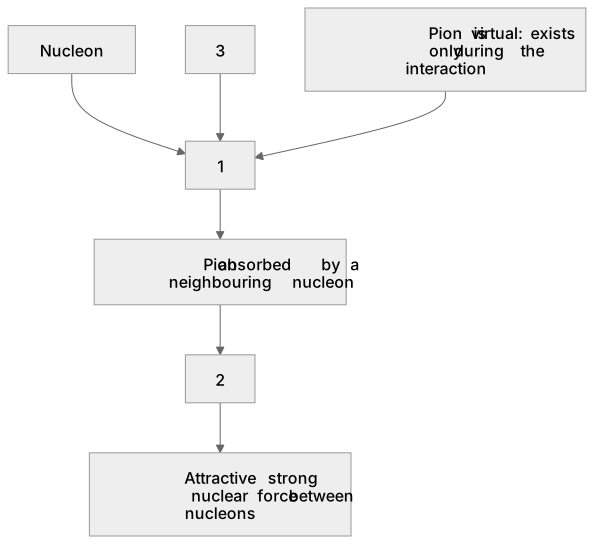
Some boxes have lost their names. Pick the right name for each number.
1Box 1
2Box 2
3Box 3
There is more to this lesson
The full lesson goes on to check your understanding and help you earn the marks. Create a free account to carry on, with your progress saved.
A week of Premium from your first lesson · Then the free plan continues · No card, no charge
Test your understanding of Classification of particles: The pion as the exchange particle of the strong nuclear force.
Active recall beats re-reading. Take an instant quiz now to test what you’ve learned and lock it into long-term memory.
A week of Premium from your first lesson · Then the free plan continues · No card, no charge