AQA · A-Level · Physics
Course version: 7408 · Version from Sept 2016
Ionisation and excitation; understanding of ionisation and excitation in…
Full specification wording
Collisions of electrons with atoms: Ionisation and excitation; understanding of ionisation and excitation in the fluorescent tube.
Ionisation is when an electron gains enough energy to escape from an atom, leaving a positive ion.
Checked against the AQA 7408 specification (opens in a new tab) on .
- Point 1 of 3
- 4 key terms
Study notes
From the checked teaching notes for this specification point.
The idea
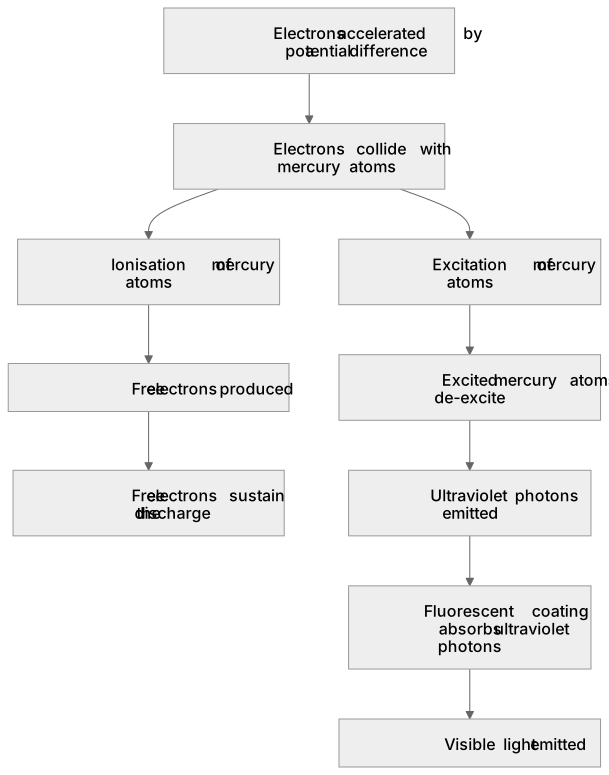
Ionisation is when an electron gains enough energy to escape from an atom, leaving a positive ion. Excitation is when an electron gains a specific amount of energy and moves to a higher energy level within the atom. In a fluorescent tube, electrons are accelerated by a potential difference and collide with mercury atoms. These collisions can cause excitation of mercury atoms, which then emit ultraviolet photons as they de-excite. The ultraviolet photons are absorbed by the fluorescent coating on the tube, which then emits visible light. Ionisation can also occur, producing free electrons that sustain the discharge. You should be able to describe these processes and explain how they lead to the emission of visible light.
What earns the marks
- Define ionisation as the removal of an electron from an atom, requiring energy greater than or equal to the ionisation energy.
- Define excitation as the promotion of an electron to a higher energy level within an atom, requiring a specific amount of energy.
- Explain that in a fluorescent tube, accelerated electrons collide with mercury atoms, causing excitation and ionisation.
- Describe how excited mercury atoms emit ultraviolet photons when they de-excite.
- Explain that the fluorescent coating absorbs ultraviolet photons and re-emits visible light.
Common mistakes and how to put them right
Confusing ionisation with excitation.
Put it right: Ionisation removes an electron completely, while excitation moves an electron to a higher energy level within the atom.
Thinking that any collision energy can cause excitation.
Put it right: Excitation requires a specific energy equal to the difference between energy levels.
Believing that the mercury vapour emits visible light directly.
Put it right: Mercury atoms emit ultraviolet photons, which are converted to visible light by the fluorescent coating.
Exam tips
- Use clear diagrams to show energy levels and transitions when explaining excitation and ionisation.
- Link the processes step by step: acceleration of electrons, collisions, excitation/ionisation, emission of UV, absorption by coating, emission of visible light.
- Remember that ionisation energy is the minimum energy needed to remove an electron from an atom, and it is specific to each element.
Try the lesson
The start of the Collisions of electrons with atoms: Ionisation and excitation; understanding of ionisation and excitation in the fluorescent tube. lesson, made from checked teaching notes for this specification point.
Have a go first
In a fluorescent tube, what term describes an electron in an atom moving to a higher energy level after a collision?
Listen
Ionisation is when an electron gains enough energy to escape from an atom, leaving a positive ion. Excitation is when an electron gains a specific amount of energy and moves to a higher energy level within the atom. In a fluorescent tube, electrons are accelerated by a potential difference and collide with mercury atoms. These collisions can cause excitation of mercury atoms, which then emit ultraviolet photons as they de-excite. The ultraviolet photons are absorbed by the fluorescent coating on the tube, which then emits visible light. Ionisation can also occur, producing free electrons that sustain the discharge. You should be able to describe these processes and explain how they lead to the emission of visible light. A strong answer earns marks for these points. Define ionisation as the removal of an electron from an atom, requiring energy greater than or equal to the ionisation energy. Define excitation as the promotion of an electron to a higher energy level within an atom, requiring a specific amount of energy. Explain that in a fluorescent tube, accelerated electrons collide with mercury atoms, causing excitation and ionisation. Describe how excited mercury atoms emit ultraviolet photons when they de-excite. A common slip: Confusing ionisation with excitation. Instead, ionisation removes an electron completely, while excitation moves an electron to a higher energy level within the atom. Exam tip: Use clear diagrams to show energy levels and transitions when explaining excitation and ionisation.
See it
Key words
Say what each word means before you turn the card.
Ionisation
Try answering aloud or in your head before turning the card.
Excitation
Try answering aloud or in your head before turning the card.
Fluorescent tube
Try answering aloud or in your head before turning the card.
Energy levels
Try answering aloud or in your head before turning the card.
See every definition
- Ionisation
- When an electron gains enough energy to escape from an atom, leaving a positive ion.
- Excitation
- When an electron gains a specific amount of energy and moves to a higher energy level within the atom.
- Fluorescent tube
- A tube in which accelerated electrons collide with mercury atoms, and a fluorescent coating absorbs ultraviolet photons and re-emits visible light.
- Energy levels
- Levels within an atom to which an electron moves when it gains a specific amount of energy.
Label the diagram
Some boxes have lost their names. Pick the right name for each number.
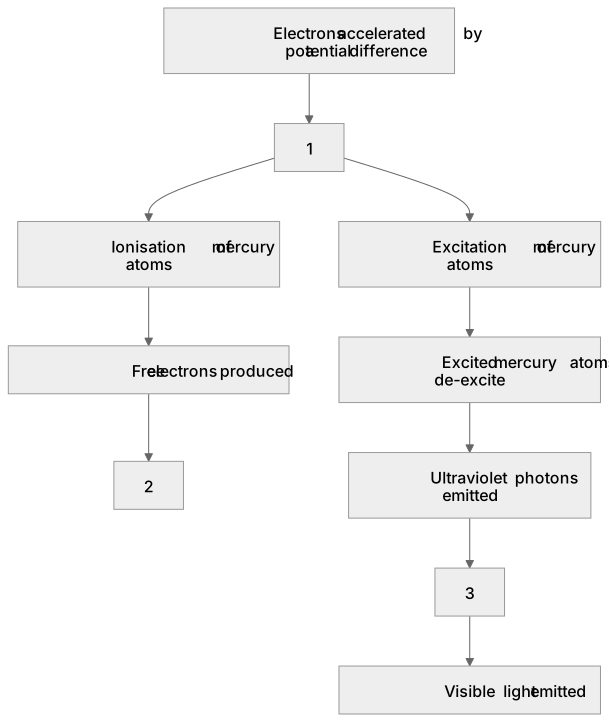
1Box 1
2Box 2
3Box 3
There is more to this lesson
The full lesson goes on to check your understanding and help you earn the marks. Create a free account to carry on, with your progress saved.
A week of Premium from your first lesson · Then the free plan continues · No card, no charge
Test your understanding of Collisions of electrons with atoms: Ionisation and excitation; understanding of ionisation and excitation in the fluorescent tube.
Active recall beats re-reading. Take an instant quiz now to test what you’ve learned and lock it into long-term memory.
A week of Premium from your first lesson · Then the free plan continues · No card, no charge