AQA · A-Level · Physics
Course version: 7408 · Version from Sept 2016
Students will be expected to be able to convert eV into J and vice versa.
Full specification wording
Collisions of electrons with atoms: Students will be expected to be able to convert eV into J and vice versa.
Converting between electron volts and joules uses the definition 1 eV = 1.60 × 10⁻¹⁹ J. To change eV into J, multiply the number of electron volts by 1.60 × 10⁻¹⁹.
Checked against the AQA 7408 specification (opens in a new tab) on .
- Point 3 of 3
- 3 key terms
Study notes
From the checked teaching notes for this specification point.
The idea
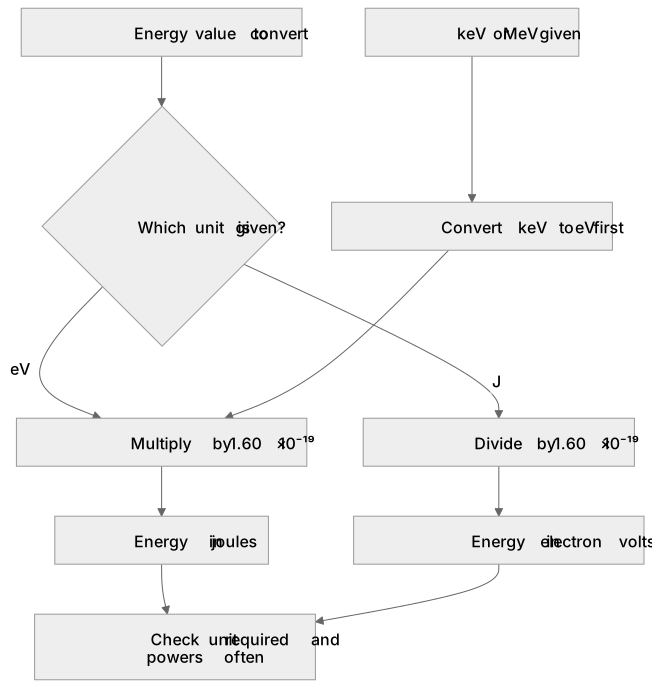
Converting between electron volts and joules uses the definition 1 eV = 1.60 × 10⁻¹⁹ J. To change eV into J, multiply the number of electron volts by 1.60 × 10⁻¹⁹. To change J into eV, divide the energy in joules by 1.60 × 10⁻¹⁹. For example, 25 eV becomes 25 × 1.60 × 10⁻¹⁹ J = 4.0 × 10⁻¹⁸ J, while 3.2 × 10⁻¹⁷ J becomes 3.2 × 10⁻¹⁷ ÷ 1.60 × 10⁻¹⁹ = 200 eV. This skill is needed whenever collision energies, ionisation energies or photon energies are quoted in different units, so always check which unit the final answer requires and keep powers of ten consistent.
What earns the marks
- Recalls the conversion factor 1 eV = 1.60 × 10⁻¹⁹ J and applies it in the correct direction.
- Multiplies an energy in eV by 1.60 × 10⁻¹⁹ to obtain the energy in joules.
- Divides an energy in joules by 1.60 × 10⁻¹⁹ to obtain the energy in electron volts.
- Handles powers of ten correctly when converting values such as keV or MeV, for example 1 keV = 1.60 × 10⁻¹⁶ J.
- Presents the converted value with an appropriate unit and a sensible number of significant figures.
Common mistakes and how to put them right
Multiplying when converting from J to eV.
Put it right by dividing the joule value by 1.60 × 10⁻¹⁹.
Using 1.60 × 10⁻¹⁹ as a power of ten adjustment rather than as the charge factor.
Put it right by treating it as the conversion factor between the two energy units.
Mixing up keV and eV by a factor of 1000.
Put it right by converting keV to eV first, then applying the joule conversion.
Exam tips
- Write the conversion as a clear equation, such as E(J) = E(eV) × 1.60 × 10⁻¹⁹, before substituting numbers.
- Estimate the expected order of magnitude first so an incorrect power of ten is easy to spot.
- Give the final answer in the unit requested by the question and include the unit symbol to avoid losing credit.
Try the lesson
The start of the Collisions of electrons with atoms: Students will be expected to be able to convert eV into J and vice versa. lesson, made from checked teaching notes for this specification point.
Have a go first
Which conversion factor correctly changes an energy in electron volts into joules?
Listen
Converting between electron volts and joules uses the definition 1 eV = 1.60 × 10⁻¹⁹ J. To change eV into J, multiply the number of electron volts by 1.60 × 10⁻¹⁹. To change J into eV, divide the energy in joules by 1.60 × 10⁻¹⁹. For example, 25 eV becomes 25 × 1.60 × 10⁻¹⁹ J = 4.0 × 10⁻¹⁸ J, while 3.2 × 10⁻¹⁷ J becomes 3.2 × 10⁻¹⁷ ÷ 1.60 × 10⁻¹⁹ = 200 eV. This skill is needed whenever collision energies, ionisation energies or photon energies are quoted in different units, so always check which unit the final answer requires and keep powers of ten consistent. A strong answer earns marks for these points. Recalls the conversion factor 1 eV = 1.60 × 10⁻¹⁹ J and applies it in the correct direction. Multiplies an energy in eV by 1.60 × 10⁻¹⁹ to obtain the energy in joules. Divides an energy in joules by 1.60 × 10⁻¹⁹ to obtain the energy in electron volts. Handles powers of ten correctly when converting values such as keV or MeV, for example 1 keV = 1.60 × 10⁻¹⁶ J. A common slip: Multiplying when converting from J to eV. Instead, dividing the joule value by 1.60 × 10⁻¹⁹. Exam tip: Write the conversion as a clear equation, such as E(J) = E(eV) × 1.60 × 10⁻¹⁹, before substituting numbers.
See it
Key words
Say what each word means before you turn the card.
Energy unit conversion
Try answering aloud or in your head before turning the card.
Use of the elementary charge
Try answering aloud or in your head before turning the card.
Numerical precision and significant figures
Try answering aloud or in your head before turning the card.
See every definition
- Energy unit conversion
- Changing an energy between electron volts and joules using the definition 1 eV = 1.60 × 10⁻¹⁹ J, multiplying or dividing as required.
- Use of the elementary charge
- Treating 1.60 × 10⁻¹⁹ as the conversion factor between the two energy units rather than as a power of ten adjustment.
- Numerical precision and significant figures
- Presenting the converted value with an appropriate unit and a sensible number of significant figures, keeping powers of ten consistent.
There is more to this lesson
The full lesson goes on to check your understanding and help you earn the marks. Create a free account to carry on, with your progress saved.
A week of Premium from your first lesson · Then the free plan continues · No card, no charge
Test your understanding of Collisions of electrons with atoms: Students will be expected to be able to convert eV into J and vice versa.
Active recall beats re-reading. Take an instant quiz now to test what you’ve learned and lock it into long-term memory.
A week of Premium from your first lesson · Then the free plan continues · No card, no charge