AQA · A-Level · Physics
Course version: 7408 · Version from Sept 2016
Use of Boolean algebra related to truth tables and logic gates.
Full specification wording
Combinational logic (A-level only): Use of Boolean algebra related to truth tables and logic gates.
Boolean algebra describes logic circuits using variables that take only 0 or 1.
Checked against the AQA 7408 specification (opens in a new tab) on .
- Point 1 of 4
- 3 key terms
Study notes
From the checked teaching notes for this specification point.
The idea
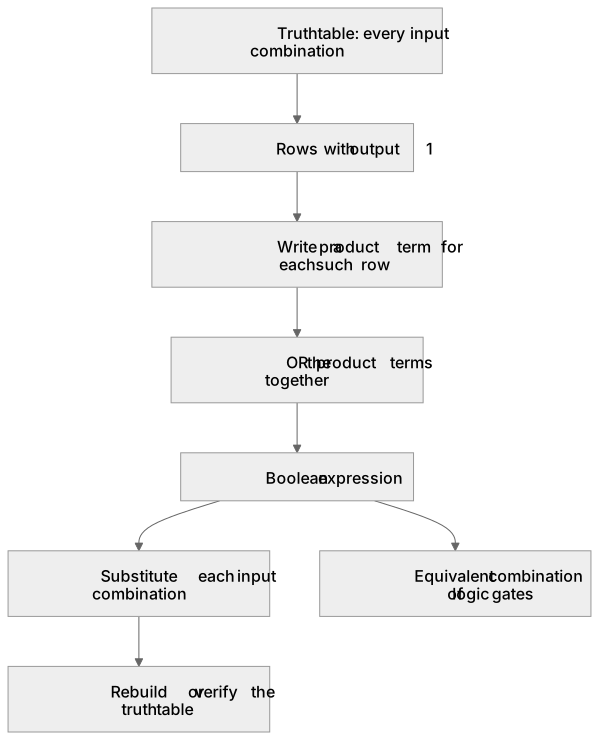
Boolean algebra describes logic circuits using variables that take only 0 or 1. A truth table lists every input combination and the resulting output, so it defines a circuit's behaviour completely. From a truth table you can read off a Boolean expression: each row giving output 1 contributes a product term, and the expression is the OR of those terms. For example, a two-input table with 1s on rows 01 and 10 gives Q = (NOT A AND B) OR (A AND NOT B), the exclusive-OR function. Conversely, substitute each input combination into an expression to rebuild the table. This links gate symbols, tables and algebra, letting you simplify circuits and check that two designs behave identically.
What earns the marks
- State that Boolean variables take only the values 0 and 1, representing false and true or low and high.
- Construct a truth table with one row for every possible input combination, using 2ⁿ rows for n inputs.
- Derive a Boolean expression from a truth table by writing a product term for each row whose output is 1 and OR-ing those terms.
- Evaluate a given Boolean expression for each input combination to complete or verify a truth table.
- Recognise standard results such as A AND NOT A = 0 and A OR NOT A = 1, and use them to simplify expressions.
- Translate between a truth table, a Boolean expression and an equivalent combination of logic gates.
Common mistakes and how to put them right
Omitting input combinations from a truth table.
Put it right: For n inputs there must be 2ⁿ rows, so a three-input table needs eight rows, not six.
Writing a product term for rows where the output is 0.
Put it right: Only rows with output 1 contribute to a sum-of-products expression.
Confusing the order of operations, treating A OR B AND C as (A OR B) AND C.
Put it right: AND binds more tightly than OR unless brackets say otherwise.
Exam tips
- Write inputs in a fixed counting order such as 00, 01, 10, 11 so no combination is missed or duplicated.
- When deriving an expression, label each product term with the row it came from, then combine them with OR signs.
- Check a simplified expression against the original truth table row by row before committing to your final answer.
Try the lesson
The start of the Combinational logic (A-level only): Use of Boolean algebra related to truth tables and logic gates. lesson, made from checked teaching notes for this specification point.
Have a go first
A logic gate has two inputs A and B. Its output Q is 0 only when A = 0 and B = 0. Which Boolean expression describes Q?
Listen
Boolean algebra describes logic circuits using variables that take only 0 or 1. A truth table lists every input combination and the resulting output, so it defines a circuit's behaviour completely. From a truth table you can read off a Boolean expression: each row giving output 1 contributes a product term, and the expression is the OR of those terms. For example, a two-input table with 1s on rows 01 and 10 gives Q = (NOT A AND B) OR (A AND NOT B), the exclusive-OR function. Conversely, substitute each input combination into an expression to rebuild the table. This links gate symbols, tables and algebra, letting you simplify circuits and check that two designs behave identically. A strong answer earns marks for these points. State that Boolean variables take only the values 0 and 1, representing false and true or low and high. Construct a truth table with one row for every possible input combination, using 2ⁿ rows for n inputs. Derive a Boolean expression from a truth table by writing a product term for each row whose output is 1 and OR-ing those terms. Evaluate a given Boolean expression for each input combination to complete or verify a truth table. Exam tip: Write inputs in a fixed counting order such as 00, 01, 10, 11 so no combination is missed or duplicated.
See it
Key words
Say what each word means before you turn the card.
Boolean algebra
Try answering aloud or in your head before turning the card.
Truth table
Try answering aloud or in your head before turning the card.
Sum-of-products
Try answering aloud or in your head before turning the card.
See every definition
- Boolean algebra
- Describes logic circuits using variables that take only 0 or 1.
- Truth table
- Lists every input combination and the resulting output, so it defines a circuit's behaviour completely.
- Sum-of-products
- Each row giving output 1 contributes a product term, and the expression is the OR of those terms.
Label the diagram
Some boxes have lost their names. Pick the right name for each number.
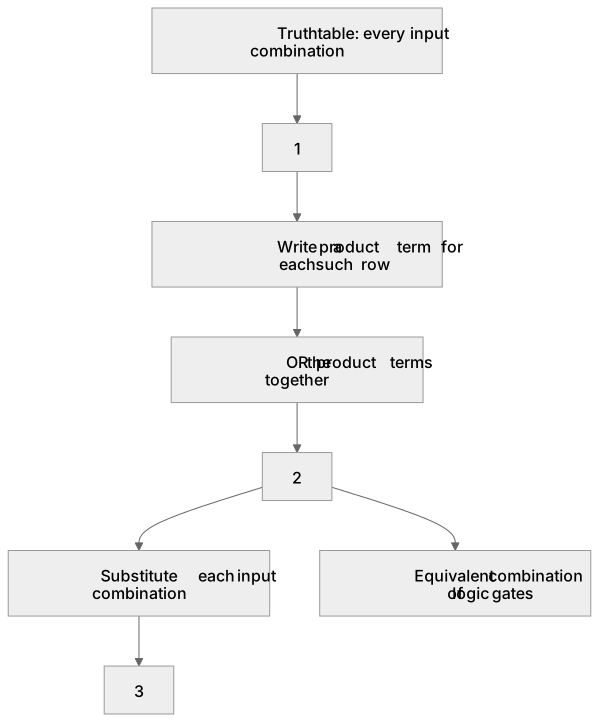
1Box 1
2Box 2
3Box 3
There is more to this lesson
The full lesson goes on to check your understanding and help you earn the marks. Create a free account to carry on, with your progress saved.
A week of Premium from your first lesson · Then the free plan continues · No card, no charge
Test your understanding of Combinational logic (A-level only): Use of Boolean algebra related to truth tables and logic gates.
Active recall beats re-reading. Take an instant quiz now to test what you’ve learned and lock it into long-term memory.
A week of Premium from your first lesson · Then the free plan continues · No card, no charge