AQA · A-Level · Physics
Course version: 7408 · Version from Sept 2016
The format of prescriptions for astigmatism.
Full specification wording
Defects of vision and their correction using lenses (A-level only): The format of prescriptions for astigmatism.
Astigmatism arises when the cornea or lens has different curvatures in different meridians, causing rays in perpendicular planes to focus at different distances.
Checked against the AQA 7408 specification (opens in a new tab) on .
- Point 2 of 2
- 4 key terms
Study notes
From the checked teaching notes for this specification point.
The idea
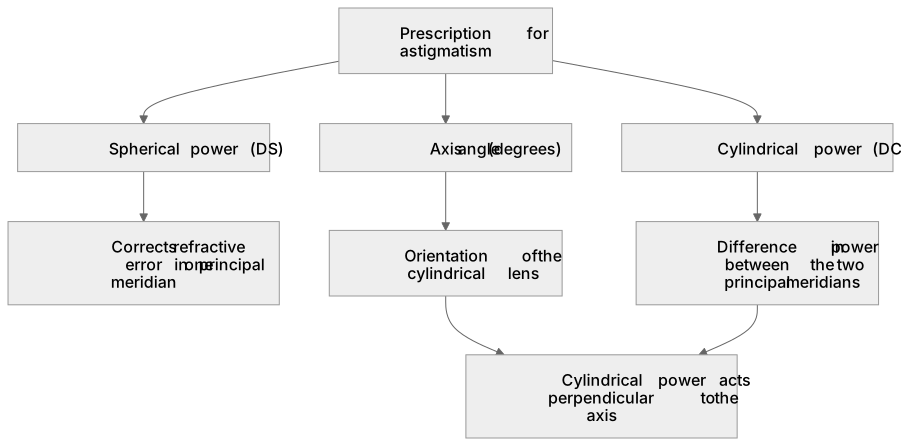
Astigmatism arises when the cornea or lens has different curvatures in different meridians, causing rays in perpendicular planes to focus at different distances. A prescription provides two power values for each eye plus an axis angle. The spherical component corrects the refractive error in one principal meridian. The cylindrical component provides the difference in power between the two principal meridians. Crucially, a cylindrical lens acts perpendicular to its axis. For example, −2.00 DS / −1.50 DC × 180 means a spherical power of −2.00 D in all meridians, with an additional −1.50 D applied at 90° (perpendicular to the 180° axis). Thus, the principal powers are −2.00 D at 180° and −3.50 D at 90°. Pure astigmatism can be corrected with a cylindrical lens alone (0.00 DS).
What earns the marks
- Astigmatism is caused by unequal curvature of refracting surfaces in different meridians, giving the eye two different focal powers.
- A prescription specifies a spherical power to correct one principal meridian and a cylindrical power equal to the difference between the two meridional powers.
- The axis is an angle in degrees that identifies the orientation of the cylindrical lens; its refractive power acts perpendicular to this axis.
- Standard notation uses DS for spherical power, DC for cylindrical power and × followed by the axis angle.
- Pure astigmatism can be corrected using only a cylindrical lens, meaning the spherical component is 0.00 DS.
- Powers are measured in dioptres, where the dioptre is the reciprocal of focal length in metres.
Common mistakes and how to put them right
Stating the spherical component corrects the average focus.
Put it right by specifying it corrects the refractive error in one principal meridian.
Assuming the cylindrical power acts along the axis angle.
Put it right by remembering that a cylindrical lens applies its power perpendicular to its axis.
Omitting the axis angle or treating it as a power value.
Put it right: The axis is an orientation in degrees, not a dioptre value.
Exam tips
- Practise reading a sample prescription aloud, identifying the spherical power for one meridian and the cylindrical power difference.
- Sketch the two principal meridians and show how the cylindrical lens adds extra power perpendicular to its axis.
Try the lesson
The start of the Defects of vision and their correction using lenses (A-level only): The format of prescriptions for astigmatism. lesson, made from checked teaching notes for this specification point.
Have a go first
A prescription for astigmatism gives two powers for the same eye, for example +2.00 D and +3.50 D. What does the difference between these two powers describe?
Listen
Astigmatism arises when the cornea or lens has different curvatures in different meridians, causing rays in perpendicular planes to focus at different distances. A prescription provides two power values for each eye plus an axis angle. The spherical component corrects the refractive error in one principal meridian. The cylindrical component provides the difference in power between the two principal meridians. Crucially, a cylindrical lens acts perpendicular to its axis. For example, −2.00 DS / −1.50 DC × 180 means a spherical power of −2.00 D in all meridians, with an additional −1.50 D applied at 90° (perpendicular to the 180° axis). Thus, the principal powers are −2.00 D at 180° and −3.50 D at 90°. Pure astigmatism can be corrected with a cylindrical lens alone (0.00 DS). A strong answer earns marks for these points. Astigmatism is caused by unequal curvature of refracting surfaces in different meridians, giving the eye two different focal powers. A prescription specifies a spherical power to correct one principal meridian and a cylindrical power equal to the difference between the two meridional powers. The axis is an angle in degrees that identifies the orientation of the cylindrical lens; its refractive power acts perpendicular to this axis. Standard notation uses DS for spherical power, DC for cylindrical power and × followed by the axis angle. A common slip: Stating the spherical component corrects the average focus. Instead, specifying it corrects the refractive error in one principal meridian. Exam tip: Practise reading a sample prescription aloud, identifying the spherical power for one meridian and the cylindrical power difference.
See it
Key words
Say what each word means before you turn the card.
Cylindrical lens
Try answering aloud or in your head before turning the card.
Axis
Try answering aloud or in your head before turning the card.
Spherical component
Try answering aloud or in your head before turning the card.
Pure astigmatism
Try answering aloud or in your head before turning the card.
See every definition
- Cylindrical lens
- A lens whose refractive power acts perpendicular to its axis, providing the difference in power between the two principal meridians.
- Axis
- An angle in degrees that identifies the orientation of the cylindrical lens, with its refractive power acting perpendicular to this axis.
- Spherical component
- The power that corrects the refractive error in one principal meridian, given in DS in standard notation.
- Pure astigmatism
- A condition that can be corrected using only a cylindrical lens, meaning the spherical component is 0.00 DS.
Label the diagram
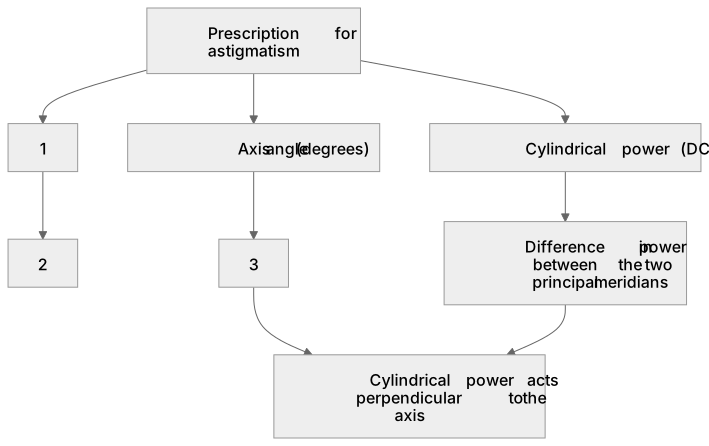
Some boxes have lost their names. Pick the right name for each number.
1Box 1
2Box 2
3Box 3
There is more to this lesson
The full lesson goes on to check your understanding and help you earn the marks. Create a free account to carry on, with your progress saved.
A week of Premium from your first lesson · Then the free plan continues · No card, no charge
Test your understanding of Defects of vision and their correction using lenses (A-level only): The format of prescriptions for astigmatism.
Active recall beats re-reading. Take an instant quiz now to test what you’ve learned and lock it into long-term memory.
A week of Premium from your first lesson · Then the free plan continues · No card, no charge