AQA · A-Level · Physics
Course version: 7408 · Version from Sept 2016
Difficulties in the direct detection of exoplanets.
Full specification wording
Detection of exoplanets (A-level only): Difficulties in the direct detection of exoplanets.
Direct detection means obtaining light from an exoplanet itself, rather than inferring its presence from the host star.
Checked against the AQA 7408 specification (opens in a new tab) on .
- Point 1 of 3
- 4 key terms
Study notes
From the checked teaching notes for this specification point.
The idea
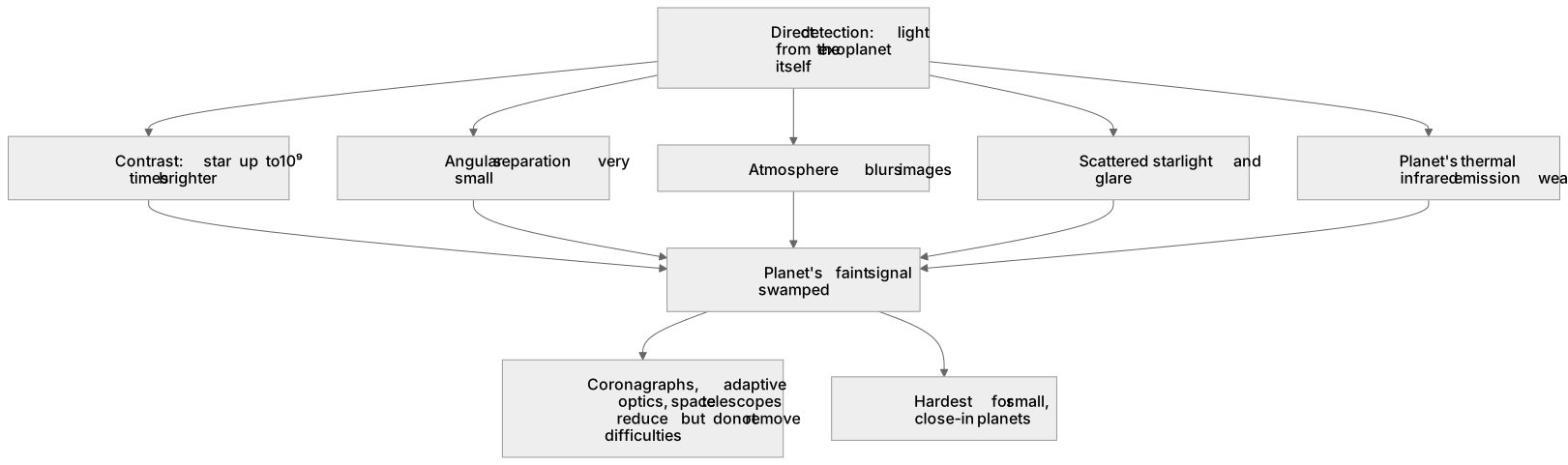
Direct detection means obtaining light from an exoplanet itself, rather than inferring its presence from the host star. The central difficulty is contrast: a star can be 10⁹ times brighter than a reflected-light planet, so the planet's faint signal is swamped. The angular separation is also tiny; at a distance of 10 parsecs, a planet 1 astronomical unit from its star is separated by about 0.1 arcsecond, below the resolution of most telescopes and blurred by the atmosphere. Starlight scattered by telescope optics and dust adds glare, while the planet's own thermal infrared emission is weak. Coronagraphs, adaptive optics and space telescopes reduce these problems, but direct imaging remains hardest for small, close-in planets.
What earns the marks
- The host star greatly outshines the planet, so the planet's reflected or emitted light is difficult to isolate.
- The angular separation between star and planet is very small, requiring high angular resolution.
- Earth's atmosphere blurs images, so ground-based direct detection needs adaptive optics or space-based observation.
- Scattered starlight and instrumental glare add background that can hide the planet's faint signal.
- Small, close-in planets are especially hard to image directly because their contrast and separation are both unfavourable.
- Techniques such as coronagraphy, adaptive optics and infrared space telescopes improve but do not remove these difficulties.
Common mistakes and how to put them right
Confusing direct detection with indirect methods such as transit or radial-velocity measurements.
Put it right by stating that direct detection requires light from the planet itself.
Assuming the main problem is simply distance.
Put it right by explaining that contrast and angular separation are the dominant difficulties even for relatively nearby systems.
Believing that a larger telescope alone solves the problem.
Put it right by noting that atmospheric blurring, scattered starlight and glare also limit detection.
Exam tips
- Quantify the contrast between star and planet to show why the planet's light is hard to see.
- Use the idea of angular resolution to explain why close-in planets are difficult to separate from their star.
- Mention at least one practical technique, such as a coronagraph or adaptive optics, and state what limitation it reduces.
Try the lesson
The start of the Detection of exoplanets (A-level only): Difficulties in the direct detection of exoplanets. lesson, made from checked teaching notes for this specification point.
Have a go first
Why is it difficult to detect an exoplanet directly by its light?
Listen
Direct detection means obtaining light from an exoplanet itself, rather than inferring its presence from the host star. The central difficulty is contrast: a star can be 10⁹ times brighter than a reflected-light planet, so the planet's faint signal is swamped. The angular separation is also tiny; at a distance of 10 parsecs, a planet 1 astronomical unit from its star is separated by about 0.1 arcsecond, below the resolution of most telescopes and blurred by the atmosphere. Starlight scattered by telescope optics and dust adds glare, while the planet's own thermal infrared emission is weak. Coronagraphs, adaptive optics and space telescopes reduce these problems, but direct imaging remains hardest for small, close-in planets. A strong answer earns marks for these points. The host star greatly outshines the planet, so the planet's reflected or emitted light is difficult to isolate. The angular separation between star and planet is very small, requiring high angular resolution. Earth's atmosphere blurs images, so ground-based direct detection needs adaptive optics or space-based observation. Scattered starlight and instrumental glare add background that can hide the planet's faint signal. A common slip: Confusing direct detection with indirect methods such as transit or radial-velocity measurements. Instead, stating that direct detection requires light from the planet itself. Exam tip: Quantify the contrast between star and planet to show why the planet's light is hard to see.
See it
Key words
Say what each word means before you turn the card.
Contrast
Try answering aloud or in your head before turning the card.
Angular separation
Try answering aloud or in your head before turning the card.
Glare
Try answering aloud or in your head before turning the card.
Coronagraphs
Try answering aloud or in your head before turning the card.
See every definition
- Contrast
- A star can be 10⁹ times brighter than a reflected-light planet, so the planet's faint signal is swamped.
- Angular separation
- The tiny angle between star and planet, about 0.1 arcsecond at 10 parsecs, which is below the resolution of most telescopes.
- Glare
- Starlight scattered by telescope optics and dust adds background that can hide the planet's faint signal.
- Coronagraphs
- Techniques that reduce these problems, though direct imaging remains hardest for small, close-in planets.
Label the diagram
Some boxes have lost their names. Pick the right name for each number.
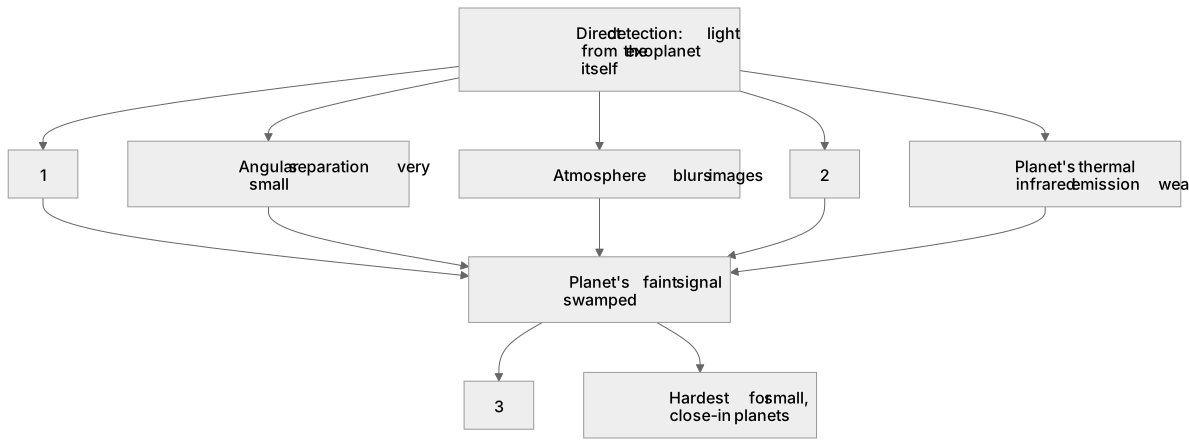
1Box 1
2Box 2
3Box 3
There is more to this lesson
The full lesson goes on to check your understanding and help you earn the marks. Create a free account to carry on, with your progress saved.
A week of Premium from your first lesson · Then the free plan continues · No card, no charge
Test your understanding of Detection of exoplanets (A-level only): Difficulties in the direct detection of exoplanets.
Active recall beats re-reading. Take an instant quiz now to test what you’ve learned and lock it into long-term memory.
A week of Premium from your first lesson · Then the free plan continues · No card, no charge