AQA · A-Level · Physics
Course version: 7408 · Version from Sept 2016
Difference between analogue and digital signals (A-level only): Bits, bytes.
A bit is the fundamental unit of digital information and has exactly two possible states, conventionally 0 and 1.
Checked against the AQA 7408 specification (opens in a new tab) on .
- Point 1 of 5
- 4 key terms
Study notes
From the checked teaching notes for this specification point.
The idea
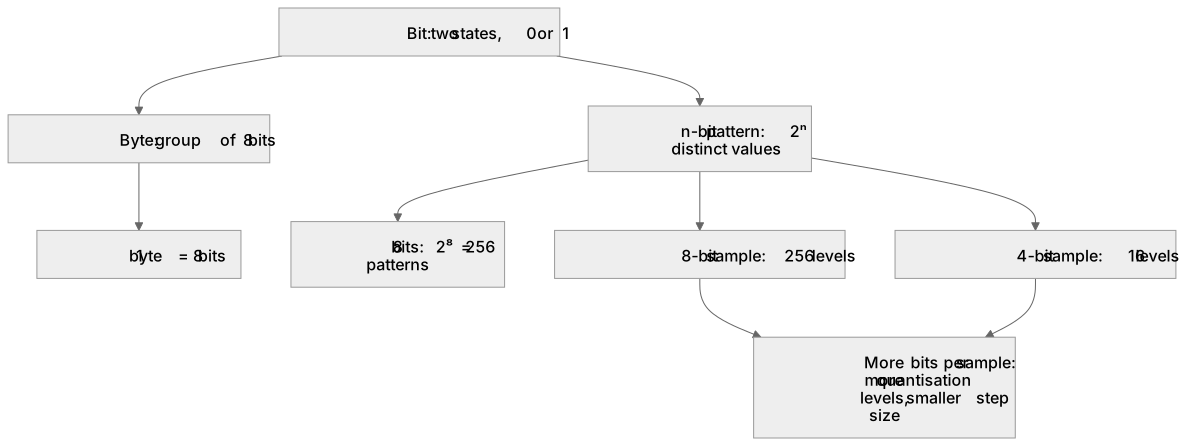
A bit is the fundamental unit of digital information and has exactly two possible states, conventionally 0 and 1. A byte is a group of 8 bits treated as one unit, so one byte can represent 2⁸ = 256 distinct patterns. In A-level physics, bits and bytes matter because digital signals are encoded as sequences of binary digits, and the number of bits available limits how precisely a quantity such as a voltage sample can be represented.
For example: A 4-bit sample can take only 16 levels, whereas an 8-bit sample can take 256 levels, giving finer resolution.
What earns the marks
- A bit is a binary digit with two possible states, 0 or 1, and is the smallest unit of digital information.
- A byte is a fixed group of 8 bits, so 1 byte = 8 bits and 1 kB = 8 kbit when using the same prefix convention.
- An n-bit binary pattern can represent 2ⁿ distinct values, so 8 bits give 2⁸ = 256 possible patterns.
- Increasing the number of bits per sample increases the number of quantisation levels and reduces the step size between adjacent levels.
- Binary patterns can be converted to decimal by summing place values, for example 1011₂ = 1 × 2³ + 0 × 2² + 1 × 2¹ + 1 × 2⁰ = 11.
- Digital data transmission rates are often quoted in bits per second, so a byte rate must be multiplied by 8 to compare with a bit rate.
Common mistakes and how to put them right
Confusing bits with bytes and treating them as interchangeable.
Put it right by remembering that a byte contains 8 bits and by checking the unit symbol b for bit and B for byte.
Assuming that a larger number of bits automatically means a faster transmission rate.
Put it right by separating bit depth, which affects resolution, from bit rate, which affects transmission speed.
Writing binary place values using baseline digits such as 23 instead of raised exponents such as 2³.
Put it right by using proper index notation throughout.
Thinking that 8 bits can represent 8 values rather than 256.
Put it right by using 2ⁿ for the number of distinct patterns.
Exam tips
- State the unit clearly in every numerical answer, for example 16 bits or 2 bytes, so the examiner can see that the bit–byte distinction has been applied.
- When converting a binary pattern to decimal, show the place-value sum explicitly rather than writing only the final number.
- Link bit depth to quantisation in a sentence, for example more bits per sample means more levels and a smaller voltage step.
- Check whether a data rate is given in bit s⁻¹ or byte s⁻¹ before substituting it into a calculation.
Try the lesson
The start of the Difference between analogue and digital signals (A-level only): Bits, bytes. lesson, made from checked teaching notes for this specification point.
Have a go first
A digital file is described as being 3 bytes in size. How many bits does the file contain?
Listen
A bit is the fundamental unit of digital information and has exactly two possible states, conventionally 0 and 1. A byte is a group of 8 bits treated as one unit, so one byte can represent 2⁸ = 256 distinct patterns. In A-level physics, bits and bytes matter because digital signals are encoded as sequences of binary digits, and the number of bits available limits how precisely a quantity such as a voltage sample can be represented. For example, a 4-bit sample can take only 16 levels, whereas an 8-bit sample can take 256 levels, giving finer resolution. A strong answer earns marks for these points. A bit is a binary digit with two possible states, 0 or 1, and is the smallest unit of digital information. A byte is a fixed group of 8 bits, so 1 byte = 8 bits and 1 kB = 8 kbit when using the same prefix convention. An n-bit binary pattern can represent 2ⁿ distinct values, so 8 bits give 2⁸ = 256 possible patterns. Increasing the number of bits per sample increases the number of quantisation levels and reduces the step size between adjacent levels. A common slip: Confusing bits with bytes and treating them as interchangeable. Instead, remembering that a byte contains 8 bits and by checking the unit symbol b for bit and B for byte. Exam tip: State the unit clearly in every numerical answer, for example 16 bits or 2 bytes, so the examiner can see that the bit–byte distinction has been applied.
See it
Key words
Say what each word means before you turn the card.
bit
Try answering aloud or in your head before turning the card.
byte
Try answering aloud or in your head before turning the card.
bit depth
Try answering aloud or in your head before turning the card.
binary pattern
Try answering aloud or in your head before turning the card.
See every definition
- bit
- A binary digit with two possible states, 0 or 1, and the smallest unit of digital information.
- byte
- A fixed group of 8 bits, so 1 byte = 8 bits and 1 kB = 8 kbit when using the same prefix convention.
- bit depth
- The number of bits per sample; increasing it increases the number of quantisation levels and reduces the step size between adjacent levels.
- binary pattern
- An n-bit pattern can represent 2ⁿ distinct values, and can be converted to decimal by summing place values.
Label the diagram
Some boxes have lost their names. Pick the right name for each number.
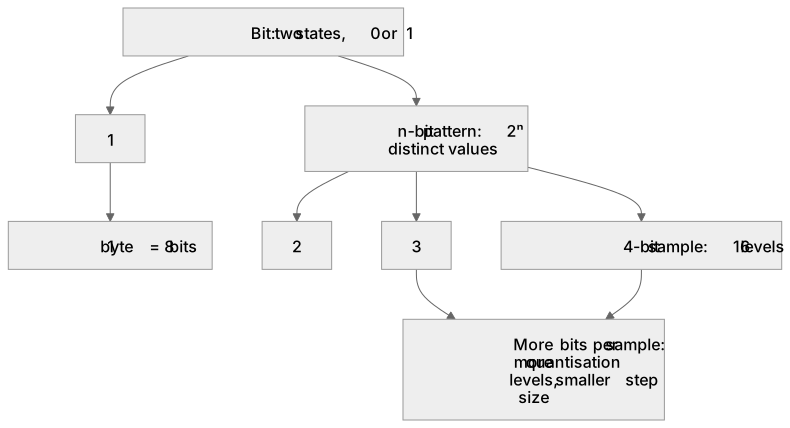
1Box 1
2Box 2
3Box 3
There is more to this lesson
The full lesson goes on to check your understanding and help you earn the marks. Create a free account to carry on, with your progress saved.
A week of Premium from your first lesson · Then the free plan continues · No card, no charge
Test your understanding of Difference between analogue and digital signals (A-level only): Bits, bytes.
Active recall beats re-reading. Take an instant quiz now to test what you’ve learned and lock it into long-term memory.
A week of Premium from your first lesson · Then the free plan continues · No card, no charge