AQA · A-Level · Physics
Course version: 7408 · Version from Sept 2016
Pulse code modulation.
Full specification wording
Difference between analogue and digital signals (A-level only): Pulse code modulation.
Pulse code modulation (PCM) converts a continuously varying analogue signal into a digital bitstream.
Checked against the AQA 7408 specification (opens in a new tab) on .
- Point 3 of 5
- 4 key terms
Study notes
From the checked teaching notes for this specification point.
The idea
Pulse code modulation (PCM) converts a continuously varying analogue signal into a digital bitstream. The analogue voltage is sampled at regular intervals at the sampling frequency; each sample is quantised by rounding to the nearest available level on a fixed scale; each level is then assigned a binary code, and the codes are transmitted as pulses. A higher sampling rate and more quantisation levels give a closer copy of the original but need more bits per second. For example, a 2 V signal sampled at 8 kHz with 256 levels uses 8 bits per sample, giving 64 kbit/s. The receiver decodes each binary word back to a voltage and reconstructs an approximation of the original waveform.
What earns the marks
- Sampling: the analogue signal is measured at regular time intervals, with the sampling frequency determining how often samples are taken.
- Quantisation: each sample value is rounded to the nearest discrete level on a fixed amplitude scale, introducing quantisation error.
- Encoding: each quantisation level is represented by a binary code, and the sequence of codes is transmitted as pulses.
- Bit rate: bit rate equals samples per second multiplied by bits per sample, so more levels or a higher sampling frequency increase the data rate.
- Reconstruction: the receiver converts each binary word back to a voltage level and outputs a stepped approximation of the original signal.
- Fidelity: increasing sampling frequency and the number of quantisation levels reduces distortion and quantisation error but increases bandwidth or storage needs.
Common mistakes and how to put them right
Confusing sampling with quantisation.
Put it right: Sampling fixes the times at which values are read, while quantisation fixes the amplitude values available; state both stages separately.
Believing that a digital copy is exact.
Put it right by explaining quantisation error.
Forgetting that bit rate depends on both sampling frequency and bits per sample.
Put it right by using bit rate = sampling frequency × bits per sample.
Exam tips
- Define each stage in order — sampling, quantisation, encoding, transmission and reconstruction — so the whole process is clear.
- Use a numerical example, such as 8 kHz sampling with 8 bits per sample giving 64 kbit/s, to show how bit rate is calculated.
- When comparing PCM with analogue transmission, refer to noise immunity, regeneration of pulses and the trade-off between quality and data rate.
Try the lesson
The start of the Difference between analogue and digital signals (A-level only): Pulse code modulation. lesson, made from checked teaching notes for this specification point.
Have a go first
In pulse code modulation, what is the first stage carried out on an analogue signal before it is quantised?
Listen
Pulse code modulation (PCM) converts a continuously varying analogue signal into a digital bitstream. The analogue voltage is sampled at regular intervals at the sampling frequency; each sample is quantised by rounding to the nearest available level on a fixed scale; each level is then assigned a binary code, and the codes are transmitted as pulses. A higher sampling rate and more quantisation levels give a closer copy of the original but need more bits per second. For example, a 2 V signal sampled at 8 kHz with 256 levels uses 8 bits per sample, giving 64 kbit/s. The receiver decodes each binary word back to a voltage and reconstructs an approximation of the original waveform. A strong answer earns marks for these points. Sampling: the analogue signal is measured at regular time intervals, with the sampling frequency determining how often samples are taken. Quantisation: each sample value is rounded to the nearest discrete level on a fixed amplitude scale, introducing quantisation error. Encoding: each quantisation level is represented by a binary code, and the sequence of codes is transmitted as pulses. Bit rate: bit rate equals samples per second multiplied by bits per sample, so more levels or a higher sampling frequency increase the data rate. A common slip: Believing that a digital copy is exact: quantisation rounds each sample, so the reconstructed signal is an approximation. Instead, explaining quantisation error. Exam tip: Define each stage in order — sampling, quantisation, encoding, transmission and reconstruction — so the whole process is clear.
See it
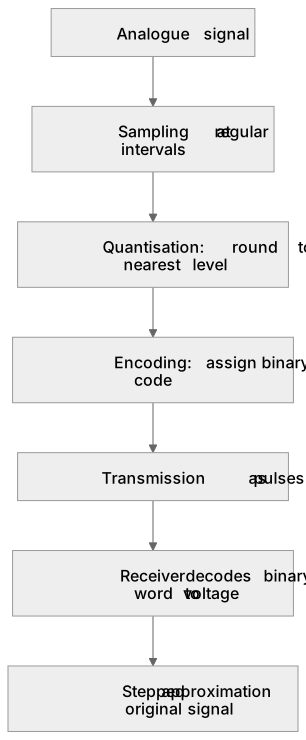
Put it in order
Put these steps in the order they happen.
- 1. Stepped approximation of original signal
- 2. Receiver decodes binary word to voltage
- 3. Quantisation: round to nearest level
- 4. Transmission as pulses
- 5. Analogue signal
- 6. Sampling at regular intervals
- 7. Encoding: assign binary code
Key words
Say what each word means before you turn the card.
Sampling
Try answering aloud or in your head before turning the card.
Quantisation
Try answering aloud or in your head before turning the card.
Encoding
Try answering aloud or in your head before turning the card.
Bit rate
Try answering aloud or in your head before turning the card.
See every definition
- Sampling
- The analogue signal is measured at regular time intervals, with the sampling frequency determining how often samples are taken.
- Quantisation
- Each sample value is rounded to the nearest discrete level on a fixed amplitude scale, introducing quantisation error.
- Encoding
- Each quantisation level is represented by a binary code, and the sequence of codes is transmitted as pulses.
- Bit rate
- Equals samples per second multiplied by bits per sample, so more levels or a higher sampling frequency increase the data rate.
Label the diagram
Some boxes have lost their names. Pick the right name for each number.
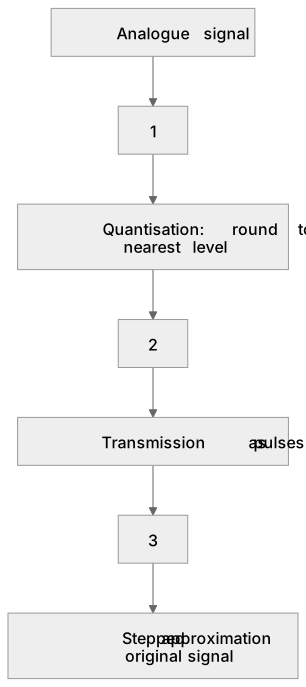
1Box 1
2Box 2
3Box 3
There is more to this lesson
The full lesson goes on to check your understanding and help you earn the marks. Create a free account to carry on, with your progress saved.
A week of Premium from your first lesson · Then the free plan continues · No card, no charge
Test your understanding of Difference between analogue and digital signals (A-level only): Pulse code modulation.
Active recall beats re-reading. Take an instant quiz now to test what you’ve learned and lock it into long-term memory.
A week of Premium from your first lesson · Then the free plan continues · No card, no charge