AQA · A-Level · Physics
Course version: 7408 · Version from Sept 2016
Simple structure of the ear, transmission processes.
Full specification wording
Ear as a sound detection system (A-level only): Simple structure of the ear, transmission processes.
The ear converts pressure variations in air into electrical signals in the auditory nerve.
Checked against the AQA 7408 specification (opens in a new tab) on .
- 4 key terms
Study notes
From the checked teaching notes for this specification point.
The idea
The ear converts pressure variations in air into electrical signals in the auditory nerve. Sound waves enter the ear canal and strike the tympanic membrane, making it vibrate. These vibrations pass through the ossicles, the malleus, incus and stapes, which act as a lever system and impedance-matching device. The stapes pushes on the oval window of the fluid-filled cochlea, generating pressure waves in the cochlear fluid. These waves displace the basilar membrane, bending hair cells in the organ of Corti and triggering nerve impulses. The Eustachian tube equalises pressure on both sides of the tympanic membrane. Transmission therefore involves mechanical vibration, then fluid pressure waves, then electrochemical signalling.
What earns the marks
- Sound is a longitudinal pressure wave that enters the ear canal and causes the tympanic membrane to vibrate.
- The ossicles, malleus, incus and stapes, transmit and amplify vibrations from the tympanic membrane to the oval window.
- The oval window couples the vibrations into the fluid-filled cochlea, where pressure waves travel through the cochlear fluid.
- Movement of the basilar membrane bends hair cells in the organ of Corti, generating electrical impulses in the auditory nerve.
- The Eustachian tube connects the middle ear to the throat and equalises pressure across the tympanic membrane.
- The middle ear acts as an impedance-matching system, improving energy transfer from air to the fluid-filled inner ear.
Common mistakes and how to put them right
Saying the ossicles amplify sound without explaining impedance matching.
Put it right: The key idea is efficient transfer from air to fluid.
Confusing the oval window with the round window or placing the cochlea in the middle ear.
Put it right: The cochlea is part of the inner ear.
Describing the ear as detecting transverse waves.
Put it right: Sound in air is a longitudinal pressure wave.
Omitting the role of hair cells and the auditory nerve, which converts mechanical movement into electrical signals.
Exam tips
- Draw a labelled flow diagram from ear canal to auditory nerve, naming each structure in order.
- Use the phrase pressure wave for sound and vibration for the tympanic membrane and ossicles.
- When asked about transmission, state the energy conversion at each stage: pressure to mechanical, mechanical to fluid pressure, fluid movement to electrical.
- Link the Eustachian tube to pressure equalisation rather than to hearing sensitivity.
Try the lesson
The start of the Ear as a sound detection system (A-level only): Simple structure of the ear, transmission processes. lesson, made from checked teaching notes for this specification point.
Have a go first
In the ear, which part first converts the vibrations of sound in air into vibrations of the ear ossicles?
Listen
The ear converts pressure variations in air into electrical signals in the auditory nerve. Sound waves enter the ear canal and strike the tympanic membrane, making it vibrate. These vibrations pass through the ossicles, the malleus, incus and stapes, which act as a lever system and impedance-matching device. The stapes pushes on the oval window of the fluid-filled cochlea, generating pressure waves in the cochlear fluid. These waves displace the basilar membrane, bending hair cells in the organ of Corti and triggering nerve impulses. The Eustachian tube equalises pressure on both sides of the tympanic membrane. Transmission therefore involves mechanical vibration, then fluid pressure waves, then electrochemical signalling. A strong answer earns marks for these points. Sound is a longitudinal pressure wave that enters the ear canal and causes the tympanic membrane to vibrate. The ossicles, malleus, incus and stapes, transmit and amplify vibrations from the tympanic membrane to the oval window. The oval window couples the vibrations into the fluid-filled cochlea, where pressure waves travel through the cochlear fluid. Movement of the basilar membrane bends hair cells in the organ of Corti, generating electrical impulses in the auditory nerve. Exam tip: Draw a labelled flow diagram from ear canal to auditory nerve, naming each structure in order.
See it
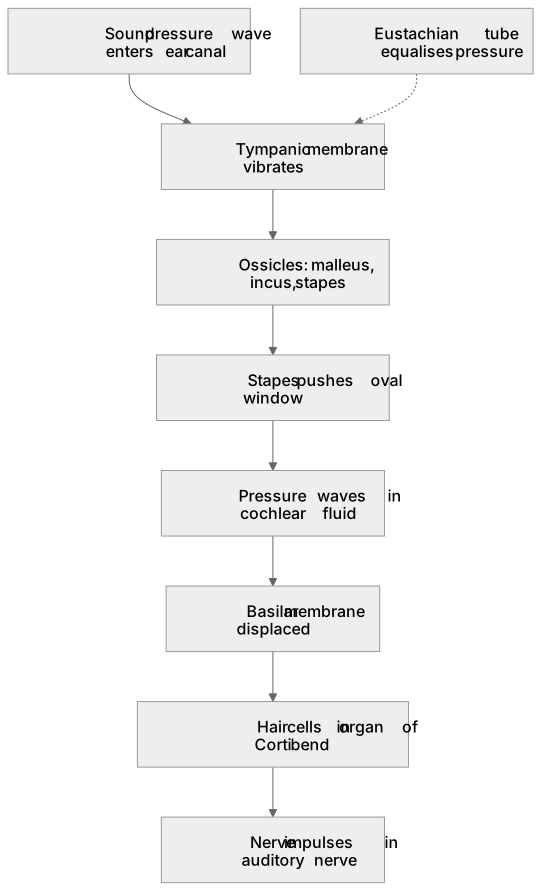
Key words
Say what each word means before you turn the card.
Impedance matching
Try answering aloud or in your head before turning the card.
Ossicles
Try answering aloud or in your head before turning the card.
Basilar membrane
Try answering aloud or in your head before turning the card.
Eustachian tube
Try answering aloud or in your head before turning the card.
See every definition
- Impedance matching
- The middle ear acts as an impedance-matching system, improving energy transfer from air to the fluid-filled inner ear.
- Ossicles
- The malleus, incus and stapes transmit and amplify vibrations from the tympanic membrane to the oval window.
- Basilar membrane
- Movement of this structure bends hair cells in the organ of Corti, generating electrical impulses in the auditory nerve.
- Eustachian tube
- Connects the middle ear to the throat and equalises pressure across the tympanic membrane.
Label the diagram
Some boxes have lost their names. Pick the right name for each number.
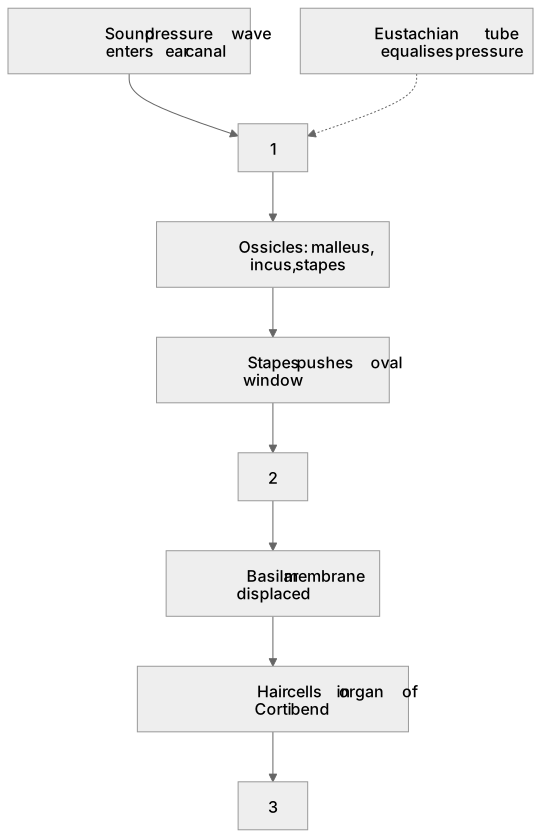
1Box 1
2Box 2
3Box 3
There is more to this lesson
The full lesson goes on to check your understanding and help you earn the marks. Create a free account to carry on, with your progress saved.
A week of Premium from your first lesson · Then the free plan continues · No card, no charge
Test your understanding of Ear as a sound detection system (A-level only): Simple structure of the ear, transmission processes.
Active recall beats re-reading. Take an instant quiz now to test what you’ve learned and lock it into long-term memory.
A week of Premium from your first lesson · Then the free plan continues · No card, no charge