AQA · A-Level · Physics
Course version: 7408 · Version from Sept 2016
Understanding of a four-stroke petrol engine cycle and a diesel engine…
Full specification wording
Engine cycles (A-level only): Understanding of a four-stroke petrol engine cycle and a diesel engine cycle, and of the corresponding indicator diagrams.
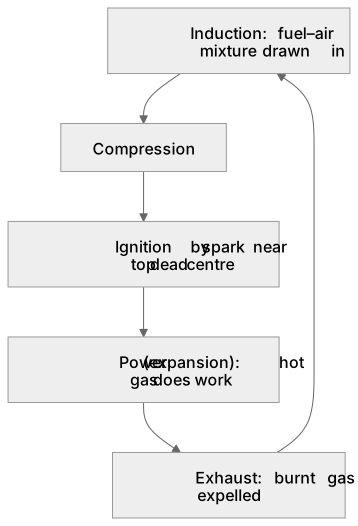
A four-stroke petrol engine repeats induction, compression, power and exhaust.
Checked against the AQA 7408 specification (opens in a new tab) on .
- Point 1 of 2
- 3 key terms
Study notes
From the checked teaching notes for this specification point.
The idea
A four-stroke petrol engine repeats induction, compression, power and exhaust. On a p−V indicator diagram the loop runs clockwise: intake near atmospheric pressure, steep compression, near-vertical pressure rise at ignition, expansion doing work, then exhaust. A diesel engine draws in air only, compresses it enough to raise temperature above the fuel's ignition point, then injects fuel that self-ignites; its diagram shows a longer, higher compression and a broader power loop. The enclosed area equals net work per cycle. Compare the two cycles by compression ratio, ignition method and loop shape, and relate each stroke to the piston positions at top and bottom dead centre.
What earns the marks
- Identifies the four strokes in order as induction, compression, power (expansion) and exhaust, linking each to piston motion between top dead centre and bottom dead centre.
- Describes the petrol cycle: fuel–air mixture drawn in, compressed, ignited by a spark, hot gas expands doing work, burnt gas expelled.
- Describes the diesel cycle: air alone drawn in and compressed to a high pressure and temperature, fuel injected and self-ignited, expansion then exhaust.
- Reads an indicator diagram: the enclosed loop area represents net work done per cycle and the loop direction shows whether work is done by or on the gas.
- Compares the cycles, noting the diesel's higher compression ratio, higher peak pressure and ignition by compression heating rather than a spark.
- Relates the near-vertical sections of the diagram to rapid combustion at approximately constant volume and the sloping sections to compression and expansion.
Common mistakes and how to put them right
Treating the four strokes as simultaneous rather than sequential.
Put it right by tracking one cylinder through two crankshaft revolutions.
Believing the spark plug ignites fuel throughout the power stroke.
Put it right by stating ignition occurs at one point near top dead centre.
Assuming the diesel cycle compresses a fuel–air mixture.
Put it right by stating only air is compressed and fuel is injected near the end of compression.
Confusing the loop area with peak pressure.
Put it right by explaining that area gives net work per cycle while peak pressure is a single point on the curve.
Exam tips
- Sketch both diagrams side by side and label the strokes, axes and enclosed area before writing prose.
- Use comparative language such as higher compression ratio and greater peak pressure when contrasting diesel with petrol.
- Link each diagram feature to the physical event in the cylinder so explanations stay causal rather than descriptive.
Try the lesson
The start of the Engine cycles (A-level only): Understanding of a four-stroke petrol engine cycle and a diesel engine cycle, and of the corresponding indicator diagrams. lesson, made from checked teaching notes for this specification point.
Have a go first
In the four-stroke petrol engine cycle, during which stroke is the air–fuel mixture drawn into the cylinder?
Listen
A four-stroke petrol engine repeats induction, compression, power and exhaust. On a p−V indicator diagram the loop runs clockwise: intake near atmospheric pressure, steep compression, near-vertical pressure rise at ignition, expansion doing work, then exhaust. A diesel engine draws in air only, compresses it enough to raise temperature above the fuel's ignition point, then injects fuel that self-ignites; its diagram shows a longer, higher compression and a broader power loop. The enclosed area equals net work per cycle. Compare the two cycles by compression ratio, ignition method and loop shape, and relate each stroke to the piston positions at top and bottom dead centre. A strong answer earns marks for these points. Identifies the four strokes in order as induction, compression, power (expansion) and exhaust, linking each to piston motion between top dead centre and bottom dead centre. Describes the petrol cycle: fuel–air mixture drawn in, compressed, ignited by a spark, hot gas expands doing work, burnt gas expelled. Describes the diesel cycle: air alone drawn in and compressed to a high pressure and temperature, fuel injected and self-ignited, expansion then exhaust. Reads an indicator diagram: the enclosed loop area represents net work done per cycle and the loop direction shows whether work is done by or on the gas. A common slip: Treating the four strokes as simultaneous rather than sequential. Instead, tracking one cylinder through two crankshaft revolutions. Exam tip: Sketch both diagrams side by side and label the strokes, axes and enclosed area before writing prose.
See it
Key words
Say what each word means before you turn the card.
Enclosed loop area
Try answering aloud or in your head before turning the card.
Diesel cycle
Try answering aloud or in your head before turning the card.
Petrol cycle
Try answering aloud or in your head before turning the card.
See every definition
- Enclosed loop area
- Represents net work done per cycle, while the loop direction shows whether work is done by or on the gas.
- Diesel cycle
- Air alone is drawn in and compressed to a high pressure and temperature, fuel is injected and self-ignites, then expansion and exhaust follow.
- Petrol cycle
- Fuel–air mixture is drawn in, compressed, ignited by a spark, hot gas expands doing work, and burnt gas is expelled.
Label the diagram
Some boxes have lost their names. Pick the right name for each number.
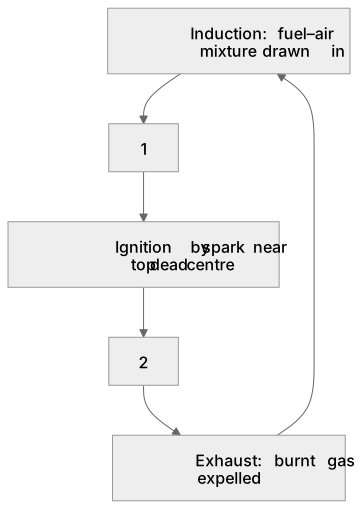
1Box 1
2Box 2
There is more to this lesson
The full lesson goes on to check your understanding and help you earn the marks. Create a free account to carry on, with your progress saved.
A week of Premium from your first lesson · Then the free plan continues · No card, no charge
Test your understanding of Engine cycles (A-level only): Understanding of a four-stroke petrol engine cycle and a diesel engine cycle, and of the corresponding indicator diagrams.
Active recall beats re-reading. Take an instant quiz now to test what you’ve learned and lock it into long-term memory.
A week of Premium from your first lesson · Then the free plan continues · No card, no charge