AQA · A-Level · Physics
Course version: 7408 · Version from Sept 2016
Physical principles of the optical system of a flexible endoscope; the use…
Full specification wording
Fibre optics and endoscopy (A-level only): Physical principles of the optical system of a flexible endoscope; the use of coherent and non- coherent fibre bundles; examples of use for internal imaging and related advantages.
A flexible endoscope uses fibre bundles to carry light into and out of the body.
Checked against the AQA 7408 specification (opens in a new tab) on .
- Point 2 of 2
- 4 key terms
Study notes
From the checked teaching notes for this specification point.
The idea
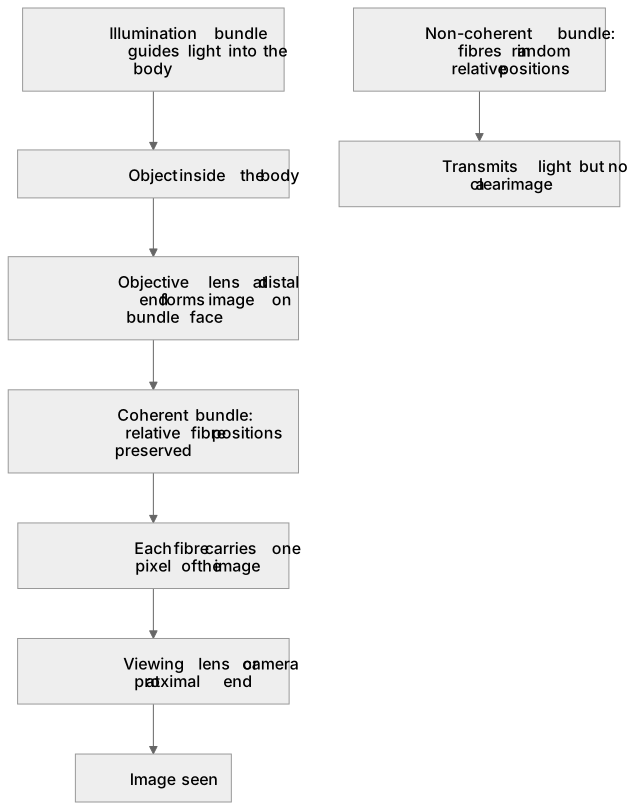
A flexible endoscope uses fibre bundles to carry light into and out of the body. A non-coherent bundle has fibres in random relative positions, so it transmits illumination but not a clear image. A coherent bundle keeps the same relative positions at both ends, so each fibre carries one pixel of the image and the pattern is preserved. An objective lens forms an image on the distal face of the coherent bundle, and a viewing lens or camera at the proximal end reconstructs the image. This allows internal imaging of organs such as the stomach or colon, with the advantages of flexibility, smaller incisions and real-time visualisation.
What earns the marks
- A flexible endoscope uses fibre bundles to guide light into the body for illumination and to carry light out for imaging.
- A coherent bundle preserves the relative positions of fibres at both ends, so it can transmit an image.
- A non-coherent bundle has fibres in random relative positions, so it transmits light but not a spatially resolved image.
- An objective lens at the distal end forms an image on the bundle face, and a viewing lens or camera at the proximal end allows the image to be seen.
- Endoscopes enable internal imaging, for example of the gastrointestinal tract, with advantages such as flexibility, reduced invasiveness and real-time observation.
Common mistakes and how to put them right
Confusing coherent and non-coherent bundles.
Put it right: Coherent bundles preserve fibre order and can carry an image, while non-coherent bundles cannot.
Thinking that a single fibre can produce a full image.
Put it right: An image requires many fibres in a coherent bundle, each carrying part of the image.
Assuming the endoscope only illuminates and does not image.
Put it right: Separate bundles or channels are used for illumination and for image transmission.
Exam tips
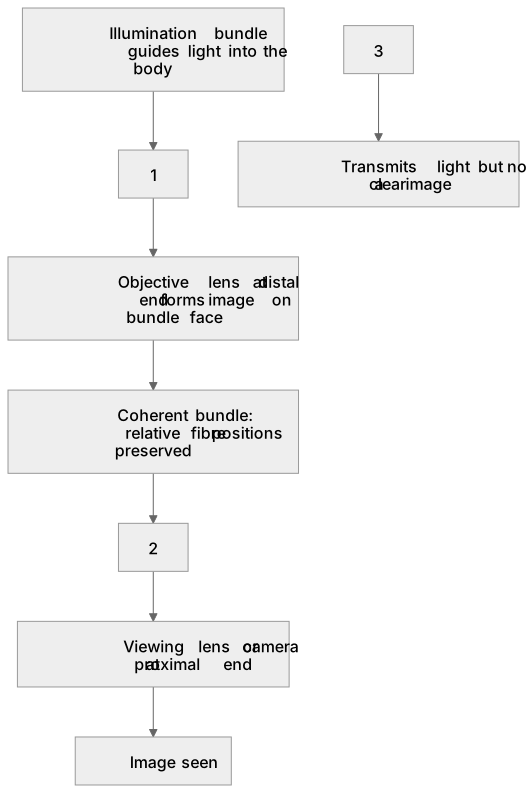
- Use a labelled diagram to show the light path: illumination bundle, object, objective lens, coherent image bundle and viewing end.
- When comparing bundle types, state clearly whether relative fibre positions are preserved and link this to image formation.
- Give a named medical example, such as gastroscopy or colonoscopy, and state one advantage such as flexibility or reduced recovery time.
Try the lesson
The start of the Fibre optics and endoscopy (A-level only): Physical principles of the optical system of a flexible endoscope; the use of coherent and non- coherent fibre bundles; examples of use for internal imaging and related advantages. lesson, made from checked teaching notes for this specification point.
Have a go first
A flexible endoscope uses two fibre bundles. Which type of bundle is used to carry an image from inside the patient back to the clinician, and why?
Listen
A flexible endoscope uses fibre bundles to carry light into and out of the body. A non-coherent bundle has fibres in random relative positions, so it transmits illumination but not a clear image. A coherent bundle keeps the same relative positions at both ends, so each fibre carries one pixel of the image and the pattern is preserved. An objective lens forms an image on the distal face of the coherent bundle, and a viewing lens or camera at the proximal end reconstructs the image. This allows internal imaging of organs such as the stomach or colon, with the advantages of flexibility, smaller incisions and real-time visualisation. A strong answer earns marks for these points. A flexible endoscope uses fibre bundles to guide light into the body for illumination and to carry light out for imaging. A coherent bundle preserves the relative positions of fibres at both ends, so it can transmit an image. A non-coherent bundle has fibres in random relative positions, so it transmits light but not a spatially resolved image. An objective lens at the distal end forms an image on the bundle face, and a viewing lens or camera at the proximal end allows the image to be seen. A common slip: Confusing coherent and non-coherent bundles. Instead, coherent bundles preserve fibre order and can carry an image, while non-coherent bundles cannot. Exam tip: Use a labelled diagram to show the light path: illumination bundle, object, objective lens, coherent image bundle and viewing end.
See it
Key words
Say what each word means before you turn the card.
Coherent fibre bundle
Try answering aloud or in your head before turning the card.
Non-coherent fibre bundle
Try answering aloud or in your head before turning the card.
Internal imaging
Try answering aloud or in your head before turning the card.
Objective lens
Try answering aloud or in your head before turning the card.
See every definition
- Coherent fibre bundle
- Keeps the same relative positions of fibres at both ends, so each fibre carries one pixel of the image and the pattern is preserved.
- Non-coherent fibre bundle
- Has fibres in random relative positions, so it transmits illumination but not a clear image.
- Internal imaging
- Allows imaging of organs such as the stomach or colon, with the advantages of flexibility, smaller incisions and real-time visualisation.
- Objective lens
- Forms an image on the distal face of the coherent bundle, while a viewing lens or camera at the proximal end reconstructs the image.
Label the diagram
Some boxes have lost their names. Pick the right name for each number.
1Box 1
2Box 2
3Box 3
There is more to this lesson
The full lesson goes on to check your understanding and help you earn the marks. Create a free account to carry on, with your progress saved.
A week of Premium from your first lesson · Then the free plan continues · No card, no charge
Test your understanding of Fibre optics and endoscopy (A-level only): Physical principles of the optical system of a flexible endoscope; the use of coherent and non- coherent fibre bundles; examples of use for internal imaging and related advantages.
Active recall beats re-reading. Take an instant quiz now to test what you’ve learned and lock it into long-term memory.
A week of Premium from your first lesson · Then the free plan continues · No card, no charge