AQA · A-Level · Physics
Course version: 7408 · Version from Sept 2016
Concept of a force field as a region in which a body experiences a…
Full specification wording
Fields (A-level only): Concept of a force field as a region in which a body experiences a non-contact force.
A force field is a region of space in which a body experiences a non-contact force, meaning the force acts without the bodies touching.
Checked against the AQA 7408 specification (opens in a new tab) on .
- Point 1 of 4
Study notes
From the checked teaching notes for this specification point.
The idea
A force field is a region of space in which a body experiences a non-contact force, meaning the force acts without the bodies touching. The field is a property of the space itself, created by a source such as a mass, a charge or a magnet, and any suitable test body placed in that region feels a force. For example, a small mass placed near a planet experiences gravitational attraction without contact; a positive test charge placed near a positive point charge experiences repulsion; a magnetic compass needle near a magnet aligns without touching it. The force may be attractive or repulsive and its size and direction generally vary from point to point, so the field is described as a vector quantity at each point. Fields allow action at a distance to be modelled, and they are central to explaining gravitational, electric and magnetic interactions throughout A-level physics.
What earns the marks
- Defines a force field as a region in which a non-contact force acts on a body placed there.
- Identifies that the field is produced by a source such as a mass, charge or magnet and exists in the surrounding space.
- States that the force is non-contact, so the interacting bodies need not touch.
- Gives a correct example such as gravitational attraction between a mass and a planet, electric force between charges, or magnetic force on a compass needle.
- Recognises that the force can be attractive or repulsive and may vary in magnitude and direction across the region.
- Explains that the field is a vector quantity at each point, with both magnitude and direction.
- Distinguishes a field from a contact force such as friction or normal contact force.
Common mistakes and how to put them right
Thinking a force field requires the two bodies to touch.
Put it right by stressing that the force acts at a distance through the field.
Believing the field only exists where a test body is present.
Put it right by explaining the field is a property of the space around the source and exists independently.
Confusing the field with the force itself.
Put it right by stating the field is defined at a point and the force depends on the body placed there.
Exam tips
- Define the term precisely, including the words region and non-contact force, before giving an example.
- Use a named example such as the gravitational field of a planet or the electric field of a point charge to show understanding.
- When asked to explain, link the source, the field in the surrounding space and the force on a test body in a clear chain.
Try the lesson
The start of the Fields (A-level only): Concept of a force field as a region in which a body experiences a non-contact force. lesson, made from checked teaching notes for this specification point.
Have a go first
Which statement best describes what is meant by a force field?
Listen
A force field is a region of space in which a body experiences a non-contact force, meaning the force acts without the bodies touching. The field is a property of the space itself, created by a source such as a mass, a charge or a magnet, and any suitable test body placed in that region feels a force. For example, a small mass placed near a planet experiences gravitational attraction without contact; a positive test charge placed near a positive point charge experiences repulsion; a magnetic compass needle near a magnet aligns without touching it. The force may be attractive or repulsive and its size and direction generally vary from point to point, so the field is described as a vector quantity at each point. Fields allow action at a distance to be modelled, and they are central to explaining gravitational, electric and magnetic interactions throughout A-level physics. A strong answer earns marks for these points. Defines a force field as a region in which a non-contact force acts on a body placed there. Identifies that the field is produced by a source such as a mass, charge or magnet and exists in the surrounding space. States that the force is non-contact, so the interacting bodies need not touch. Gives a correct example such as gravitational attraction between a mass and a planet, electric force between charges, or magnetic force on a compass needle. A common slip: Thinking a force field requires the two bodies to touch. Instead, stressing that the force acts at a distance through the field. Exam tip: Define the term precisely, including the words region and non-contact force, before giving an example.
See it
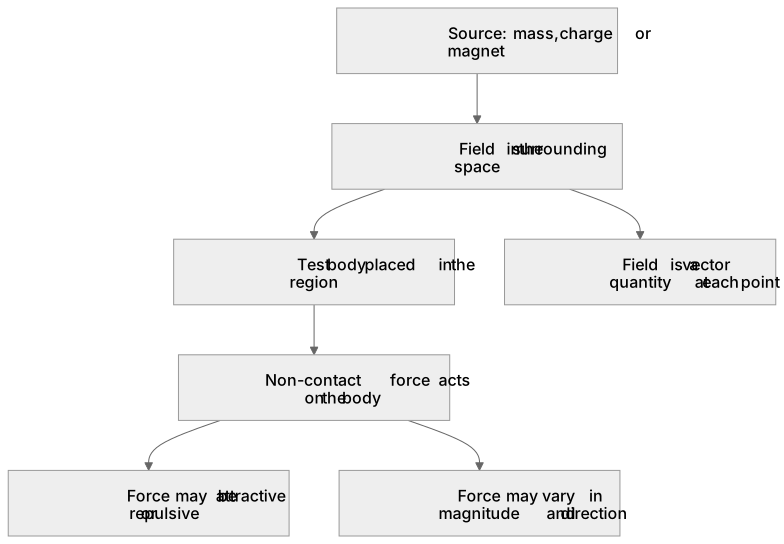
Label the diagram
Some boxes have lost their names. Pick the right name for each number.
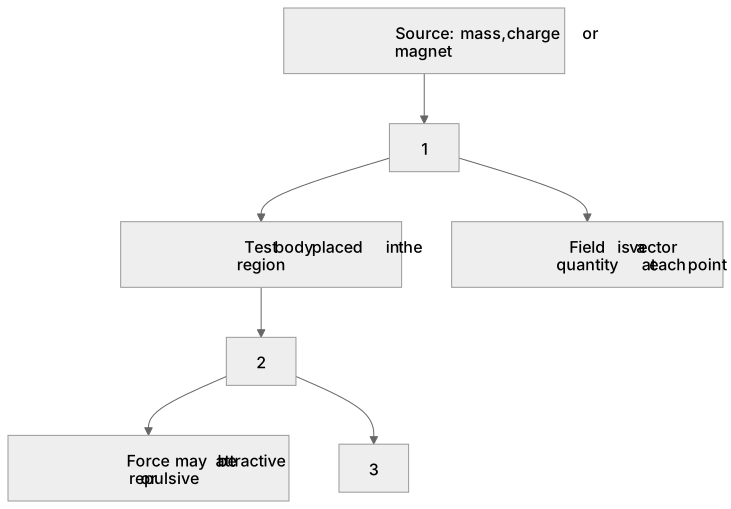
1Box 1
2Box 2
3Box 3
There is more to this lesson
The full lesson goes on to check your understanding and help you earn the marks. Create a free account to carry on, with your progress saved.
A week of Premium from your first lesson · Then the free plan continues · No card, no charge
Test your understanding of Fields (A-level only): Concept of a force field as a region in which a body experiences a non-contact force.
Active recall beats re-reading. Take an instant quiz now to test what you’ve learned and lock it into long-term memory.
A week of Premium from your first lesson · Then the free plan continues · No card, no charge