AQA · A-Level · Physics
Course version: 7408 · Version from Sept 2016
Force fields arise from the interaction of mass, of static charge, and…
Full specification wording
Fields (A-level only): Force fields arise from the interaction of mass, of static charge, and between moving charges.
A field is a region where a suitable test object experiences a force.
Checked against the AQA 7408 specification (opens in a new tab) on .
- Point 3 of 4
- 4 key terms
Study notes
From the checked teaching notes for this specification point.
The idea
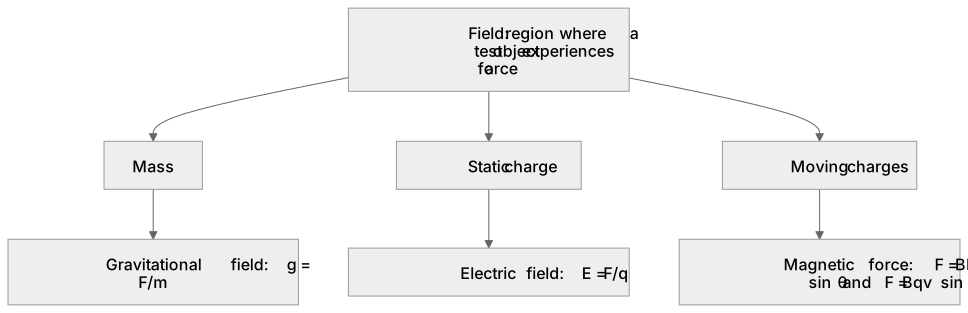
A field is a region where a suitable test object experiences a force. Mass creates a gravitational field: place a small test mass m at a point and measure the force per unit mass, g = F/m, directed towards the mass. Static charge creates an electric field: a small positive test charge q experiences F = qE, with E = F/q. Field lines map direction and relative strength, and field strength falls with distance. Moving charges interact magnetically: a current-carrying wire in a magnetic field feels F = BIL sin θ, and a single charge feels F = Bqv sin θ, with force perpendicular to both velocity and field. Thus gravitational, electric and magnetic fields all arise from mass, static charge, and moving charge respectively.
What earns the marks
- Defines a field as a region where a test mass, test charge or moving charge experiences a force, and distinguishes the three sources: mass, static charge, moving charge.
- Uses g = F/m for gravitational field strength and E = F/q for electric field strength, stating that both are vector quantities with direction given by the force on a positive test quantity.
- Explains that field lines show the direction of the force on a positive test charge or on a test mass, and that line spacing indicates relative field strength.
- Applies F = BIL sin θ to a current-carrying conductor and F = Bqv sin θ to a moving charge, noting the force is perpendicular to both the field and the velocity or current.
- Describes how field strength decreases with distance for point mass and point charge, linking to inverse-square behaviour, and contrasts this with the uniform field between parallel plates.
Common mistakes and how to put them right
Treating the electric field direction as the direction of force on a negative charge.
Put it right: E points in the direction of force on a positive test charge, so a negative charge feels force opposite to E.
Assuming a magnetic force acts on a stationary charge in a magnetic field.
Put it right: A magnetic force requires relative motion, so F = Bqv sin θ is zero when v = 0.
Confusing field strength with potential or with force.
Put it right: Field strength is force per unit test quantity, whereas potential is energy per unit test quantity, and the two are related but distinct.
Using F = BIL without the sin θ factor when the conductor is not perpendicular to the field.
Put it right: Include sin θ, which equals 1 only at 90°.
Exam tips
- When asked to compare fields, name the source, the test quantity and the defining equation before substituting numbers; this makes the physics explicit and avoids vague descriptions.
- For magnetic force questions, sketch the field direction, the current or velocity direction and the force direction, then apply Fleming's left-hand rule to check the direction before calculating magnitude.
- If a question gives a graph of force against distance or against 1/r², state the relationship shown and use the gradient or area only where the axes make that physically meaningful.
Try the lesson
The start of the Fields (A-level only): Force fields arise from the interaction of mass, of static charge, and between moving charges. lesson, made from checked teaching notes for this specification point.
Have a go first
Which interaction is responsible for producing a gravitational field?
Listen
A field is a region where a suitable test object experiences a force. Mass creates a gravitational field: place a small test mass m at a point and measure the force per unit mass, g = F/m, directed towards the mass. Static charge creates an electric field: a small positive test charge q experiences F = qE, with E = F/q. Field lines map direction and relative strength, and field strength falls with distance. Moving charges interact magnetically: a current-carrying wire in a magnetic field feels F = BIL sin θ, and a single charge feels F = Bqv sin θ, with force perpendicular to both velocity and field. Thus gravitational, electric and magnetic fields all arise from mass, static charge, and moving charge respectively. A strong answer earns marks for these points. Defines a field as a region where a test mass, test charge or moving charge experiences a force, and distinguishes the three sources: mass, static charge, moving charge. Uses g = F/m for gravitational field strength and E = F/q for electric field strength, stating that both are vector quantities with direction given by the force on a positive test quantity. Explains that field lines show the direction of the force on a positive test charge or on a test mass, and that line spacing indicates relative field strength. Applies F = BIL sin θ to a current-carrying conductor and F = Bqv sin θ to a moving charge, noting the force is perpendicular to both the field and the velocity or current. A common slip: Treating the electric field direction as the direction of force on a negative charge. Instead, E points in the direction of force on a positive test charge, so a negative charge feels force opposite to E. Exam tip: When asked to compare fields, name the source, the test quantity and the defining equation before substituting numbers; this makes the physics explicit and avoids vague descriptions.
See it
Key words
Say what each word means before you turn the card.
Field
Try answering aloud or in your head before turning the card.
Gravitational field strength
Try answering aloud or in your head before turning the card.
Electric field strength
Try answering aloud or in your head before turning the card.
Magnetic force
Try answering aloud or in your head before turning the card.
See every definition
- Field
- A region where a suitable test object experiences a force.
- Gravitational field strength
- The force per unit mass, g = F/m, directed towards the mass.
- Electric field strength
- The force per unit charge, E = F/q, on a small positive test charge.
- Magnetic force
- A force on a current-carrying wire given by F = BIL sin θ, or on a single charge by F = Bqv sin θ, perpendicular to both velocity and field.
Label the diagram
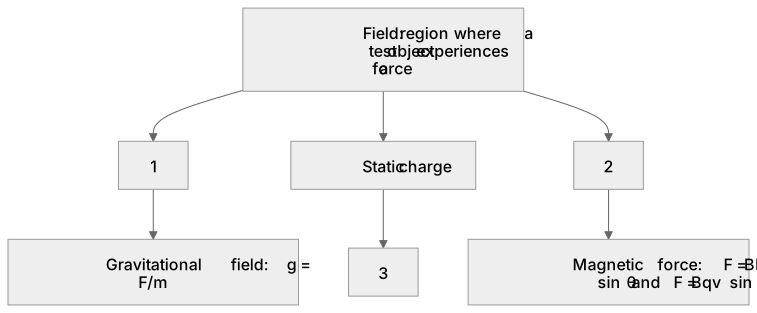
Some boxes have lost their names. Pick the right name for each number.
1Box 1
2Box 2
3Box 3
There is more to this lesson
The full lesson goes on to check your understanding and help you earn the marks. Create a free account to carry on, with your progress saved.
A week of Premium from your first lesson · Then the free plan continues · No card, no charge
Test your understanding of Fields (A-level only): Force fields arise from the interaction of mass, of static charge, and between moving charges.
Active recall beats re-reading. Take an instant quiz now to test what you’ve learned and lock it into long-term memory.
A week of Premium from your first lesson · Then the free plan continues · No card, no charge