AQA · A-Level · Physics
Course version: 7408 · Version from Sept 2016
Quantitative treatment of first law of thermodynamics, Q = ∆U + W where Q…
Full specification wording
First law of thermodynamics (A-level only): Quantitative treatment of first law of thermodynamics, Q = ∆U + W where Q is energy transferred to the system by heating, ∆U is increase in internal energy and W is work done by the system.
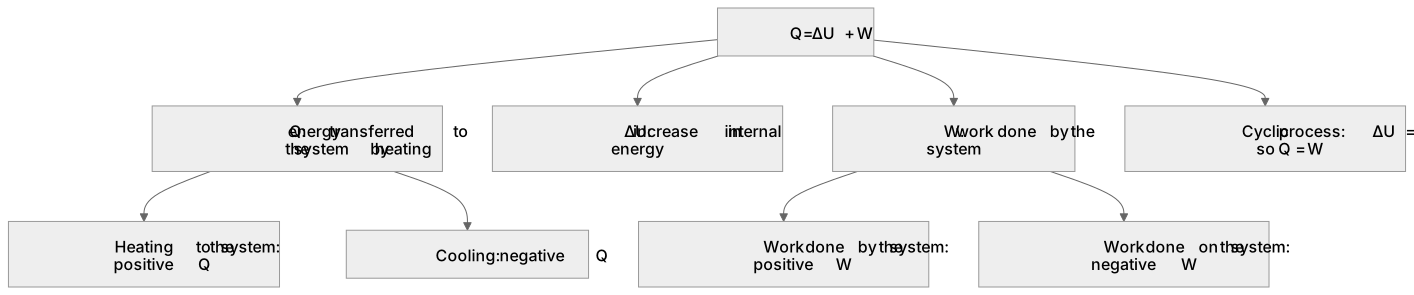
The first law is energy conservation for a thermodynamic system: Q = ∆U + W. Q is energy transferred to the system by heating; ∆U is the increase in internal energy; W is work done by the system.
Checked against the AQA 7408 specification (opens in a new tab) on .
- Point 1 of 2
- 3 key terms
Study notes
From the checked teaching notes for this specification point.
The idea
The first law is energy conservation for a thermodynamic system: Q = ∆U + W. Q is energy transferred to the system by heating; ∆U is the increase in internal energy; W is work done by the system. If a gas absorbs 500 J by heating and does 200 J of work expanding, then ∆U = Q − W = 500 J − 200 J = +300 J, so internal energy rises by 300 J and temperature rises for an ideal gas. If 300 J of work is done on the gas and it loses 100 J by heating, Q = −100 J and W = −300 J, giving ∆U = +200 J. Signs matter: heating to the system is positive Q; work done by the system is positive W. Use Q = ∆U + W to find any term, and state the sign convention explicitly.
What earns the marks
- States the first law as Q = ∆U + W and identifies each symbol with its meaning and sign convention.
- Applies the equation to a numerical problem, substituting Q, ∆U and W with correct signs and solving for the unknown.
- Explains that ∆U is the increase in internal energy and that for an ideal gas it is directly proportional to the change in thermodynamic temperature.
- Distinguishes between work done by the system (positive W) and work done on the system (negative W), and between heating to the system (positive Q) and cooling (negative Q).
- Uses the law to deduce energy changes in a cyclic process, where ∆U = 0 over a complete cycle so Q = W.
Common mistakes and how to put them right
Using the wrong sign for work done on the system.
Put it right: Use W = −(work done on the gas) because W is work done by the system.
Forgetting that ∆U is an increase, not a final value.
Put it right: Calculate ∆U = U_final − U_initial.
Mixing up Q and W in rearrangement.
Put it right: Use ∆U = Q − W for work done by the system.
Exam tips
- Always write the sign convention next to the equation before substituting numbers, so the examiner can see your reasoning.
- When a gas expands, W is positive; when it is compressed, W is negative. Check this before calculating.
- For a cyclic process, state that ∆U = 0 and therefore Q = W, which often simplifies the calculation.
Try the lesson
The start of the First law of thermodynamics (A-level only): Quantitative treatment of first law of thermodynamics, Q = ∆U + W where Q is energy transferred to the system by heating, ∆U is increase in internal energy and W is work done by the system. lesson, made from checked teaching notes for this specification point.
Have a go first
A gas is heated so that 500 J of energy is transferred to it by heating. During the heating, the gas does 200 J of work by expanding. Using Q = ∆U + W, what is the increase in internal energy of the gas?
Listen
The first law is energy conservation for a thermodynamic system: Q = ∆U + W. Q is energy transferred to the system by heating; ∆U is the increase in internal energy; W is work done by the system. If a gas absorbs 500 J by heating and does 200 J of work expanding, then ∆U = Q − W = 500 J − 200 J = +300 J, so internal energy rises by 300 J and temperature rises for an ideal gas. If 300 J of work is done on the gas and it loses 100 J by heating, Q = −100 J and W = −300 J, giving ∆U = +200 J. Signs matter: heating to the system is positive Q; work done by the system is positive W. Use Q = ∆U + W to find any term, and state the sign convention explicitly. A strong answer earns marks for these points. States the first law as Q = ∆U + W and identifies each symbol with its meaning and sign convention. Applies the equation to a numerical problem, substituting Q, ∆U and W with correct signs and solving for the unknown. Explains that ∆U is the increase in internal energy and that for an ideal gas it is directly proportional to the change in thermodynamic temperature. Distinguishes between work done by the system (positive W) and work done on the system (negative W), and between heating to the system (positive Q) and cooling (negative Q). A common slip: Using the wrong sign for work done on the system: the error is treating work done on the gas as positive W. Instead, use W = −(work done on the gas) because W is work done by the system. Exam tip: Always write the sign convention next to the equation before substituting numbers, so the examiner can see your reasoning.
See it
Key words
Say what each word means before you turn the card.
Q
Try answering aloud or in your head before turning the card.
∆U
Try answering aloud or in your head before turning the card.
First law of thermodynamics
Try answering aloud or in your head before turning the card.
See every definition
- Q
- Energy transferred to the system by heating, taken as positive when heating is to the system.
- ∆U
- The increase in internal energy, calculated as the final internal energy minus the initial internal energy.
- First law of thermodynamics
- Energy conservation for a thermodynamic system, written as Q = ∆U + W.
Label the diagram
Some boxes have lost their names. Pick the right name for each number.
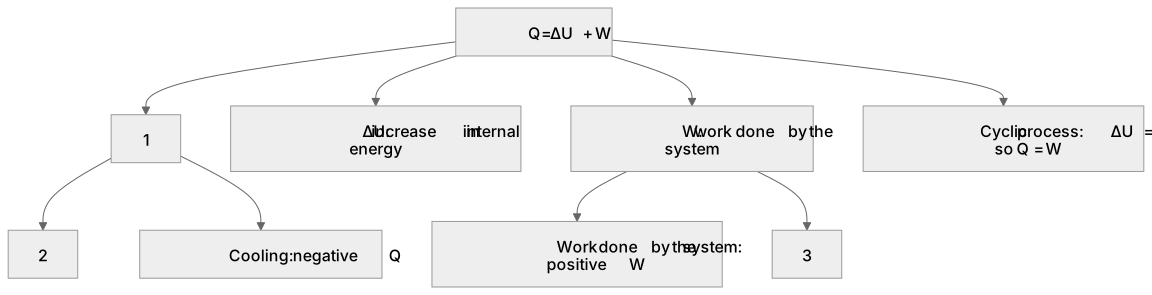
1Box 1
2Box 2
3Box 3
There is more to this lesson
The full lesson goes on to check your understanding and help you earn the marks. Create a free account to carry on, with your progress saved.
A week of Premium from your first lesson · Then the free plan continues · No card, no charge
Test your understanding of First law of thermodynamics (A-level only): Quantitative treatment of first law of thermodynamics, Q = ∆U + W where Q is energy transferred to the system by heating, ∆U is increase in internal energy and W is work done by the system.
Active recall beats re-reading. Take an instant quiz now to test what you’ve learned and lock it into long-term memory.
A week of Premium from your first lesson · Then the free plan continues · No card, no charge