AQA · A-Level · Physics
Course version: 7408 · Version from Sept 2016
Representation of a gravitational field by gravitational field lines.
Full specification wording
Gravitational field strength (A-level only): Representation of a gravitational field by gravitational field lines.
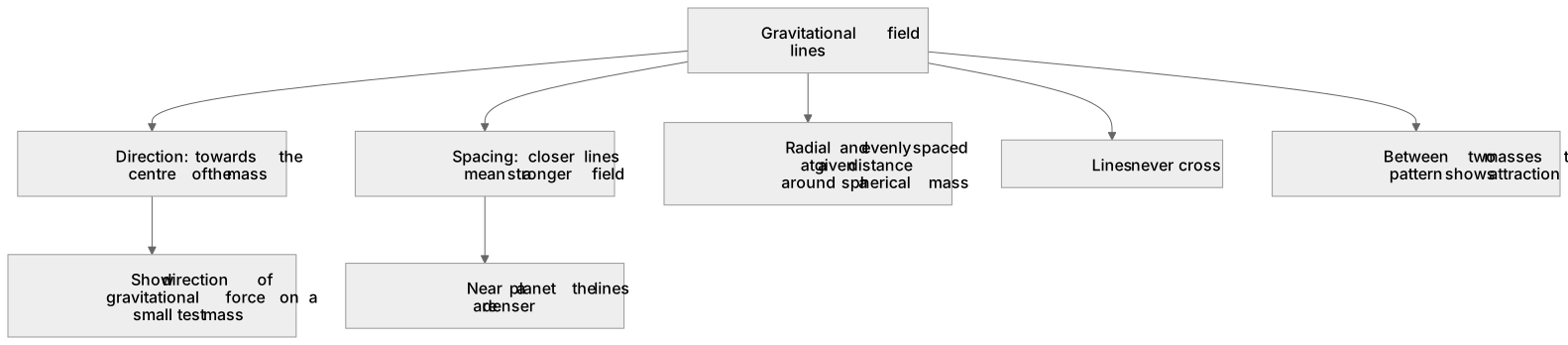
A gravitational field is represented by field lines that show the direction of the gravitational force on a small test mass.
Checked against the AQA 7408 specification (opens in a new tab) on .
- 4 key terms
Study notes
From the checked teaching notes for this specification point.
The idea
A gravitational field is represented by field lines that show the direction of the gravitational force on a small test mass. The lines point towards the centre of the mass creating the field, because gravity is always attractive. The spacing of the lines indicates field strength: closer lines mean a stronger field, so near a planet the lines are denser. Around a spherical mass, the lines are radial and evenly spaced at a given distance, while between two masses the pattern shows attraction. Field lines never cross, and their direction is the direction of the force on a positive test mass, which for gravity is towards the attracting mass.
What earns the marks
- Draw gravitational field lines pointing radially inwards towards the centre of a spherical mass.
- Use the spacing of field lines to represent the magnitude of gravitational field strength, with closer lines indicating a stronger field.
- Explain that field lines show the direction of the gravitational force on a small test mass placed in the field.
- Recognise that field lines do not cross and that the field is radial near an isolated spherical mass.
- Interpret field-line diagrams for more than one mass, showing the resultant field direction at a point.
Common mistakes and how to put them right
Drawing field lines pointing outwards from a mass.
Put it right: Gravitational field lines point inwards because gravity is attractive.
Drawing field lines crossing each other.
Put it right: Field lines never cross because the field has a single direction at any point.
Using evenly spaced lines everywhere around a planet.
Put it right: Spacing should increase with distance to show decreasing field strength.
Exam tips
- Use arrows on field lines to show direction clearly, and make the lines meet the surface at right angles for a spherical mass.
- When comparing two points, refer to the spacing of field lines to justify which has greater gravitational field strength.
- For two masses, sketch the resultant field pattern and mark the neutral point if it exists, showing where fields cancel.
Try the lesson
The start of the Gravitational field strength (A-level only): Representation of a gravitational field by gravitational field lines. lesson, made from checked teaching notes for this specification point.
Have a go first
What does the direction of a gravitational field line indicate?
Listen
A gravitational field is represented by field lines that show the direction of the gravitational force on a small test mass. The lines point towards the centre of the mass creating the field, because gravity is always attractive. The spacing of the lines indicates field strength: closer lines mean a stronger field, so near a planet the lines are denser. Around a spherical mass, the lines are radial and evenly spaced at a given distance, while between two masses the pattern shows attraction. Field lines never cross, and their direction is the direction of the force on a positive test mass, which for gravity is towards the attracting mass. A strong answer earns marks for these points. Draw gravitational field lines pointing radially inwards towards the centre of a spherical mass. Use the spacing of field lines to represent the magnitude of gravitational field strength, with closer lines indicating a stronger field. Explain that field lines show the direction of the gravitational force on a small test mass placed in the field. Recognise that field lines do not cross and that the field is radial near an isolated spherical mass. A common slip: Drawing field lines pointing outwards from a mass. Instead, gravitational field lines point inwards because gravity is attractive. Exam tip: Use arrows on field lines to show direction clearly, and make the lines meet the surface at right angles for a spherical mass.
See it
Key words
Say what each word means before you turn the card.
Direction of gravitational force
Try answering aloud or in your head before turning the card.
Field strength and line spacing
Try answering aloud or in your head before turning the card.
Radial fields
Try answering aloud or in your head before turning the card.
Superposition of fields
Try answering aloud or in your head before turning the card.
See every definition
- Direction of gravitational force
- The direction of the force on a positive test mass, which for gravity is towards the attracting mass.
- Field strength and line spacing
- Closer lines mean a stronger field, so the spacing of the lines indicates field strength.
- Radial fields
- Around a spherical mass the lines are radial and evenly spaced at a given distance.
- Superposition of fields
- Between two masses the pattern shows attraction, and the resultant field direction at a point can be interpreted.
Label the diagram
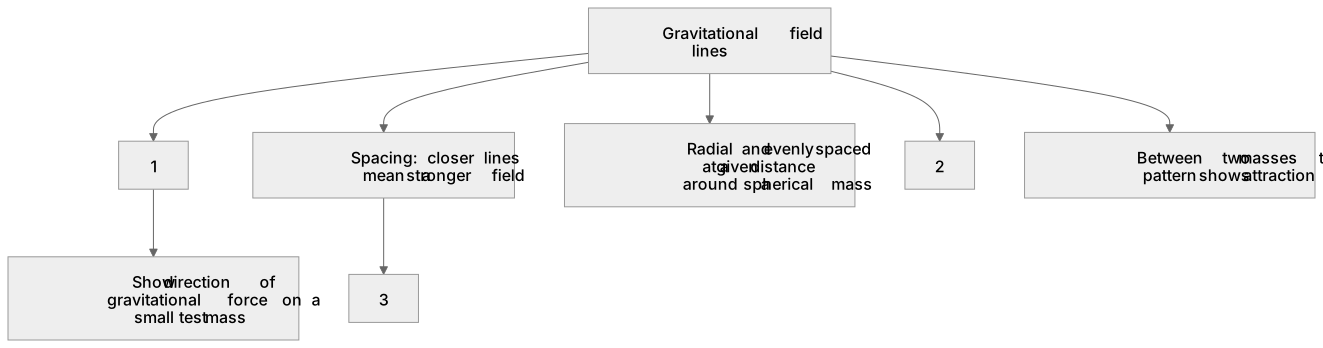
Some boxes have lost their names. Pick the right name for each number.
1Box 1
2Box 2
3Box 3
There is more to this lesson
The full lesson goes on to check your understanding and help you earn the marks. Create a free account to carry on, with your progress saved.
A week of Premium from your first lesson · Then the free plan continues · No card, no charge
Test your understanding of Gravitational field strength (A-level only): Representation of a gravitational field by gravitational field lines.
Active recall beats re-reading. Take an instant quiz now to test what you’ve learned and lock it into long-term memory.
A week of Premium from your first lesson · Then the free plan continues · No card, no charge