AQA · A-Level · Physics
Course version: 7408 · Version from Sept 2016
Graphical representations of variations of g and V with r.
Full specification wording
Gravitational potential (A-level only): Graphical representations of variations of g and V with r.
This topic requires you to sketch and interpret graphs of gravitational field strength g and gravitational potential V against distance r from a point mass or uniform sphere.
Checked against the AQA 7408 specification (opens in a new tab) on .
- Point 5 of 5
- 4 key terms
Study notes
From the checked teaching notes for this specification point.
The idea
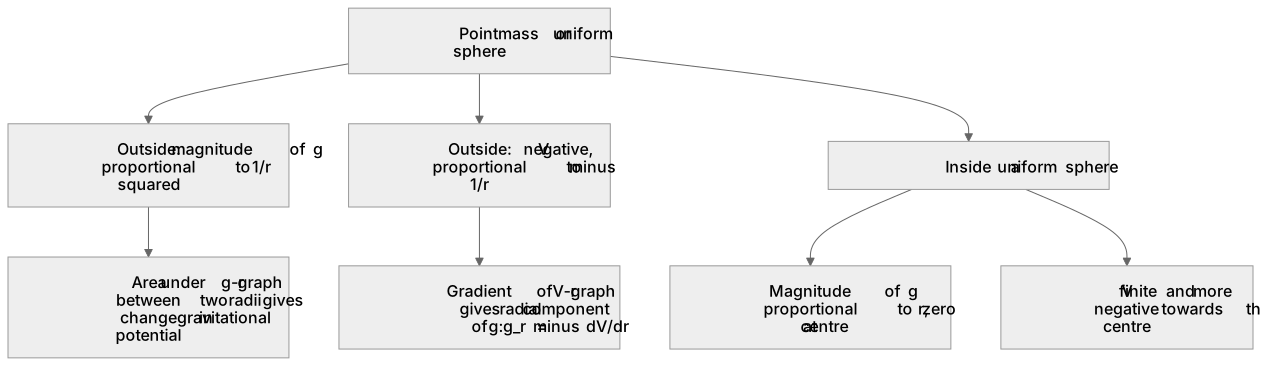
This topic requires you to sketch and interpret graphs of gravitational field strength g and gravitational potential V against distance r from a point mass or uniform sphere. For a point mass, the magnitude of g is GM/r² and V = −GM/r. The radial component of g is negative, but its magnitude falls as 1/r², while V is always negative and rises towards zero as 1/r. Inside a uniform sphere, g's magnitude increases linearly with r from zero at the centre, whereas V becomes more negative towards the centre (e.g. V at centre is −3GM/2R). You should identify asymptotes, signs, gradients and discontinuities, and use the graphs to compare fields and potentials at different distances.
What earns the marks
- Correctly sketches the magnitude of g against r outside a point mass as a positive curve proportional to 1/r², tending to zero as r tends to infinity.
- Correctly sketches V against r outside a point mass as a negative curve proportional to −1/r, approaching zero from below as r tends to infinity.
- States that inside a uniform sphere the magnitude of g is proportional to r and reaches zero at the centre, while V is finite and becomes more negative towards the centre.
- Uses the gradient of the V–r graph to obtain the radial component of gravitational field strength, recognising that g_r = −dV/dr.
- Interprets the area under a g–r graph between two radii as the change in gravitational potential, with an appropriate sign.
Common mistakes and how to put them right
Drawing V as positive outside the mass.
Put it right: Gravitational potential is negative because the zero is defined at infinity.
Treating g as proportional to 1/r rather than 1/r².
Put it right: The inverse-square law gives a steeper fall for g than for the magnitude of V.
Stating V becomes less negative inside a uniform sphere.
Put it right: V becomes more negative towards the centre, reaching a minimum at r=0.
Exam tips
- Label axes with the quantity and symbol, and mark the asymptotic behaviour towards the r-axis clearly.
- Use dashed lines or a separate sketch to distinguish the region inside a uniform sphere from the region outside it.
- When asked to compare graphs, refer explicitly to signs, powers of r and limiting values rather than describing shapes vaguely.
Try the lesson
The start of the Gravitational potential (A-level only): Graphical representations of variations of g and V with r. lesson, made from checked teaching notes for this specification point.
Have a go first
Outside a spherical planet of mass M, the gravitational field strength g varies with distance r from the centre. Which statement describes the shape of the graph of g against r for r greater than the planet's radius?
Listen
This topic requires you to sketch and interpret graphs of gravitational field strength g and gravitational potential V against distance r from a point mass or uniform sphere. For a point mass, the magnitude of g is GM/r² and V = −GM/r. The radial component of g is negative, but its magnitude falls as 1/r², while V is always negative and rises towards zero as 1/r. Inside a uniform sphere, g's magnitude increases linearly with r from zero at the centre, whereas V becomes more negative towards the centre (e.g. V at centre is −3GM/2R). You should identify asymptotes, signs, gradients and discontinuities, and use the graphs to compare fields and potentials at different distances. A strong answer earns marks for these points. Correctly sketches the magnitude of g against r outside a point mass as a positive curve proportional to 1/r², tending to zero as r tends to infinity. Correctly sketches V against r outside a point mass as a negative curve proportional to −1/r, approaching zero from below as r tends to infinity. States that inside a uniform sphere the magnitude of g is proportional to r and reaches zero at the centre, while V is finite and becomes more negative towards the centre. Uses the gradient of the V–r graph to obtain the radial component of gravitational field strength, recognising that g_r = −dV/dr. A common slip: Drawing V as positive outside the mass. Instead, gravitational potential is negative because the zero is defined at infinity. Exam tip: Label axes with the quantity and symbol, and mark the asymptotic behaviour towards the r-axis clearly.
See it
Key words
Say what each word means before you turn the card.
Inverse-square law for gravitational field strength
Try answering aloud or in your head before turning the card.
Inverse-distance law for gravitational potential
Try answering aloud or in your head before turning the card.
Sign conventions and the zero of potential at infinity
Try answering aloud or in your head before turning the card.
Uniform sphere interior fields and potentials
Try answering aloud or in your head before turning the card.
See every definition
- Inverse-square law for gravitational field strength
- The magnitude of g is GM/r², a positive curve proportional to 1/r² that tends to zero as r tends to infinity.
- Inverse-distance law for gravitational potential
- V = −GM/r, a negative curve proportional to −1/r that approaches zero from below as r tends to infinity.
- Sign conventions and the zero of potential at infinity
- Gravitational potential is negative because the zero is defined at infinity, and V is always negative and rises towards zero as 1/r.
- Uniform sphere interior fields and potentials
- Inside a uniform sphere the magnitude of g is proportional to r and reaches zero at the centre, while V is finite and becomes more negative towards the centre.
Label the diagram
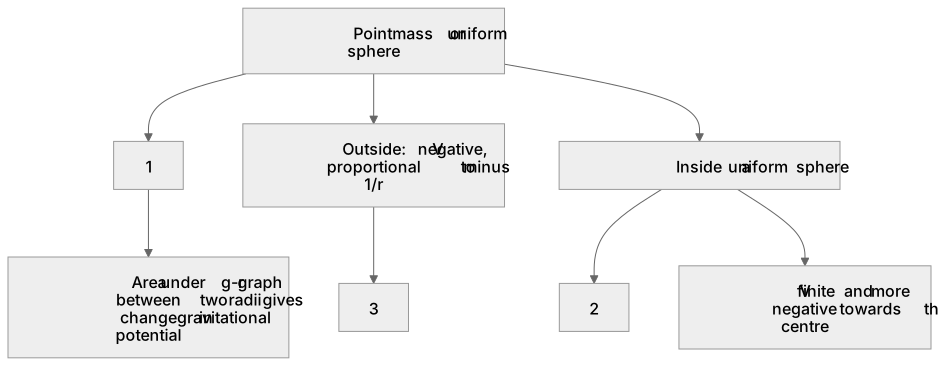
Some boxes have lost their names. Pick the right name for each number.
1Box 1
2Box 2
3Box 3
There is more to this lesson
The full lesson goes on to check your understanding and help you earn the marks. Create a free account to carry on, with your progress saved.
A week of Premium from your first lesson · Then the free plan continues · No card, no charge
Test your understanding of Gravitational potential (A-level only): Graphical representations of variations of g and V with r.
Active recall beats re-reading. Take an instant quiz now to test what you’ve learned and lock it into long-term memory.
A week of Premium from your first lesson · Then the free plan continues · No card, no charge