AQA · A-Level · Physics
Course version: 7408 · Version from Sept 2016
Hall effect sensor (A-level only): Use in tachometer.
A tachometer measures the rotational speed of a shaft or wheel, typically in revolutions per minute (rpm).
Checked against the AQA 7408 specification (opens in a new tab) on .
- Point 2 of 2
- 4 key terms
Study notes
From the checked teaching notes for this specification point.
The idea
A tachometer measures the rotational speed of a shaft or wheel, typically in revolutions per minute (rpm). A Hall effect sensor acts as the sensing element by detecting a small magnet attached to the rotating object. As the magnet passes the sensor, the magnetic flux density perpendicular to the Hall probe increases, increasing the Lorentz force on charge carriers. This generates a peak Hall voltage, processed into a digital pulse. Counting these pulses over a fixed time yields the rotation rate. For example, if a magnet on a shaft generates 24 pulses in $3.0\text{ s}$, the frequency is $8.0\text{ Hz}$ ($8\text{ rev s}^{-1}$), equating to $480\text{ rpm}$. This contactless method prevents mechanical wear and provides a reliable electrical output.
What earns the marks
- A tachometer measures the rate of rotation, often expressed in revolutions per minute (rpm) or hertz (Hz).
- A Hall effect sensor detects the passage of a magnet on a rotating shaft due to the changing magnetic flux density perpendicular to the sensor.
- The changing magnetic field alters the Lorentz force on charge carriers in the sensor, producing a pulsed Hall voltage.
- The rotation rate is determined by counting the number of voltage pulses over a specific time interval or measuring the time between successive pulses.
Common mistakes and how to put them right
Confusing the Hall effect with electromagnetic induction.
Put it right: Explain that the Hall voltage arises from the magnetic (Lorentz) force deflecting charge carriers, not from Faraday's law.
Forgetting to convert revolutions per second (Hz) to revolutions per minute (rpm).
Put it right: Multiply the frequency in Hz by 60.
Assuming the Hall voltage remains constant during rotation.
Put it right: Recognise that the voltage peaks only when the magnet is directly adjacent to the sensor, creating discrete pulses.
Exam tips
- Clearly distinguish the Hall effect (force on moving charges in a semiconductor) from electromagnetic induction when explaining how the sensor detects the magnet.
- Show all conversion steps explicitly in calculations, such as $8.0\text{ rev s}^{-1} \times 60 = 480\text{ rpm}$, to ensure method marks are awarded.
Try the lesson
The start of the Hall effect sensor (A-level only): Use in tachometer. lesson, made from checked teaching notes for this specification point.
Have a go first
A Hall effect sensor is used in a tachometer to measure the rotation rate of a shaft. What does the sensor detect as the shaft turns?
Listen
A tachometer measures the rotational speed of a shaft or wheel, typically in revolutions per minute (rpm). A Hall effect sensor acts as the sensing element by detecting a small magnet attached to the rotating object. As the magnet passes the sensor, the magnetic flux density perpendicular to the Hall probe increases, increasing the Lorentz force on charge carriers. This generates a peak Hall voltage, processed into a digital pulse. Counting these pulses over a fixed time yields the rotation rate. For example, if a magnet on a shaft generates 24 pulses in 3.0\text{ s}, the frequency is 8.0\text{ Hz} (8\text{ rev s}^{-1}), equating to 480\text{ rpm}. This contactless method prevents mechanical wear and provides a reliable electrical output. A strong answer earns marks for these points. A tachometer measures the rate of rotation, often expressed in revolutions per minute (rpm) or hertz (Hz). A Hall effect sensor detects the passage of a magnet on a rotating shaft due to the changing magnetic flux density perpendicular to the sensor. The changing magnetic field alters the Lorentz force on charge carriers in the sensor, producing a pulsed Hall voltage. The rotation rate is determined by counting the number of voltage pulses over a specific time interval or measuring the time between successive pulses. A common slip: Confusing the Hall effect with electromagnetic induction. Instead, explain that the Hall voltage arises from the magnetic (Lorentz) force deflecting charge carriers, not from Faraday's law. Exam tip: Clearly distinguish the Hall effect (force on moving charges in a semiconductor) from electromagnetic induction when explaining how the sensor detects the magnet.
See it
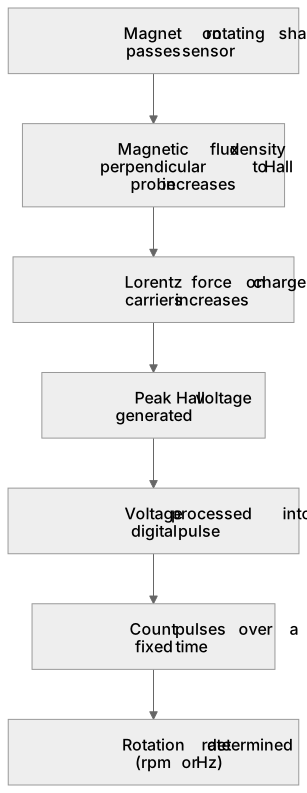
Put it in order
Put these steps in the order they happen.
- 1. Rotation rate determined (rpm or Hz)
- 2. Count pulses over a fixed time
- 3. Lorentz force on charge carriers increases
- 4. Voltage processed into a digital pulse
- 5. Magnet on rotating shaft passes sensor
- 6. Magnetic flux density perpendicular to Hall probe increases
- 7. Peak Hall voltage generated
Key words
Say what each word means before you turn the card.
Tachometer
Try answering aloud or in your head before turning the card.
Hall effect sensor
Try answering aloud or in your head before turning the card.
Lorentz force on charge carriers
Try answering aloud or in your head before turning the card.
Digital pulse
Try answering aloud or in your head before turning the card.
See every definition
- Tachometer
- Measures the rotational speed of a shaft or wheel, typically in revolutions per minute (rpm).
- Hall effect sensor
- Acts as the sensing element by detecting a small magnet attached to the rotating object.
- Lorentz force on charge carriers
- Increased by the increasing magnetic flux density perpendicular to the Hall probe as the magnet passes the sensor.
- Digital pulse
- Produced from a peak Hall voltage, and counting these over a fixed time yields the rotation rate.
Label the diagram
Some boxes have lost their names. Pick the right name for each number.
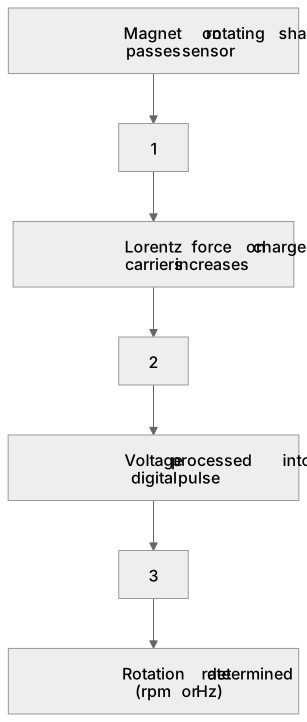
1Box 1
2Box 2
3Box 3
There is more to this lesson
The full lesson goes on to check your understanding and help you earn the marks. Create a free account to carry on, with your progress saved.
A week of Premium from your first lesson · Then the free plan continues · No card, no charge
Test your understanding of Hall effect sensor (A-level only): Use in tachometer.
Active recall beats re-reading. Take an instant quiz now to test what you’ve learned and lock it into long-term memory.
A week of Premium from your first lesson · Then the free plan continues · No card, no charge