AQA · A-Level · Physics
Course version: 7408 · Version from Sept 2016
Red shift v = Hd Simple interpretation as expansion of universe;…
Full specification wording
Hubble's law (A-level only): Red shift v = Hd Simple interpretation as expansion of universe; estimation of age of universe, assuming H is constant.
Hubble's law states that the recession speed v of a distant galaxy is proportional to its distance d from Earth: v = Hd, where H is the Hubble constant.
Checked against the AQA 7408 specification (opens in a new tab) on .
- Point 1 of 2
- 3 key terms
Study notes
From the checked teaching notes for this specification point.
The idea
Hubble's law states that the recession speed v of a distant galaxy is proportional to its distance d from Earth: v = Hd, where H is the Hubble constant. Redshift of spectral lines provides v, and distance is found from standard candles such as type Ia supernovae or Cepheid variables. The simple interpretation is that space itself is expanding uniformly, so all distant galaxies recede and more distant ones recede faster; this is not because Earth is at a special centre. If H is assumed constant, the age of the universe is estimated as t ≈ 1/H, because a galaxy now at distance d has taken approximately d/v = d/(Hd) = 1/H to reach that separation. You should use consistent units, typically converting H from km s⁻¹ Mpc⁻¹ to s⁻¹ before finding 1/H in seconds or years.
What earns the marks
- Hubble's law is v = Hd, where v is recession speed, d is distance and H is the Hubble constant.
- Redshift of spectral lines gives recession speed, often using Δλ/λ₀ = v/c for speeds much less than c.
- Distance is determined independently, for example using standard candles such as type Ia supernovae or Cepheid variables.
- The simple interpretation is that the universe is expanding uniformly, so more distant galaxies recede faster; Earth is not at the centre of expansion.
- Assuming H is constant, the age of the universe is estimated as t ≈ 1/H, obtained from time = distance/speed = d/(Hd).
- Unit conversion is essential: H in km s⁻¹ Mpc⁻¹ must be converted to s⁻¹ before calculating 1/H, using 1 Mpc ≈ 3.09 × 10¹⁹ km.
Common mistakes and how to put them right
Using H directly in km s⁻¹ Mpc⁻¹ to find an age in seconds.
Put it right by converting H to s⁻¹ first, for example by multiplying by 10³ m km⁻¹ and dividing by 3.09 × 10²² m Mpc⁻¹.
Thinking that redshift means galaxies are moving through space away from a central point.
Put it right by explaining that space itself expands and the recession is observed uniformly.
Confusing the Hubble constant H with the age of the universe.
Put it right by stating that age is estimated as 1/H only under the assumption that H has been constant.
Forgetting that v = Hd applies to distant galaxies, not to objects bound within a galaxy.
Put it right by noting that local gravitationally bound systems do not expand with the universe.
Exam tips
- Write down v = Hd and rearrange to H = v/d if you need to find H from a graph of recession speed against distance; the gradient is H.
- When estimating the age of the universe, show the unit conversion for H clearly and state the final answer in years, using 1 year ≈ 3.15 × 10⁷ s.
- Use the phrase expansion of space rather than galaxies flying through space to describe the simple interpretation.
- If a graph is provided, read the gradient using a large triangle on the line of best fit to reduce uncertainty.
Try the lesson
The start of the Hubble's law (A-level only): Red shift v = Hd Simple interpretation as expansion of universe; estimation of age of universe, assuming H is constant. lesson, made from checked teaching notes for this specification point.
Have a go first
Hubble's law relates the recessional speed v of a galaxy to its distance d from the observer. Which equation states this relationship?
Listen
Hubble's law states that the recession speed v of a distant galaxy is proportional to its distance d from Earth: v = Hd, where H is the Hubble constant. Redshift of spectral lines provides v, and distance is found from standard candles such as type Ia supernovae or Cepheid variables. The simple interpretation is that space itself is expanding uniformly, so all distant galaxies recede and more distant ones recede faster; this is not because Earth is at a special centre. If H is assumed constant, the age of the universe is estimated as t ≈ 1/H, because a galaxy now at distance d has taken approximately d/v = d/(Hd) = 1/H to reach that separation. You should use consistent units, typically converting H from km s⁻¹ Mpc⁻¹ to s⁻¹ before finding 1/H in seconds or years. A strong answer earns marks for these points. Hubble's law is v = Hd, where v is recession speed, d is distance and H is the Hubble constant. Redshift of spectral lines gives recession speed, often using Δλ/λ₀ = v/c for speeds much less than c. Distance is determined independently, for example using standard candles such as type Ia supernovae or Cepheid variables. The simple interpretation is that the universe is expanding uniformly, so more distant galaxies recede faster; Earth is not at the centre of expansion. A common slip: Using H directly in km s⁻¹ Mpc⁻¹ to find an age in seconds. Instead, converting H to s⁻¹ first, for example by multiplying by 10³ m km⁻¹ and dividing by 3.09 × 10²² m Mpc⁻¹. Exam tip: Write down v = Hd and rearrange to H = v/d if you need to find H from a graph of recession speed against distance; the gradient is H.
See it
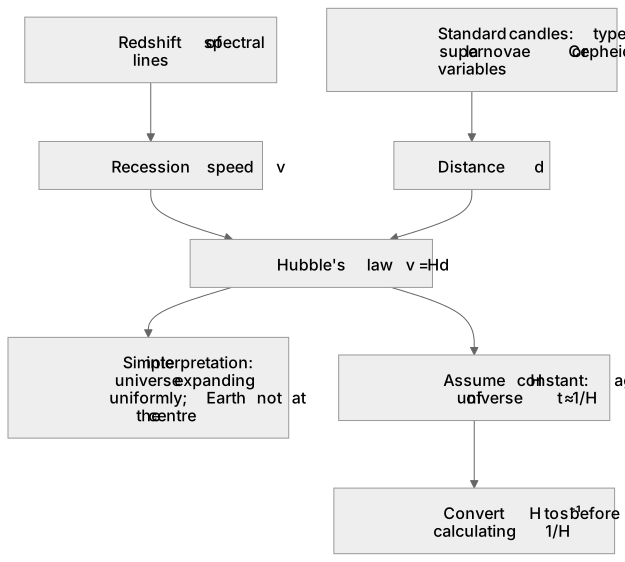
Key words
Say what each word means before you turn the card.
Hubble's law
Try answering aloud or in your head before turning the card.
Redshift
Try answering aloud or in your head before turning the card.
Age of the universe
Try answering aloud or in your head before turning the card.
See every definition
- Hubble's law
- The recession speed v of a distant galaxy is proportional to its distance d from Earth, written as v = Hd.
- Redshift
- A shift of spectral lines that gives the recession speed, often using Δλ/λ₀ = v/c for speeds much less than c.
- Age of the universe
- Estimated as t ≈ 1/H under the assumption that H is constant, since d/v = d/(Hd) = 1/H.
Label the diagram
Some boxes have lost their names. Pick the right name for each number.
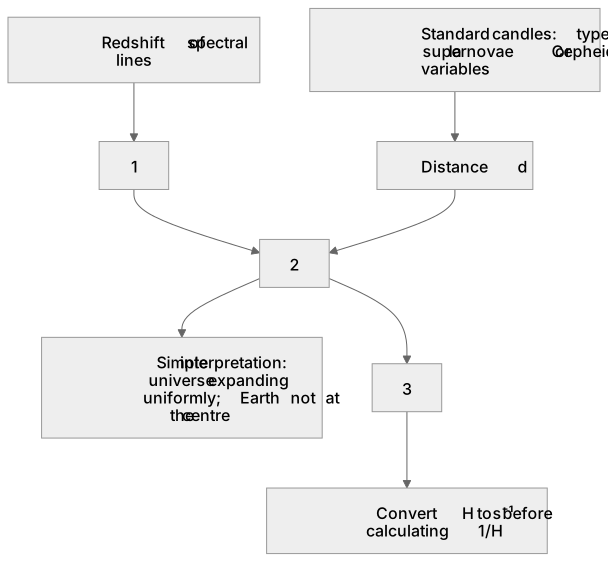
1Box 1
2Box 2
3Box 3
There is more to this lesson
The full lesson goes on to check your understanding and help you earn the marks. Create a free account to carry on, with your progress saved.
A week of Premium from your first lesson · Then the free plan continues · No card, no charge
Test your understanding of Hubble's law (A-level only): Red shift v = Hd Simple interpretation as expansion of universe; estimation of age of universe, assuming H is constant.
Active recall beats re-reading. Take an instant quiz now to test what you’ve learned and lock it into long-term memory.
A week of Premium from your first lesson · Then the free plan continues · No card, no charge