AQA · A-Level · Physics
Course version: 7408 · Version from Sept 2016
Gas laws as experimental relationships between p, V, T and the mass of the…
Full specification wording
Ideal gases (A-level only): Gas laws as experimental relationships between p, V, T and the mass of the gas.
The gas laws summarise how pressure p, volume V and thermodynamic temperature T of a fixed mass of gas are linked.
Checked against the AQA 7408 specification (opens in a new tab) on .
- Point 1 of 4
- 4 key terms
Study notes
From the checked teaching notes for this specification point.
The idea
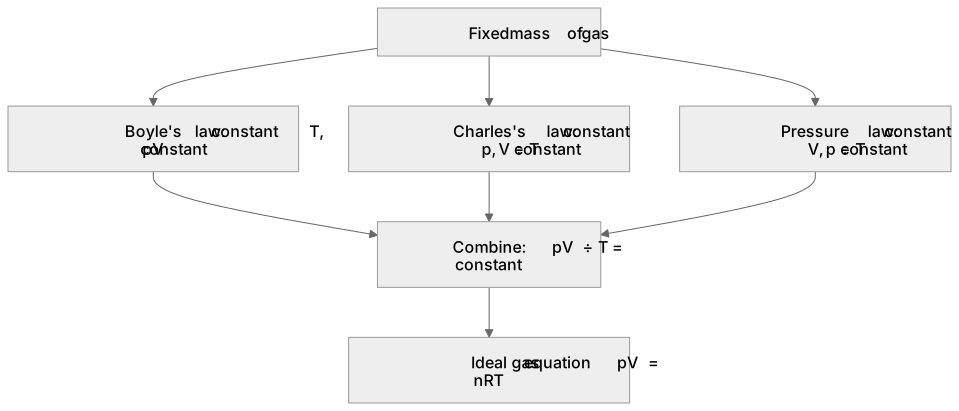
The gas laws summarise how pressure p, volume V and thermodynamic temperature T of a fixed mass of gas are linked. Boyle's law: at constant T, pV is constant, so p₁V₁ = p₂V₂. Charles's law: at constant p, V ÷ T is constant. The pressure law: at constant V, p ÷ T is constant. Each relationship was established experimentally, so temperature must be in kelvin (T/K = θ/°C + 273) and the mass of gas must stay fixed. Combining them gives pV ÷ T = constant, which leads to the ideal gas equation pV = nRT.
For example: Compressing a gas at constant temperature to half its volume doubles its pressure.
What earns the marks
- States Boyle's law: for a fixed mass of gas at constant temperature, pV is constant, so p₁V₁ = p₂V₂.
- States Charles's law: at constant pressure, V is directly proportional to thermodynamic temperature, so V₁ ÷ T₁ = V₂ ÷ T₂.
- States the pressure law: at constant volume, p is directly proportional to thermodynamic temperature, so p₁ ÷ T₁ = p₂ ÷ T₂.
- Explains that each law is an experimental relationship valid only for a fixed mass of gas, with the named variable held constant.
- Converts Celsius temperatures to kelvin by adding 273 before substituting into any gas-law calculation.
- Combines the relationships into pV ÷ T = constant and links this to the ideal gas equation pV = nRT.
Common mistakes and how to put them right
Substituting Celsius temperatures into a gas-law equation.
Put it right by converting to kelvin first, since the laws use thermodynamic temperature.
Allowing gas to escape or be added during an experiment.
Put it right by sealing the container and checking that the mass of gas is unchanged.
Inverting a ratio, for example writing p₁ ÷ p₂ = V₁ ÷ V₂ for Boyle's law.
Put it right by remembering that pressure and volume are inversely proportional, so p₁V₁ = p₂V₂.
Exam tips
- List the fixed variables before substituting; this shows the examiner which gas law applies.
- Convert temperatures to kelvin as the first step of any calculation and keep the value visible in your working.
- Check the reasonableness of the answer: at constant temperature, a smaller volume must give a larger pressure.
Try the lesson
The start of the Ideal gases (A-level only): Gas laws as experimental relationships between p, V, T and the mass of the gas. lesson, made from checked teaching notes for this specification point.
Have a go first
A fixed mass of gas is kept at constant temperature. Its volume is halved. State what happens to its pressure.
Listen
The gas laws summarise how pressure p, volume V and thermodynamic temperature T of a fixed mass of gas are linked. Boyle's law: at constant T, pV is constant, so p₁V₁ = p₂V₂. Charles's law: at constant p, V ÷ T is constant. The pressure law: at constant V, p ÷ T is constant. Each relationship was established experimentally, so temperature must be in kelvin (T/K = θ/°C + 273) and the mass of gas must stay fixed. Combining them gives pV ÷ T = constant, which leads to the ideal gas equation pV = nRT. For example, compressing a gas at constant temperature to half its volume doubles its pressure. A strong answer earns marks for these points. States Boyle's law: for a fixed mass of gas at constant temperature, pV is constant, so p₁V₁ = p₂V₂. States Charles's law: at constant pressure, V is directly proportional to thermodynamic temperature, so V₁ ÷ T₁ = V₂ ÷ T₂. States the pressure law: at constant volume, p is directly proportional to thermodynamic temperature, so p₁ ÷ T₁ = p₂ ÷ T₂. Explains that each law is an experimental relationship valid only for a fixed mass of gas, with the named variable held constant. A common slip: Substituting Celsius temperatures into a gas-law equation. Instead, converting to kelvin first, since the laws use thermodynamic temperature. Exam tip: List the fixed variables before substituting; this shows the examiner which gas law applies.
See it
Key words
Say what each word means before you turn the card.
Gas laws
Try answering aloud or in your head before turning the card.
Thermodynamic temperature
Try answering aloud or in your head before turning the card.
Fixed mass of gas
Try answering aloud or in your head before turning the card.
Ideal gas equation
Try answering aloud or in your head before turning the card.
See every definition
- Gas laws
- Experimental relationships between pressure p, volume V, thermodynamic temperature T and the mass of the gas.
- Thermodynamic temperature
- The temperature used in the gas laws, measured in kelvin, where T/K = θ/°C + 273.
- Fixed mass of gas
- A condition of the gas laws, since the mass of gas must stay fixed for each relationship to hold.
- Ideal gas equation
- The equation pV = nRT, to which the combined relationship pV ÷ T = constant leads.
Label the diagram
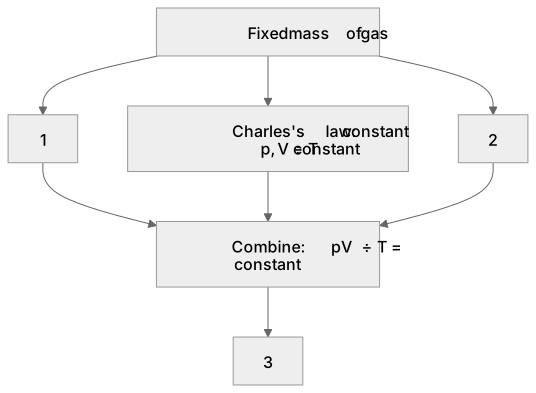
Some boxes have lost their names. Pick the right name for each number.
1Box 1
2Box 2
3Box 3
There is more to this lesson
The full lesson goes on to check your understanding and help you earn the marks. Create a free account to carry on, with your progress saved.
A week of Premium from your first lesson · Then the free plan continues · No card, no charge
Test your understanding of Ideal gases (A-level only): Gas laws as experimental relationships between p, V, T and the mass of the gas.
Active recall beats re-reading. Take an instant quiz now to test what you’ve learned and lock it into long-term memory.
A week of Premium from your first lesson · Then the free plan continues · No card, no charge