AQA · A-Level · Physics
Course version: 7408 · Version from Sept 2016
Required practical 8: Investigation of Boyle's law (constant temperature)…
Full specification wording
Ideal gases (A-level only): Required practical 8: Investigation of Boyle's law (constant temperature) and Charles’s law (constant pressure) for a gas.
This practical tests two gas relationships.
Checked against the AQA 7408 specification (opens in a new tab) on .
- Point 4 of 4
- 3 key terms
Study notes
From the checked teaching notes for this specification point.
The idea
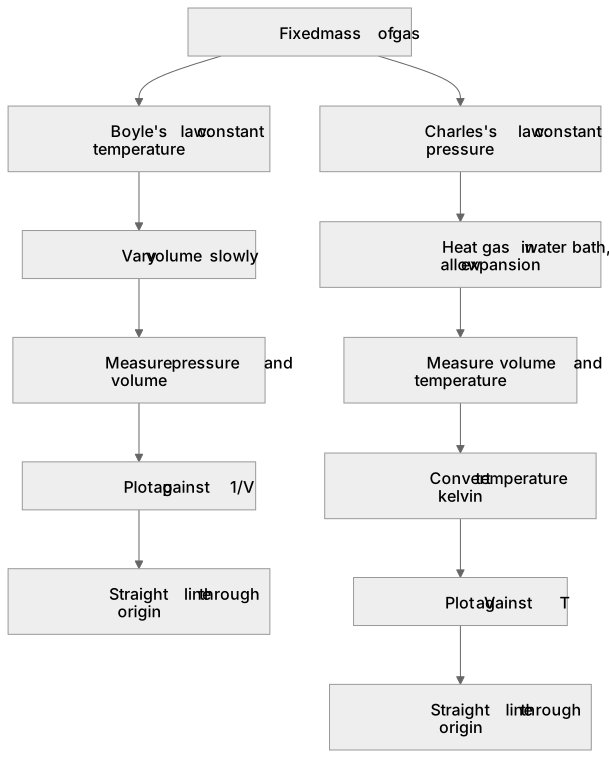
This practical tests two gas relationships. For Boyle's law, a fixed mass of trapped gas is compressed or expanded slowly at room temperature; pressure p is measured with a Bourdon gauge or pressure sensor and volume V from a syringe scale or oil column length. Plotting p against 1/V should give a straight line through the origin, since pV is constant. For Charles's law, a fixed mass of gas is heated in a water bath while pressure is kept at atmospheric pressure by allowing the gas to expand; volume is read from a capillary tube or syringe and temperature from a thermometer. Plotting V against absolute temperature T in kelvin should give a straight line through the origin, since V/T is constant. Allow thermal equilibrium before each reading, repeat readings, and use absolute temperatures.
What earns the marks
- Boyle's law: for a fixed mass of gas at constant temperature, pV = constant, so p is inversely proportional to V and a graph of p against 1/V is a straight line through the origin.
- Charles's law: for a fixed mass of gas at constant pressure, V/T = constant, so V is directly proportional to absolute temperature T, and a graph of V against T in kelvin is a straight line through the origin.
- Apparatus and method for Boyle's law: trap a fixed mass of gas, vary volume slowly, measure pressure with a pressure gauge or sensor and volume from a syringe or column length, allowing time for thermal equilibrium.
- Apparatus and method for Charles's law: heat a fixed mass of gas in a water bath, keep pressure atmospheric by allowing expansion, measure volume and temperature, and convert temperatures to kelvin by adding 273.
- Graph analysis: plot p against 1/V for Boyle's law and V against T for Charles's law; a straight line through the origin supports the proportionality, and gradients relate to the constant pV or V/T.
- Control of variables: keep temperature constant in the Boyle's law experiment and pressure constant in the Charles's law experiment; use a fixed mass of gas and avoid leaks.
- Uncertainties and improvements: repeat readings, use a wide range of values, allow thermal equilibrium, avoid parallax when reading volume, and consider the dead volume in tubing or syringe.
Common mistakes and how to put them right
Using Celsius temperature in Charles's law calculations or graphs.
Put it right: Convert to kelvin by adding 273 before plotting or calculating.
Plotting p against V for Boyle's law and expecting a straight line.
Put it right: Plot p against 1/V, which should be a straight line through the origin.
Changing the mass of gas during the experiment, for example by leaking gas when adjusting a syringe.
Put it right: Seal the apparatus and use a fixed mass throughout.
Exam tips
- State the controlled variable explicitly: constant temperature for Boyle's law and constant pressure for Charles's law.
- When describing graphs, name the axes and the expected shape, and explain how the shape supports the proportionality.
- Include one practical improvement, such as allowing thermal equilibrium or repeating readings and taking a mean, and explain how it reduces uncertainty.
Try the lesson
The start of the Ideal gases (A-level only): Required practical 8: Investigation of Boyle's law (constant temperature) and Charles’s law (constant pressure) for a gas. lesson, made from checked teaching notes for this specification point.
Have a go first
In the Boyle's law experiment, which quantity is kept constant while the pressure of the trapped gas is varied?
Listen
This practical tests two gas relationships. For Boyle's law, a fixed mass of trapped gas is compressed or expanded slowly at room temperature; pressure p is measured with a Bourdon gauge or pressure sensor and volume V from a syringe scale or oil column length. Plotting p against 1/V should give a straight line through the origin, since pV is constant. For Charles's law, a fixed mass of gas is heated in a water bath while pressure is kept at atmospheric pressure by allowing the gas to expand; volume is read from a capillary tube or syringe and temperature from a thermometer. Plotting V against absolute temperature T in kelvin should give a straight line through the origin, since V/T is constant. Allow thermal equilibrium before each reading, repeat readings, and use absolute temperatures. A strong answer earns marks for these points. Boyle's law: for a fixed mass of gas at constant temperature, pV = constant, so p is inversely proportional to V and a graph of p against 1/V is a straight line through the origin. Charles's law: for a fixed mass of gas at constant pressure, V/T = constant, so V is directly proportional to absolute temperature T, and a graph of V against T in kelvin is a straight line through the origin. Apparatus and method for Boyle's law: trap a fixed mass of gas, vary volume slowly, measure pressure with a pressure gauge or sensor and volume from a syringe or column length, allowing time for thermal equilibrium. Apparatus and method for Charles's law: heat a fixed mass of gas in a water bath, keep pressure atmospheric by allowing expansion, measure volume and temperature, and convert temperatures to kelvin by adding 273. A common slip: Using Celsius temperature in Charles's law calculations or graphs. Instead, convert to kelvin by adding 273 before plotting or calculating. Exam tip: State the controlled variable explicitly: constant temperature for Boyle's law and constant pressure for Charles's law.
See it
Key words
Say what each word means before you turn the card.
Boyle's law
Try answering aloud or in your head before turning the card.
Control of variables
Try answering aloud or in your head before turning the card.
Uncertainties and improvements
Try answering aloud or in your head before turning the card.
See every definition
- Boyle's law
- For a fixed mass of gas at constant temperature, pV = constant, so p is inversely proportional to V and a graph of p against 1/V is a straight line through the origin.
- Control of variables
- Keep temperature constant in the Boyle's law experiment and pressure constant in the Charles's law experiment; use a fixed mass of gas and avoid leaks.
- Uncertainties and improvements
- Repeat readings, use a wide range of values, allow thermal equilibrium, avoid parallax when reading volume, and consider the dead volume in tubing or syringe.
There is more to this lesson
The full lesson goes on to check your understanding and help you earn the marks. Create a free account to carry on, with your progress saved.
A week of Premium from your first lesson · Then the free plan continues · No card, no charge
Test your understanding of Ideal gases (A-level only): Required practical 8: Investigation of Boyle's law (constant temperature) and Charles’s law (constant pressure) for a gas.
Active recall beats re-reading. Take an instant quiz now to test what you’ve learned and lock it into long-term memory.
A week of Premium from your first lesson · Then the free plan continues · No card, no charge