AQA · A-Level · Physics
Course version: 7408 · Version from Sept 2016
The functions of the moderator, control rods, and coolant in a thermal…
Full specification wording
Induced fission (A-level only): The functions of the moderator, control rods, and coolant in a thermal nuclear reactor.
A thermal reactor sustains fission using neutrons slowed to thermal energies.
Checked against the AQA 7408 specification (opens in a new tab) on .
- Point 2 of 4
- 4 key terms
Study notes
From the checked teaching notes for this specification point.
The idea
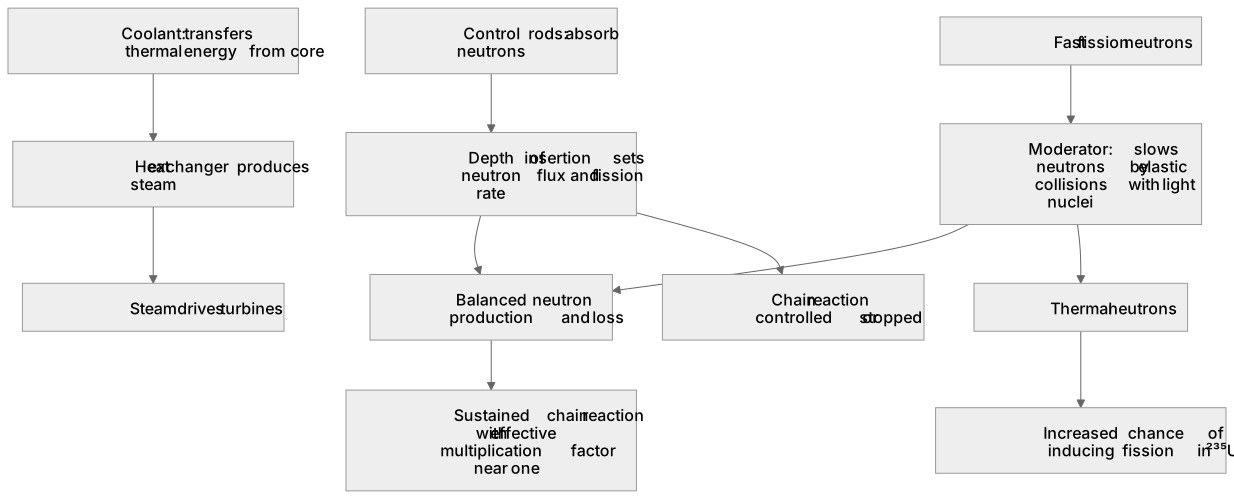
A thermal reactor sustains fission using neutrons slowed to thermal energies. The moderator surrounds the fuel and slows fast fission neutrons through elastic collisions with light nuclei, such as carbon in graphite or hydrogen in water, increasing the probability of further ²³⁵U fission. Control rods, made from boron or cadmium, absorb neutrons; inserting them deeper reduces the neutron flux and lowers the reaction rate, while withdrawing them raises it. The coolant, often water, carbon dioxide or liquid sodium, transfers thermal energy from the core to a heat exchanger to generate steam, and may also moderate. Together these components balance neutron production and loss so the chain reaction remains controlled.
What earns the marks
- The moderator slows fast neutrons to thermal energies by elastic collisions with light nuclei, increasing the chance of inducing fission in ²³⁵U.
- Control rods absorb neutrons; their depth of insertion controls the neutron flux and therefore the rate of fission, allowing the chain reaction to be controlled or stopped.
- The coolant transfers thermal energy from the reactor core to a heat exchanger, where steam is produced to drive turbines; it may also act as a moderator.
- A sustained chain reaction requires an effective multiplication factor near one, so neutron production and absorption must be balanced by the moderator, control rods and coolant.
- Materials chosen for control rods, such as boron or cadmium, have high neutron-absorption cross-sections, while moderators use light nuclei to maximise energy loss per collision.
Common mistakes and how to put them right
Confusing the moderator with the coolant.
Put it right: State each function separately and note that water can perform both roles.
Believing control rods speed up neutrons.
Put it right: Describe control rods as neutron absorbers whose insertion depth controls the rate.
Thinking the moderator absorbs neutrons.
Put it right: Link the moderator to energy loss by collisions, not to absorption.
Exam tips
- Link each component to its effect on the neutron population or energy spectrum, rather than describing hardware.
- Use the terms thermal neutron, elastic collision, neutron absorption and heat exchanger precisely in explanations.
- When asked to compare, state one function for each component and then explain how the functions combine to control the chain reaction.
Try the lesson
The start of the Induced fission (A-level only): The functions of the moderator, control rods, and coolant in a thermal nuclear reactor. lesson, made from checked teaching notes for this specification point.
Have a go first
In a thermal nuclear reactor, what is the main function of the moderator?
Listen
A thermal reactor sustains fission using neutrons slowed to thermal energies. The moderator surrounds the fuel and slows fast fission neutrons through elastic collisions with light nuclei, such as carbon in graphite or hydrogen in water, increasing the probability of further ²³⁵U fission. Control rods, made from boron or cadmium, absorb neutrons; inserting them deeper reduces the neutron flux and lowers the reaction rate, while withdrawing them raises it. The coolant, often water, carbon dioxide or liquid sodium, transfers thermal energy from the core to a heat exchanger to generate steam, and may also moderate. Together these components balance neutron production and loss so the chain reaction remains controlled. A strong answer earns marks for these points. The moderator slows fast neutrons to thermal energies by elastic collisions with light nuclei, increasing the chance of inducing fission in ²³⁵U. Control rods absorb neutrons; their depth of insertion controls the neutron flux and therefore the rate of fission, allowing the chain reaction to be controlled or stopped. The coolant transfers thermal energy from the reactor core to a heat exchanger, where steam is produced to drive turbines; it may also act as a moderator. A sustained chain reaction requires an effective multiplication factor near one, so neutron production and absorption must be balanced by the moderator, control rods and coolant. A common slip: Confusing the moderator with the coolant: the moderator slows neutrons, whereas the coolant removes thermal energy. Instead, state each function separately and note that water can perform both roles. Exam tip: Link each component to its effect on the neutron population or energy spectrum, rather than describing hardware.
See it
Key words
Say what each word means before you turn the card.
Moderator
Try answering aloud or in your head before turning the card.
Control rods
Try answering aloud or in your head before turning the card.
Coolant
Try answering aloud or in your head before turning the card.
Balance of neutron production and absorption
Try answering aloud or in your head before turning the card.
See every definition
- Moderator
- Surrounds the fuel and slows fast fission neutrons to thermal energies through elastic collisions with light nuclei, increasing the probability of further fission.
- Control rods
- Made from boron or cadmium, these absorb neutrons; inserting them deeper reduces the neutron flux and lowers the reaction rate, while withdrawing them raises it.
- Coolant
- Often water, carbon dioxide or liquid sodium, transfers thermal energy from the core to a heat exchanger to generate steam, and may also moderate.
- Balance of neutron production and absorption
- The moderator, control rods and coolant together balance neutron production and loss so the chain reaction remains controlled.
Label the diagram
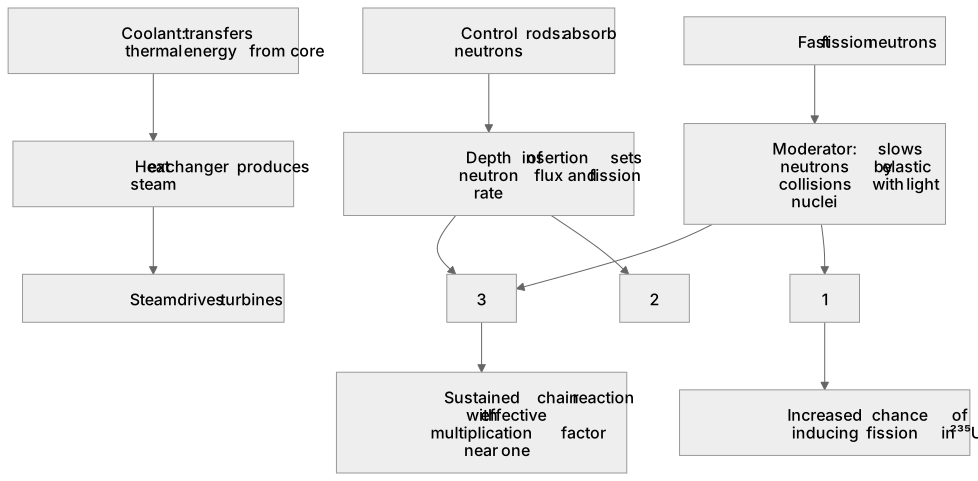
Some boxes have lost their names. Pick the right name for each number.
1Box 1
2Box 2
3Box 3
There is more to this lesson
The full lesson goes on to check your understanding and help you earn the marks. Create a free account to carry on, with your progress saved.
A week of Premium from your first lesson · Then the free plan continues · No card, no charge
Test your understanding of Induced fission (A-level only): The functions of the moderator, control rods, and coolant in a thermal nuclear reactor.
Active recall beats re-reading. Take an instant quiz now to test what you’ve learned and lock it into long-term memory.
A week of Premium from your first lesson · Then the free plan continues · No card, no charge