AQA · A-Level · Physics
Course version: 7408 · Version from Sept 2016
Appreciation of how knowledge and understanding of nature of…
Full specification wording
Interference: Appreciation of how knowledge and understanding of nature of electromagnetic radiation has changed over time.
This topic asks you to trace how explanations of electromagnetic radiation have developed.
Checked against the AQA 7408 specification (opens in a new tab) on .
- Point 6 of 7
- 4 key terms
Study notes
From the checked teaching notes for this specification point.
The idea
This topic asks you to trace how explanations of electromagnetic radiation have developed. Early models treated light as a stream of particles, then Young's double-slit results supported a wave model, and Maxwell linked light to oscillating electric and magnetic fields. Later, the photoelectric effect and black-body radiation required quantised energy packets, leading to wave–particle duality. You should be able to describe the evidence that forced each change, such as interference fringes supporting superposition, and explain that current physics accepts both wave and photon behaviour depending on the experiment. A concrete method is to compare fringe spacing predictions with observed patterns, then contrast this with threshold-frequency data.
What earns the marks
- Describe the historical shift from a particle model of light to a wave model, using Young's double-slit interference as key evidence for superposition and wave behaviour.
- Explain how Maxwell's electromagnetic theory unified electric and magnetic fields with light, predicting that light travels as a transverse wave.
- Explain how black-body radiation and the photoelectric effect could not be explained by classical wave theory alone, leading to quantised energy packets or photons.
- Describe wave–particle duality, stating that electromagnetic radiation shows wave behaviour in interference and diffraction, and particle-like behaviour in emission and absorption.
- Use the relationship E = hf to link photon energy to frequency, and explain that intensity relates to the rate of photons rather than to the energy of each photon.
- Compare the strengths and limitations of successive models, recognising that scientific knowledge changes when new evidence cannot be explained by the current model.
Common mistakes and how to put them right
Treating the wave and particle models as mutually exclusive.
Put it right: Both models are needed, with the experiment determining which behaviour is observed.
Believing that a brighter light always gives photoelectrons more energy.
Put it right: Intensity increases the number of photons per second, while frequency determines the energy of each photon via E = hf.
Describing the historical change as a simple replacement of one wrong idea by one right idea.
Put it right: Each model explains some evidence and is superseded or extended when new evidence emerges.
Exam tips
- When asked to 'appreciate' or 'describe how understanding changed', name the model, the evidence that supported it, and the evidence that challenged it in a clear sequence.
- Use precise terms such as interference, superposition, photon, quantised, threshold frequency and wave–particle duality rather than vague phrases like 'light is weird'.
- Link any calculation to the historical point: for example, use E = hf to show why a wave model cannot explain a threshold frequency in the photoelectric effect.
Try the lesson
The start of the Interference: Appreciation of how knowledge and understanding of nature of electromagnetic radiation has changed over time. lesson, made from checked teaching notes for this specification point.
Have a go first
Which early model described light as a stream of particles travelling in straight lines?
Listen
This topic asks you to trace how explanations of electromagnetic radiation have developed. Early models treated light as a stream of particles, then Young's double-slit results supported a wave model, and Maxwell linked light to oscillating electric and magnetic fields. Later, the photoelectric effect and black-body radiation required quantised energy packets, leading to wave–particle duality. You should be able to describe the evidence that forced each change, such as interference fringes supporting superposition, and explain that current physics accepts both wave and photon behaviour depending on the experiment. A concrete method is to compare fringe spacing predictions with observed patterns, then contrast this with threshold-frequency data. A strong answer earns marks for these points. Describe the historical shift from a particle model of light to a wave model, using Young's double-slit interference as key evidence for superposition and wave behaviour. Explain how Maxwell's electromagnetic theory unified electric and magnetic fields with light, predicting that light travels as a transverse wave. Explain how black-body radiation and the photoelectric effect could not be explained by classical wave theory alone, leading to quantised energy packets or photons. Describe wave–particle duality, stating that electromagnetic radiation shows wave behaviour in interference and diffraction, and particle-like behaviour in emission and absorption. A common slip: Treating the wave and particle models as mutually exclusive: the error is saying light is only a wave or only a particle. Instead, both models are needed, with the experiment determining which behaviour is observed. Exam tip: When asked to 'appreciate' or 'describe how understanding changed', name the model, the evidence that supported it, and the evidence that challenged it in a clear sequence.
See it
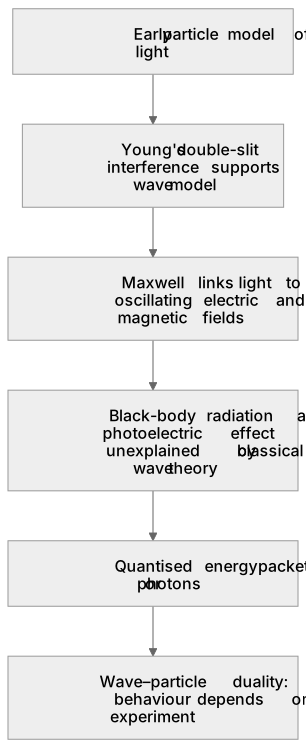
Put it in order
Put these steps in the order they happen.
- 1. Maxwell links light to oscillating electric and magnetic fields
- 2. Young's double-slit interference supports wave model
- 3. Early particle model of light
- 4. Wave–particle duality: behaviour depends on the experiment
- 5. Quantised energy packets or photons
- 6. Black-body radiation and photoelectric effect unexplained by classical wave theory
Key words
Say what each word means before you turn the card.
Wave–particle duality
Try answering aloud or in your head before turning the card.
Quantised energy packets
Try answering aloud or in your head before turning the card.
Interference fringes
Try answering aloud or in your head before turning the card.
Photon energy
Try answering aloud or in your head before turning the card.
See every definition
- Wave–particle duality
- Current physics accepts both wave and photon behaviour depending on the experiment, with interference and diffraction showing wave behaviour and emission and absorption showing particle-like behaviour.
- Quantised energy packets
- Black-body radiation and the photoelectric effect could not be explained by classical wave theory alone, leading to quantised energy packets or photons.
- Interference fringes
- Young's double-slit results supported a wave model, with interference fringes supporting superposition and wave behaviour.
- Photon energy
- The relationship E = hf links photon energy to frequency, while intensity relates to the rate of photons rather than to the energy of each photon.
Label the diagram
Some boxes have lost their names. Pick the right name for each number.
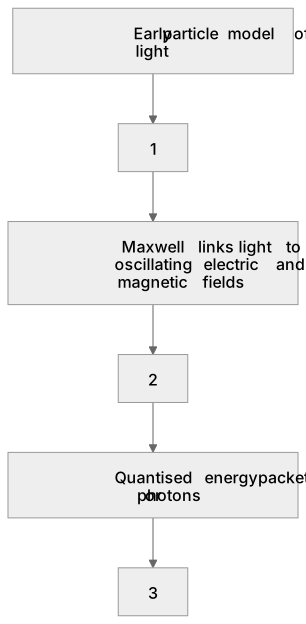
1Box 1
2Box 2
3Box 3
There is more to this lesson
The full lesson goes on to check your understanding and help you earn the marks. Create a free account to carry on, with your progress saved.
A week of Premium from your first lesson · Then the free plan continues · No card, no charge
Test your understanding of Interference: Appreciation of how knowledge and understanding of nature of electromagnetic radiation has changed over time.
Active recall beats re-reading. Take an instant quiz now to test what you’ve learned and lock it into long-term memory.
A week of Premium from your first lesson · Then the free plan continues · No card, no charge