AQA · A-Level · Physics
Course version: 7408 · Version from Sept 2016
Analogy between LC circuit and mass–spring system.
Full specification wording
LC resonance filters (A-level only): Analogy between LC circuit and mass–spring system.
An LC circuit and a mass–spring system both oscillate by exchanging energy between two stores.
Checked against the AQA 7408 specification (opens in a new tab) on .
- Point 1 of 4
- 4 key terms
Study notes
From the checked teaching notes for this specification point.
The idea
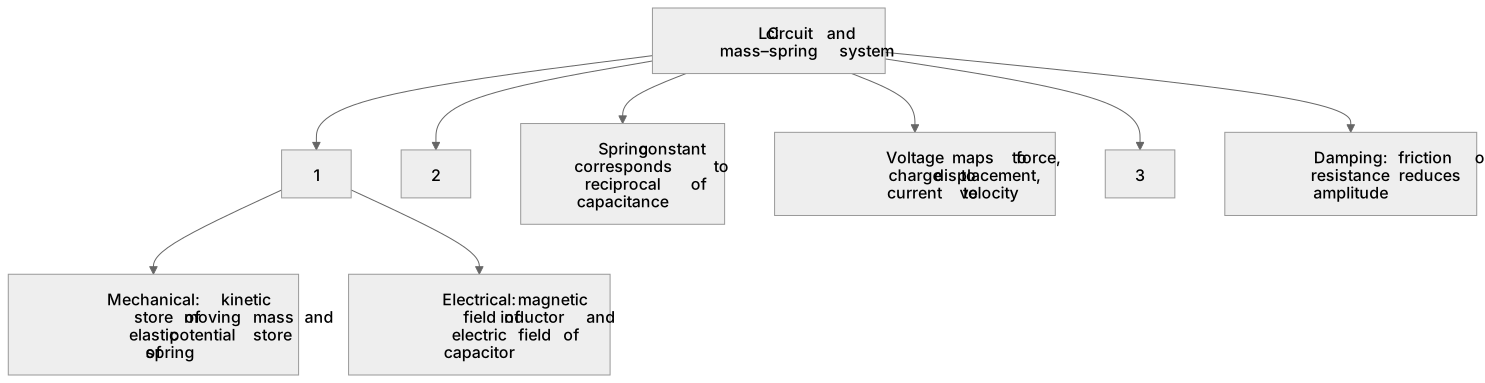
An LC circuit and a mass–spring system both oscillate by exchanging energy between two stores. In the mechanical system, energy shifts between the kinetic store of the moving mass and the elastic potential store of the spring. In the electrical system, energy shifts between the magnetic field of the inductor and the electric field of the capacitor. Mass corresponds to inductance, as both resist changes in motion or current. The spring constant corresponds to the reciprocal of capacitance. The analogy helps derive the resonant angular frequency ω = 1/√(LC) by comparing it with ω = √(k/m). Damping by friction or resistance reduces the amplitude of oscillation in both systems. Voltage maps to force, charge to displacement, and current to velocity.
What earns the marks
- States that both systems exchange energy between two stores and oscillate at a natural frequency.
- Matches the mass to the inductance, because mass opposes changes in velocity and inductance opposes changes in current.
- Matches the spring to the capacitor, because the spring stores elastic potential energy and the capacitor stores electric field energy.
- Compares the resonant angular frequency of the LC circuit, ω = 1/√(LC), with that of the mass–spring system, ω = √(k/m).
- Explains that increasing inductance or mass lowers the natural frequency, while increasing the reciprocal of capacitance or the spring constant raises it.
- Describes damping in the mechanical system as friction or air resistance and in the electrical system as resistance, both reducing oscillation amplitude.
Common mistakes and how to put them right
Matching capacitance directly to the spring constant.
Put it right by matching capacitance to the reciprocal of the spring constant, since ω = 1/√(LC) and ω = √(k/m).
Claiming that the capacitor stores magnetic energy.
Put it right by stating that the capacitor stores energy in its electric field and the inductor stores energy in its magnetic field.
Ignoring resistance or friction when describing ideal oscillations.
Put it right by noting that resistance in the LC circuit and friction in the mass–spring system cause damping.
Confusing the roles of current, charge and voltage with velocity, displacement and force.
Put it right by treating current as analogous to velocity, charge as analogous to displacement, and voltage as analogous to force.
Exam tips
- Draw the two systems side by side and label the corresponding quantities before writing your explanation.
- Use the equations ω = 1/√(LC) and ω = √(k/m) to justify each part of the analogy rather than relying on memory alone.
- When discussing energy, name the electric field store, magnetic field store, kinetic store and elastic potential store explicitly.
- Check that any comparison you make is consistent with the equations, especially the inverse relationship between capacitance and frequency.
Try the lesson
The start of the LC resonance filters (A-level only): Analogy between LC circuit and mass–spring system. lesson, made from checked teaching notes for this specification point.
Have a go first
In the analogy between an LC circuit and a mass–spring system, which quantity in the mechanical system corresponds to the inductance L?
Listen
An LC circuit and a mass–spring system both oscillate by exchanging energy between two stores. In the mechanical system, energy shifts between the kinetic store of the moving mass and the elastic potential store of the spring. In the electrical system, energy shifts between the magnetic field of the inductor and the electric field of the capacitor. Mass corresponds to inductance, as both resist changes in motion or current. The spring constant corresponds to the reciprocal of capacitance. The analogy helps derive the resonant angular frequency ω = 1/√(LC) by comparing it with ω = √(k/m). Damping by friction or resistance reduces the amplitude of oscillation in both systems. Voltage maps to force, charge to displacement, and current to velocity. A strong answer earns marks for these points. States that both systems exchange energy between two stores and oscillate at a natural frequency. Matches the mass to the inductance, because mass opposes changes in velocity and inductance opposes changes in current. Matches the spring to the capacitor, because the spring stores elastic potential energy and the capacitor stores electric field energy. Compares the resonant angular frequency of the LC circuit, ω = 1/√(LC), with that of the mass–spring system, ω = √(k/m). A common slip: Matching capacitance directly to the spring constant. Instead, matching capacitance to the reciprocal of the spring constant, since ω = 1/√(LC) and ω = √(k/m). Exam tip: Draw the two systems side by side and label the corresponding quantities before writing your explanation.
See it

Key words
Say what each word means before you turn the card.
Energy exchange in oscillating systems
Try answering aloud or in your head before turning the card.
Resonance and natural frequency
Try answering aloud or in your head before turning the card.
Electrical and mechanical analogues
Try answering aloud or in your head before turning the card.
Damping
Try answering aloud or in your head before turning the card.
See every definition
- Energy exchange in oscillating systems
- Both an LC circuit and a mass–spring system oscillate by exchanging energy between two stores.
- Resonance and natural frequency
- Both systems oscillate at a natural frequency, with the LC circuit's resonant angular frequency ω = 1/√(LC) compared with ω = √(k/m).
- Electrical and mechanical analogues
- Mass corresponds to inductance, the spring constant corresponds to the reciprocal of capacitance, voltage maps to force, charge to displacement and current to velocity.
- Damping
- Friction or resistance reduces the amplitude of oscillation in both systems.
Label the diagram
Some boxes have lost their names. Pick the right name for each number.
1Box 1
2Box 2
3Box 3
There is more to this lesson
The full lesson goes on to check your understanding and help you earn the marks. Create a free account to carry on, with your progress saved.
A week of Premium from your first lesson · Then the free plan continues · No card, no charge
Test your understanding of LC resonance filters (A-level only): Analogy between LC circuit and mass–spring system.
Active recall beats re-reading. Take an instant quiz now to test what you’ve learned and lock it into long-term memory.
A week of Premium from your first lesson · Then the free plan continues · No card, no charge