AQA · A-Level · Physics
Course version: 7408 · Version from Sept 2016
Uncertainty: Absolute, fractional and percentage uncertainties represent…
Full specification wording
Limitation of physical measurements: Uncertainty: Absolute, fractional and percentage uncertainties represent uncertainty in the final answer for a quantity.
Suppose a metre rule reads a length as 0.842 m with a reading uncertainty of ±0.001 m.
Checked against the AQA 7408 specification (opens in a new tab) on .
- Point 3 of 7
- 4 key terms
Study notes
From the checked teaching notes for this specification point.
The idea
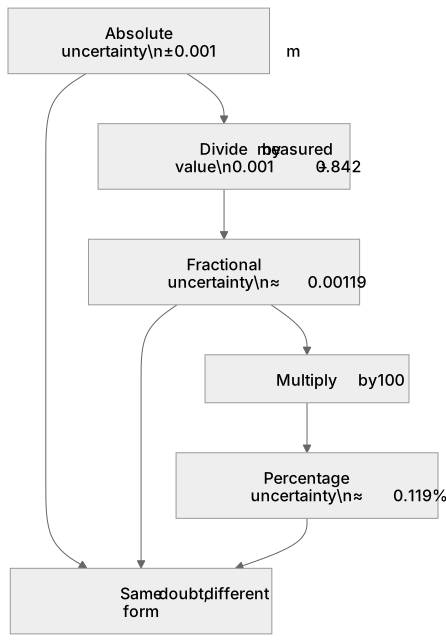
Suppose a metre rule reads a length as 0.842 m with a reading uncertainty of ±0.001 m. The absolute uncertainty is the ±0.001 m itself, carrying the same unit as the quantity. The fractional uncertainty is the absolute uncertainty divided by the measured value: 0.001 ÷ 0.842 ≈ 0.00119. The percentage uncertainty is that fraction multiplied by 100, giving about 0.119%. All three describe the same doubt, so converting between them changes only the form, never the size. The final answer for a quantity should therefore be quoted with its uncertainty, and the form chosen must match what the question asks. A small absolute uncertainty on a large value gives a tiny percentage uncertainty, which is why percentage form is useful for comparing precision across different quantities.
What earns the marks
- Absolute uncertainty is expressed in the same unit as the measured quantity, for example ±0.001 m for a length of 0.842 m.
- Fractional uncertainty equals absolute uncertainty divided by the measured value, so 0.001 ÷ 0.842 ≈ 0.00119.
- Percentage uncertainty equals fractional uncertainty multiplied by 100, giving about 0.119% in this example.
- The three forms represent the same doubt, so converting between them must not change the underlying size of the uncertainty.
- A final answer for a quantity should state its uncertainty, and the form used should match the form requested.
- Percentage uncertainty allows fair comparison of precision between quantities measured in different units.
Common mistakes and how to put them right
Dividing the measured value by the absolute uncertainty instead of dividing the absolute uncertainty by the measured value.
Put it right by keeping the uncertainty on top of the fraction.
Forgetting to multiply the fractional uncertainty by 100 when a percentage is requested.
Put it right by checking whether the answer is sensibly below 100% for a precise measurement.
Attaching a unit to a fractional or percentage uncertainty.
Put it right by leaving fractional and percentage forms unitless while the absolute form keeps the unit.
Exam tips
- Write the conversion chain explicitly: absolute, then divide by the value, then multiply by 100, so the examiner can follow your reasoning.
- Check the size of your percentage: a precise measurement usually gives a small percentage uncertainty, so a value above 100% signals an error.
- When a question asks for the uncertainty in the final answer, decide first whether it wants an absolute, fractional or percentage form before calculating.
Try the lesson
The start of the Limitation of physical measurements: Uncertainty: Absolute, fractional and percentage uncertainties represent uncertainty in the final answer for a quantity. lesson, made from checked teaching notes for this specification point.
Have a go first
A student records the length of a metal rod as 24.0 cm ± 0.2 cm. What is the absolute uncertainty in this measurement?
Listen
Suppose a metre rule reads a length as 0.842 m with a reading uncertainty of ±0.001 m. The absolute uncertainty is the ±0.001 m itself, carrying the same unit as the quantity. The fractional uncertainty is the absolute uncertainty divided by the measured value: 0.001 ÷ 0.842 ≈ 0.00119. The percentage uncertainty is that fraction multiplied by 100, giving about 0.119%. All three describe the same doubt, so converting between them changes only the form, never the size. The final answer for a quantity should therefore be quoted with its uncertainty, and the form chosen must match what the question asks. A small absolute uncertainty on a large value gives a tiny percentage uncertainty, which is why percentage form is useful for comparing precision across different quantities. A strong answer earns marks for these points. Absolute uncertainty is expressed in the same unit as the measured quantity, for example ±0.001 m for a length of 0.842 m. Fractional uncertainty equals absolute uncertainty divided by the measured value, so 0.001 ÷ 0.842 ≈ 0.00119. Percentage uncertainty equals fractional uncertainty multiplied by 100, giving about 0.119% in this example. The three forms represent the same doubt, so converting between them must not change the underlying size of the uncertainty. A common slip: Dividing the measured value by the absolute uncertainty instead of dividing the absolute uncertainty by the measured value. Instead, keeping the uncertainty on top of the fraction. Exam tip: Write the conversion chain explicitly: absolute, then divide by the value, then multiply by 100, so the examiner can follow your reasoning.
See it
Key words
Say what each word means before you turn the card.
Absolute uncertainty
Try answering aloud or in your head before turning the card.
Fractional uncertainty
Try answering aloud or in your head before turning the card.
Percentage uncertainty
Try answering aloud or in your head before turning the card.
Percentage form
Try answering aloud or in your head before turning the card.
See every definition
- Absolute uncertainty
- Expressed in the same unit as the measured quantity, for example ±0.001 m for a length of 0.842 m.
- Fractional uncertainty
- Equals the absolute uncertainty divided by the measured value, so 0.001 ÷ 0.842 ≈ 0.00119.
- Percentage uncertainty
- Equals the fractional uncertainty multiplied by 100, giving about 0.119% in this example.
- Percentage form
- Useful for comparing precision across different quantities, because a small absolute uncertainty on a large value gives a tiny percentage uncertainty.
Label the diagram
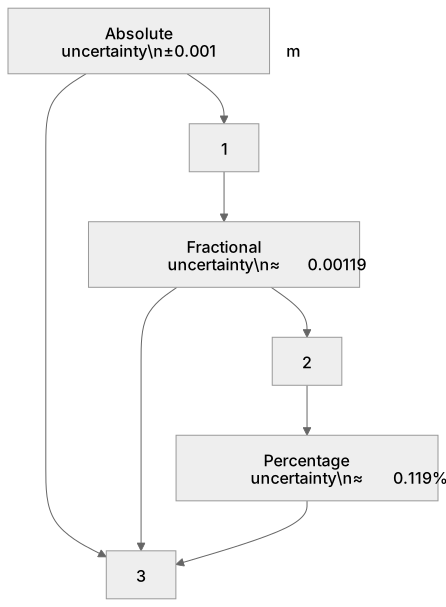
Some boxes have lost their names. Pick the right name for each number.
1Box 1
2Box 2
3Box 3
There is more to this lesson
The full lesson goes on to check your understanding and help you earn the marks. Create a free account to carry on, with your progress saved.
A week of Premium from your first lesson · Then the free plan continues · No card, no charge
Test your understanding of Limitation of physical measurements: Uncertainty: Absolute, fractional and percentage uncertainties represent uncertainty in the final answer for a quantity.
Active recall beats re-reading. Take an instant quiz now to test what you’ve learned and lock it into long-term memory.
A week of Premium from your first lesson · Then the free plan continues · No card, no charge