AQA · A-Level · Physics
Course version: 7408 · Version from Sept 2016
Applications of polarisers to include Polaroid material and the alignment…
Full specification wording
Longitudinal and transverse waves: Applications of polarisers to include Polaroid material and the alignment of aerials for transmission and reception.
Polaroid material contains long-chain molecules that transmit light oscillations parallel to one axis while absorbing components in other planes, so unpolarised light becomes plane-polarised and…
Checked against the AQA 7408 specification (opens in a new tab) on .
- Point 5 of 5
- 4 key terms
Study notes
From the checked teaching notes for this specification point.
The idea
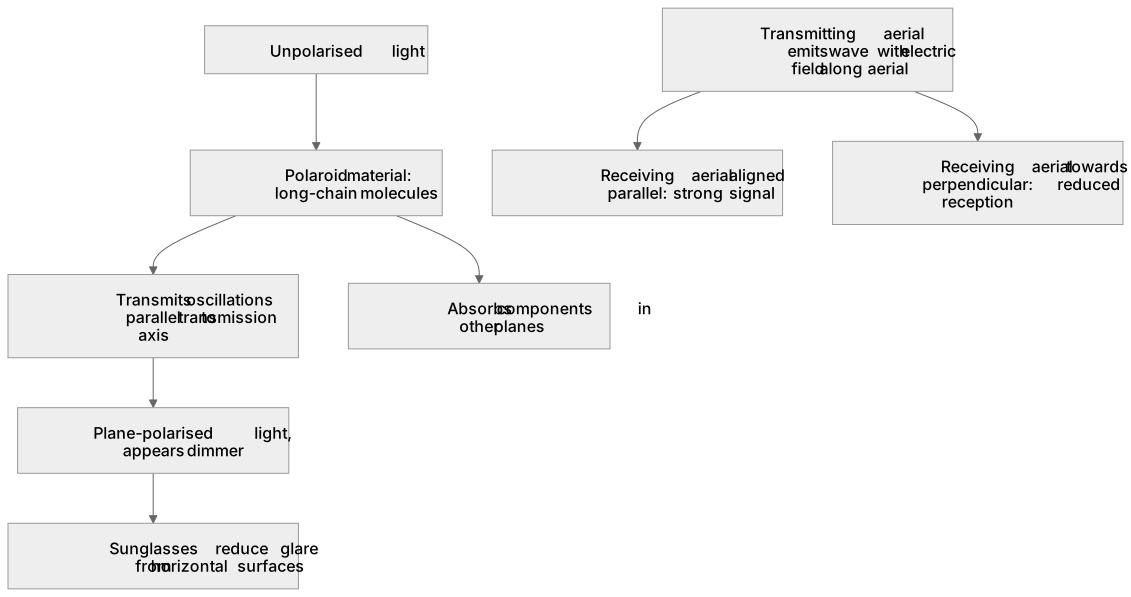
Polaroid material contains long-chain molecules that transmit light oscillations parallel to one axis while absorbing components in other planes, so unpolarised light becomes plane-polarised and appears dimmer. This is used in sunglasses to reduce glare from horizontal surfaces, because reflected glare is partly polarised horizontally; a vertical transmission axis blocks much of it. In radio and television, the transmitting aerial emits an electromagnetic wave whose electric field oscillates along the aerial's direction. A receiving aerial must be aligned parallel to that oscillation to detect the signal strongly; rotating it towards perpendicular reduces reception. Thus polarisation is exploited both to control light intensity and to select or reject signals according to aerial orientation.
What earns the marks
- Polaroid transmits oscillations parallel to its transmission axis and absorbs or blocks other planes.
- Polaroid sunglasses reduce glare because light reflected from horizontal surfaces is partly horizontally polarised.
- A transmitting aerial emits an electromagnetic wave with electric field oscillations along the aerial's alignment.
- A receiving aerial detects the signal best when aligned parallel to the incoming electric field oscillations.
- Rotating the receiving aerial towards perpendicular alignment reduces the received signal, demonstrating polarisation selection.
Common mistakes and how to put them right
Thinking Polaroid blocks all light.
Put it right: It transmits the component parallel to its axis, so intensity is reduced rather than necessarily zero.
Believing aerial orientation does not matter for reception.
Put it right: A receiving aerial aligned perpendicular to the electric field oscillations picks up little or no signal.
Assuming Polaroid sunglasses work by darkening all light equally.
Put it right: They selectively reduce polarised glare according to the transmission axis orientation.
Exam tips
- Link the transmission axis direction to the oscillation direction that passes through.
- For aerials, state that the receiving aerial must be parallel to the electric field oscillations for maximum reception.
- Use a clear application such as glare reduction or radio reception to show understanding rather than just naming Polaroid.
Try the lesson
The start of the Longitudinal and transverse waves: Applications of polarisers to include Polaroid material and the alignment of aerials for transmission and reception. lesson, made from checked teaching notes for this specification point.
Have a go first
Which everyday application makes use of Polaroid material to control the polarisation of light?
Listen
Polaroid material contains long-chain molecules that transmit light oscillations parallel to one axis while absorbing components in other planes, so unpolarised light becomes plane-polarised and appears dimmer. This is used in sunglasses to reduce glare from horizontal surfaces, because reflected glare is partly polarised horizontally; a vertical transmission axis blocks much of it. In radio and television, the transmitting aerial emits an electromagnetic wave whose electric field oscillates along the aerial's direction. A receiving aerial must be aligned parallel to that oscillation to detect the signal strongly; rotating it towards perpendicular reduces reception. Thus polarisation is exploited both to control light intensity and to select or reject signals according to aerial orientation. A strong answer earns marks for these points. Polaroid transmits oscillations parallel to its transmission axis and absorbs or blocks other planes. Polaroid sunglasses reduce glare because light reflected from horizontal surfaces is partly horizontally polarised. A transmitting aerial emits an electromagnetic wave with electric field oscillations along the aerial's alignment. A receiving aerial detects the signal best when aligned parallel to the incoming electric field oscillations. A common slip: Thinking Polaroid blocks all light. Instead, it transmits the component parallel to its axis, so intensity is reduced rather than necessarily zero. Exam tip: Link the transmission axis direction to the oscillation direction that passes through.
See it
Key words
Say what each word means before you turn the card.
Polaroid material
Try answering aloud or in your head before turning the card.
Polaroid sunglasses
Try answering aloud or in your head before turning the card.
Transmitting aerial
Try answering aloud or in your head before turning the card.
Receiving aerial
Try answering aloud or in your head before turning the card.
See every definition
- Polaroid material
- Contains long-chain molecules that transmit light oscillations parallel to one axis while absorbing components in other planes, so unpolarised light becomes plane-polarised and appears dimmer.
- Polaroid sunglasses
- Reduce glare from horizontal surfaces, because reflected glare is partly polarised horizontally and a vertical transmission axis blocks much of it.
- Transmitting aerial
- Emits an electromagnetic wave whose electric field oscillates along the aerial's direction.
- Receiving aerial
- Must be aligned parallel to the electric field oscillations to detect the signal strongly; rotating it towards perpendicular reduces reception.
Label the diagram
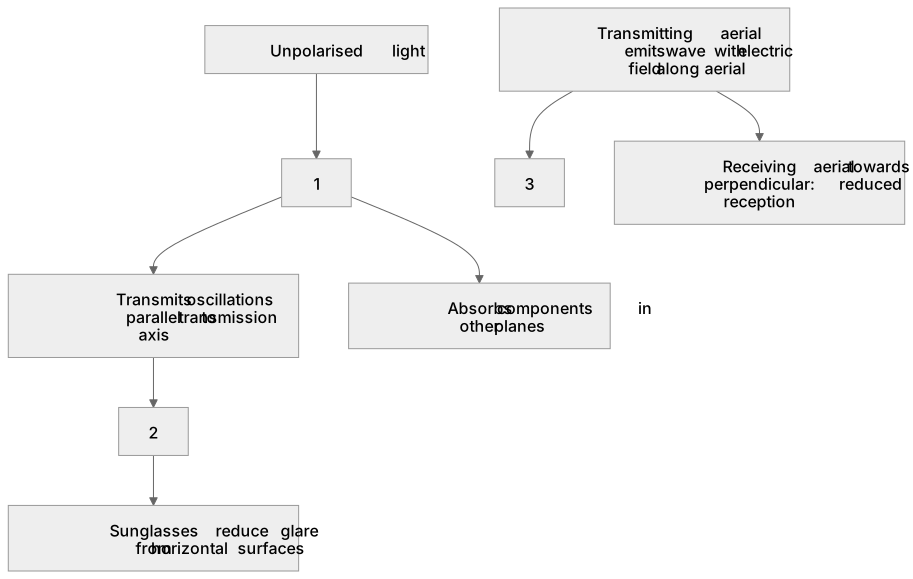
Some boxes have lost their names. Pick the right name for each number.
1Box 1
2Box 2
3Box 3
There is more to this lesson
The full lesson goes on to check your understanding and help you earn the marks. Create a free account to carry on, with your progress saved.
A week of Premium from your first lesson · Then the free plan continues · No card, no charge
Test your understanding of Longitudinal and transverse waves: Applications of polarisers to include Polaroid material and the alignment of aerials for transmission and reception.
Active recall beats re-reading. Take an instant quiz now to test what you’ve learned and lock it into long-term memory.
A week of Premium from your first lesson · Then the free plan continues · No card, no charge