AQA · A-Level · Physics
Course version: 7408 · Version from Sept 2016
Nature of longitudinal and transverse waves.
Full specification wording
Longitudinal and transverse waves: Nature of longitudinal and transverse waves.
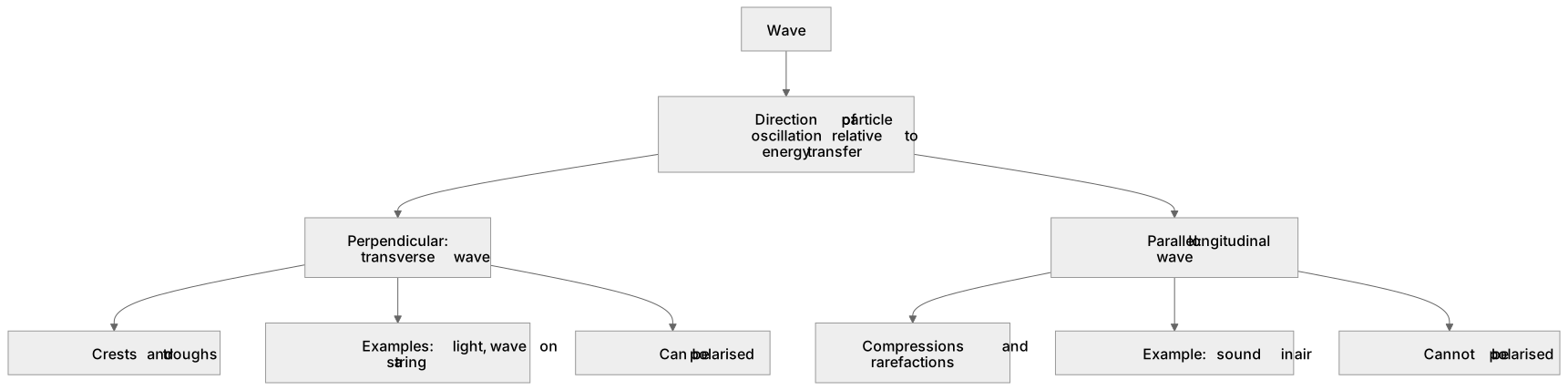
Waves are classified by the direction of particle oscillation relative to the direction of energy transfer.
Checked against the AQA 7408 specification (opens in a new tab) on .
- Point 1 of 5
- 4 key terms
Study notes
From the checked teaching notes for this specification point.
The idea
Waves are classified by the direction of particle oscillation relative to the direction of energy transfer. In a transverse wave, particles oscillate perpendicular to the direction of travel, so crests and troughs form; examples include light and waves on a string. In a longitudinal wave, particles oscillate parallel to the direction of travel, producing compressions where particles are close together and rarefactions where they are spread apart; sound in air is the standard example. The classification depends only on the geometry of oscillation, not on the medium. A displacement–distance graph for a longitudinal wave can still show compressions and rarefactions as regions of high and low particle density, while a displacement–time graph for one particle shows its oscillation. Recognising the type allows correct interpretation of polarisation, which occurs only for transverse waves.
What earns the marks
- States that transverse waves have particle oscillation perpendicular to the direction of energy transfer.
- States that longitudinal waves have particle oscillation parallel to the direction of energy transfer.
- Identifies compressions and rarefactions as the regions of high and low particle density in a longitudinal wave.
- Classifies given examples correctly, such as sound as longitudinal and light or a wave on a string as transverse.
- Links transverse nature to polarisation and explains that longitudinal waves cannot be polarised.
Common mistakes and how to put them right
Thinking that all waves in solids are longitudinal.
Put it right: Both transverse and longitudinal waves can travel through solids, and classification depends on oscillation direction.
Believing that sound can travel through a vacuum.
Put it right: Sound is a mechanical longitudinal wave and needs a medium.
Assuming that a wave shown as a sine curve must be transverse.
Put it right: A displacement–distance graph can represent a longitudinal wave even though the particles oscillate along the direction of travel.
Exam tips
- Use the words perpendicular and parallel explicitly when comparing the two wave types.
- When classifying an example, state the direction of particle oscillation relative to energy transfer, not just the name of the wave.
- For longitudinal waves, label compressions and rarefactions on any diagram to show understanding of particle spacing.
Try the lesson
The start of the Longitudinal and transverse waves: Nature of longitudinal and transverse waves. lesson, made from checked teaching notes for this specification point.
Have a go first
Which statement describes the particle oscillation in a longitudinal wave?
Listen
Waves are classified by the direction of particle oscillation relative to the direction of energy transfer. In a transverse wave, particles oscillate perpendicular to the direction of travel, so crests and troughs form; examples include light and waves on a string. In a longitudinal wave, particles oscillate parallel to the direction of travel, producing compressions where particles are close together and rarefactions where they are spread apart; sound in air is the standard example. The classification depends only on the geometry of oscillation, not on the medium. A displacement–distance graph for a longitudinal wave can still show compressions and rarefactions as regions of high and low particle density, while a displacement–time graph for one particle shows its oscillation. Recognising the type allows correct interpretation of polarisation, which occurs only for transverse waves. A strong answer earns marks for these points. States that transverse waves have particle oscillation perpendicular to the direction of energy transfer. States that longitudinal waves have particle oscillation parallel to the direction of energy transfer. Identifies compressions and rarefactions as the regions of high and low particle density in a longitudinal wave. Classifies given examples correctly, such as sound as longitudinal and light or a wave on a string as transverse. A common slip: Thinking that all waves in solids are longitudinal. Instead, both transverse and longitudinal waves can travel through solids, and classification depends on oscillation direction. Exam tip: Use the words perpendicular and parallel explicitly when comparing the two wave types.
See it
Key words
Say what each word means before you turn the card.
Transverse wave
Try answering aloud or in your head before turning the card.
Longitudinal wave
Try answering aloud or in your head before turning the card.
Compressions and rarefactions
Try answering aloud or in your head before turning the card.
Polarisation
Try answering aloud or in your head before turning the card.
See every definition
- Transverse wave
- A wave in which particles oscillate perpendicular to the direction of travel, so crests and troughs form.
- Longitudinal wave
- A wave in which particles oscillate parallel to the direction of travel, producing compressions and rarefactions.
- Compressions and rarefactions
- The regions of high and low particle density in a longitudinal wave, where particles are close together and spread apart.
- Polarisation
- A property that occurs only for transverse waves, recognised once the type of wave is correctly identified.
Label the diagram
Some boxes have lost their names. Pick the right name for each number.
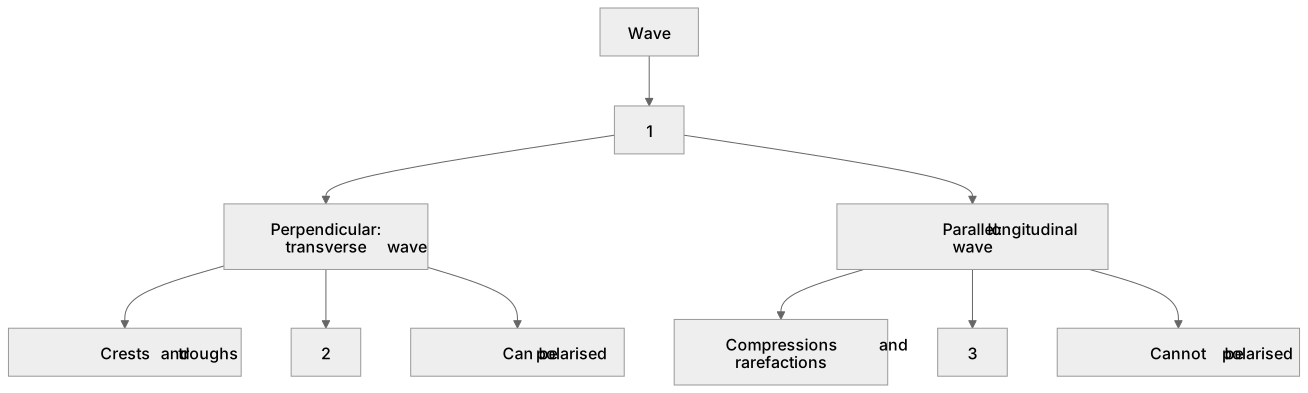
1Box 1
2Box 2
3Box 3
There is more to this lesson
The full lesson goes on to check your understanding and help you earn the marks. Create a free account to carry on, with your progress saved.
A week of Premium from your first lesson · Then the free plan continues · No card, no charge
Test your understanding of Longitudinal and transverse waves: Nature of longitudinal and transverse waves.
Active recall beats re-reading. Take an instant quiz now to test what you’ve learned and lock it into long-term memory.
A week of Premium from your first lesson · Then the free plan continues · No card, no charge